(Click on images to enlarge)
A. Lawrence Kocher, date and photographer unknown.
Perhaps the best known of the 12 children of long-time San Jose, California jewelry store proprietor Rudolph R. Kocher was son Alfred Lawrence Kocher, born in 1885, who became managing editor of the prestigious architectural journal Architectural Record between 1927 and 1938. Two of Rudolph's other sons, Jacob John Kocher, born in 1876, and Rudolph Alfred Kocher, born in 1883, became prominent doctors who made names for themselves in Palm Springs and Carmel, California respectively as will be discussed later below. (Family Search).
Kocher was born in 1885 as the second youngest of twelve children of Rudolph R. and Anna Kocher. Kocher graduated from Stanford University in 1909 and proceeded to study architecture at MIT until 1912. He then enrolled at Penn State University as a graduate student in
Architectural History and Design. Kocher opted to study eighteenth-century colonial architecture in Pennsylvania for which he was ultimately awarded his master's degree in 1916. His Master's Thesis was titled "The Character and Development of Colonial Architecture in Centre County, Pennsylvania." ("Making Prefabrication American: The Work of A. Lawrence Kocher" by Anna Goodman, Journal of Architectural Education, Volume 71, 2017, Issue 1, pp.22-33; Centre County Historical Society ).
"Early Architecture of Pennsylvania" by A. Lawrence Kocher, Architectural Record, Vol. 48: pp. 513-530; 49: 31-43, 135-155, 233-248, 409-422, 519-535; 50: 27-44,147-157, 214-226, 397-406; 51: 507-520.).
Kocher's graduate research was essentially published in Architectural Record between 1920 and 1922 in a twelve-part series entitled "Early Architecture of Pennsylvania."(See above for example). Publication of these articles by Managing Editor Michael A. Mikkelsen proved quite important to the rise in Kocher's editorial career as will be seen later below. While in the midst of publishing his research in the Record Kocher was also busy designing and building three residences in State College including his own. (See below).
Kocher House, 357. E. Prospect Ave., State College, PA, 1922. From "An American Style: Three State College Houses by A. Lawrence Kocher" posted in Hearts in the Highlands. Kocher was appointed to a full professorship at Penn State in 1918, and served as head of the Department of
Architecture until he left the University in 1924 to pursue doctoral studies in colonial architecture in Pennsylvania under Fiske Kimball at New York University. Himself regularly published in Architectural Record, Kimball had just arrived at NYU from heading, since it was formed in 1919, the University of Virginia Department of Art and Architecture where he was succeeded by Joseph Hudnut in 1923.
After completing all of the class work for his doctorate in preservation, Kocher would forego completing his dissertation to instead succeed Joseph Hudnut as Director of the
McIntire School of Art and Architecture at the University of Virginia in 1926. Kimball likely played a major role in Kocher attending NYU and later landing his former position at the University of Virginia. Shortly thereafter Kocher officially accepted the position of Assistant Editor to Michael A. Mikkelsen at the Architectural Record in August of 1927.
Kocher also published a series of articles in the
Record named "The Library of the Architect" which resulted in him being added to the magazine's masthead as a contributing editor in August 1926. After becoming managing editor Kocher quickly embraced modernism with the nudging assistance of
Henry-Russell Hitchcock starting in January 1928,
Douglas Haskell,
Knud Lonberg-Holm and others in 1929-30 and completely setting the magazine on a new, much more modern, course, moving its coverage to highlight building techniques and his new-found fetish for prefabrication.
(Wright and New York, the Making of America's Architect by Anthony Alofsin, Yale University Press, New Haven, 2019, note 26, p. 308..
"The Library of the Architect" by A. Lawrence Kocher, Architectural Record, 56, July 1924: 123-128; September 1924, 218-24; October 1924, 316-20, November 1924, 517-20; 57 (January 1925): 29-32.
In August 1926 Kocher was named as a contributing editor on the masthead of Architectural Record due to his fine work on the magazine's November Country House issues in 1925-27. In the November 1926 issue Kocher's impressive 117-page article, "The Country House, Are We Developing an American Style" so impressed managing editor M. A. Mikkelsen that he hired Kocher as a fill-time member of the editorial staff at the end of the school year at the University of Virginia in August of 1927. (Notes and Comments, "Prof. Kocher Joins the Architectural Record Staff," Architectural Record, August, 1927, p. 513).
"The Country House, Are We Developing an American Style?" by A. Lawrence Kocher, Architectural Record, November 1926, pp. 385-502.
At the end of his 1926 "American Country House" article Kocher presciently predicted a new American "modernism" with his closing statement,
"Are we any nearer a realization of the old yearning for an
“American style?” Perhaps no nearer than our novelists to the “great American
novel.” But if such a style is to be achieved it will be, not by the general
adoption of any group of historic shapes and details, but by the free selection
and development of styles to meet the newer and more diverse needs of modem
life. Regional differences, the variety of local materials, and above all the
fundamental American characteristic of looking toward the future rather than
toward the past make the outlook decidedly a hopeful one. When our ruins are
unearthed, some hundreds of thousands of years hence, the archaeologist may
find twentieth century American architecture, even of the less pretentious
domestic variety, as deeply and beautifully stamped with the spirit of an age
as we now find the medieval churches of France." (Ibid., 60: 396)
Throughout the early 1920s Professor Kocher was quite active on the Historic Resources Committee (HRC) of the American Institute of Architects, taking over the chairmanship from Fiske Kimball in 1925. In 1926 he submitted a lengthy report on the committee's activities to the president of the AIA, Milton B. Medary, Jr. In a June "exclusive" from Medary in New York to the Los Angeles Times, Kocher described in his report the public's lack of appreciation and the indifference of civic authorities among the major factors hindering the preservation of historic monuments. "Many buildings of greatest interest as historical records of our architectural growth are disappearing to make way for the ever-increasing congestion of our cities" said Professor Kocher. "Continuous watchfulness and quick action is necessary to check the loss of valuable monuments." Kocher went on to delineate many important landmarks and describe the efforts of the Philadelphia Chapter and other local chapters to save them. Two more articles on the same subject appeared in the New York Times in March and again in May of 1928. (Architects in Historic Preservation: The Formal Role of the AIA, 1890-1990, The American Institute of Architects, Washington, D.C., 1990 p. 16. "Seeks to Save Landmarks," New York exclusive, Los Angeles Times, June 21, 1926, p. 9, "Seeks Fund to Save Historic Buildings," New York Times, May 26, 1928, p. 2, "Architects Deplore Razing of Landmarks, New York Times, p. 9.). (Author's note: Valley Forge and Colonial Williamsburg were major historical landmarks Kocher's Philadelphia Chapter was concerned with during his time on the AIA's HRC and presaged his becoming a member of Williamsburg's original Advisory Committee of Architects in 1928 and in 1944 joining the Foundation staff as Editor of Architectural Records.). 1927 was a notable year for Architectural Record and managing editor Michael A. Mikkelsen, not to mention Frank Lloyd Wright. Mikkelsen signed a contract with Wright for fifteen articles at $500 each for a total of $7,500 reprising his original title "In the Cause of Architecture" which was a much-needed financial infusion for the cash-strapped Wright then in the middle of a messy divorce and facing massive bills for the recent fire repairs of his beloved Taliesin. Wright ended up supplying five articles in 1927 and then another nine in 1928, leaving a standing joke with Record editors that he still owed them an article. (Wright and New York, the Making of America's Architect by Anthony Alofsin, Yale University Press, New Haven, 2019, pp. 195-198. See also Frederick Gutheim's Preface to In the Cause of Architecture, Frank Lloyd Wright, Wright's Historical Essays For Architectural Record, 1908-1952, Architectural Record Books, New York, 1987, p. VII).
Offices of the Architectural Record, 119 W. 40th St., New York, 1918. Shorpy.com.
In August Mikkelsen published under "Notes and Comments" an article announcing Kocher being named to the full-time Assistant Editor position and the before the end of the year also naming Kocher's friend Fiske Kimball and Frank Lloyd Wright's friend Andrew N. Rebori as contributing editors. In December Kimball published a three-page article on the work of Bertram Goodhue.
("Notes and Comments, Prof. Kocher Joins the Architectural Record Staff," Architectural Record, August 1927, p. 167. Goodhue's Architecture - A Critical Estimate, Architectural Record, December 1927, pp. 537-39.).
Kocher was most likely finally hired as a full-time editor due to his significant body of work for the previous six years. In addition to his historic 12-part Pennsylvania series between 1920 and 1922, Kocher also published another five part series, "The Library of the Architect," in 1924-1925 (see above for example) and three times edited the Record's annual "American Country House" issue from 1925-1927. ("The American Country House" by A. Lawrence Kocher, Architectural Record, 58, November 1925, 401-512; 60, 385-502; 62, 337-448.). Photos of Frank Lloyd Wright's Taliesin were shown on pp. 309-10. (Author's note: Fiske Kimball was responsible for preparing the entire Country House issue in Architectural Record in October 1919 and was also named a contributing editor by Kocher in 1930. See also: "In Search of a Cultural Background: The Recommended Reading Lists of Alfred Lawrence Kocher and the Beauty of Utility in 1920s America" by Mario Canato, ENQ, Vol. 17, Issue 1, pp. 47-63).
Also in December of 1927, Rebori, in collaboration with Frank Lloyd Wright, authored an article entitled "Frank Lloyd Wright's Textile-Block Slab Construction." Perhaps unbeknownst to Rebori, Richard Neutra had previously written a very similar article "Eine Bauweise in bewehrtem Beton an Neubauten von Frank
Lloyd Wright"
while at Taliesin in 1924 which he had published in Germany in Heinrich de Fries' Die Baugilde in February 1925. (Author's note: Heinrich de Fries also edited the architectural
journal Die Baugilde and had previously published Neutra's "Die
altesten Hochhauser und der jungste Turm" describing the construction of
Chicago's Tribune Tower in his June 1924 issue before Neutra arrived at Taliesin. In March of 1925 de Fries also asked Werner Moser for Schindler's contact
information after seeing Moser's photos of Schindler's Pueblo Ribera in La
Jolla at his father Karl's house. He had also likely seen Moser's photos of Schindler's Kings Road House in which he stayed before arriving at Taliesin in the spring of 1924. (Courtesy March 5, 1925 letter from Werner Moser to R. M. Schindler from the Schindler Collection at UC-Santa Barbara graciously
translated by Gabrielle Mary Ann Schicketanz at studioschicketanz.com. After leaving Taliesin Werner Moser also published "Frank Lloyd Wright und Amerikanische Architektur" (Freeman and Millard Houses) in Das Werk, May 1925, pp. 129-157.).
From left to right; Frank Lloyd Wright Kameki Tsuchiura, Richard Neutra, Werner Moser, and Nobu Tsuchiura. From Frank Lloyd Wright, The Heroic Years: 1920-1932, Bruse Brooks Pfeiffer, Rizzoli, New York, 2009, p. 111. FLLW Fdn# 6833.0007.
Christmas Eve Concert at Taliesin II, 1924. From left to right; Frank Lloyd Wright, Richard Neutra, Sylva Moser, Kameki and Nobu Tsuchiura, Werner Moser and Dione Neutra. Taliesin 1924. Ibid., FLLW Fdn# 6833024.
Neutra, Kameki and Nobu Tsuchiura, and Werner Moser collaborated with Wright to put together the above book on the Los Angeles textile-block houses and other unbuilt projects designed in Los Angeles in 1922-3 and at Taliesin during 1924 which was submitted to Heinrich de Fries using Neutra's previous publishing connections described in the note above. The book was published in Berlin 1926. (See also my "Taliesin Class of 1924: A Case Study in Publicity and Fame.").
The Life Work of the American Architect Frank Lloyd Wright, Wendingen, Amsterdam, 1925. Langmead144.
Neutra wrote to his mother-in-law in January 1925 just before he and Dione left Taliesin for California referencing his significant assistance in preparing the above two books:
"These months and the last twelve years I have learned great things from this great master and I am very glad to show my gratitude in having carefully prepared (besides the other work) those two extensive publications which are going to appear in Amsterdam and Berlin. Holabird and Roche have sent me a wonderful reference. We shall hope that luck does not desert us at the Pacific." (Richard Neutra: Promise and Fulfillment, 1919-1932 edited by Dione Neutra, Southern Illinois University Press, Carbondale, 1986, p. 136. See also my "Taliesin Class of 1924").
Wright published his first five-part series "In the Cause of Architecture," which appeared in the Record in May, June, August, and twice in October of 1927, the last three appearing after Kocher was named to the editorial staff. In the fall of 1927 Wright wrote to Andrew Rebori regarding his Los Angeles cement-block houses for an article Rebori was preparing for the December 1927 issue of the Architectural Record:
"None of the advantages which the system was designed to have were had in the construction of these models. We had no organization - Prepared the molds experimentally...
None of the accuracy which is essential to the economy in manufacture nor any benefit of organization was achieved in these models....The blocks were made of various combinations of the decayed granite and sand and gravel of the sites - The mixture was not rich - Nor was it possible to cure the blocks in sufficient moisture. The blocks might well have been of better quality.
Some unnecessary trouble was experienced in making the buildings waterproof. All the difficulties met with were due to poor workmanship and not to the nature of the scheme.
But it is seldom that buildings of a new type are built outright as experimental models with less trouble than were these notwithstanding our lack of organization and our concentration on invention." (Frank Lloyd Wright to A. N. Rebori, September 15, 1927. From Wright in Hollywood by Robert Sweeney, MIT Press, Cambridge, 1994, p. 118).
Perhaps working from a copy of the above De Fries book in collaboration with Wright, Rebori used some of the exact same illustrations, including renderings of the Freeman (see below) and Ennis Houses, likely by Kameki or Nobuku Tsuchiura, and Neutra's "Textile-Block Slab Construction" diagram seen below, in his Architectural Record article. Rebori observed that "Wright has succeeded in breaking the old traditions by making use of mechanical methods, modern structural forms and their application by the shaping of monolithic masses and finally by devising a method of building construction calling for the use of ornamented reinforced blocks."
Residence of Samuel Freeman, Hollywood, California, Frank Lloyd Wright, Architect, "Frank Lloyd Wright's Textile-Block Slab Construction," by A. N. Rebori, Architectural Record, December 1927, p. 451. Langmead 162.
January 1928 was a definitely a major turning point in Architectural Record. Kocher's influence was becoming readily apparent as can be inferred by reading Mikkelsen's opening editorial titled, "A Word About the New Format." Mikkelsen wrote about the new page size standardization and the typographical design and new Garamond type provided by Frederic W. Goudy as well as the new design layout. He paid tribute to Louis Sullivan and Frank Lloyd Wright's influence in the evolution of architecture and presciently ended his piece with,
"Possibly the impulse originated by Sullivan, developed by Frank Lloyd Wright and amplified abroad will bring repercussions from Europe. No doubt standardized shapes and machine-made surfaces will find their places in design. That there will be movement, enterprise, new feeling is clear from the evidence we - more particularly my colleague A. Lawrence Kocher - have taken pains to bring together in the present number." ("A Word About the New Format," Michael A. Mikkelsen, Architectural Record, January 1928, pp. 1-2.)
The Architectural Record kicked off 1928 by trumpeting a brand new format in the January issue. From the time Mikkelsen and Kocher named Henry-Russell Hitchcock a contributing editor in January of 1928, the magazine immediately struck a more modern path. For example, January's issue included Hitchcock's review of the first English edition of Le Corbusier's Towards A New Architecture." (See below).
"The polemical book contains seven essays, each of which dismisses the contemporary trends of eclecticism, replacing them with architecture that was meant to be more than a stylistic experiment; rather, an architecture that would fundamentally change how humans interacted with buildings. This new mode of living derived from a new spirit defining the industrial age, demanding a rebirth of architecture based on function and a new aesthetic based on pure form." (Amazon blurb).
Towards a New Architecture (Vers une Architecture) by Le Corbusier, First English translation by Frederick Etchells, Payson and Clark, Ltd., New York, 1927. (The American edition was actually printed in England from sheets supplied by the English publisher. See note 71 on p. 326 of Le Corbusier in America by Mardges Bacon, MIT Press, 2001.).
"As a critic, editor, and curator, Hitchcock was largely responsible for constructing the dominant view of modernism in America, based almost exclusively on his interpretation of the moralist canon of the European modern movement. He came to be identified as Le Corbusier's principal supporter in America. Hitchcock first read Vers une Architecture before its appearance in translation while he was working toward a masters degree at Harvard from 1925 to 1927. As graduate students, he recalled, "we had our own copies of one of the Paris issues, soon worn out by repeated reading. "In the spring of 1927 Hitchcock gave his first lectures at Wellesley and "emphasized Corbu."(Le Corbusier in America, Bacon, p. 19. "Modern Architecture - A Memoir," Hitchcock, JSAH 27, (December 1969), p. 229.)
Monographs by Corbusier, 1912-1931, from Le Corbusier, Architect of Books by Catherine De Smet, Lars Muller, Baden, 2005, p. 121.
Hitchcock's enthusiastic and premonitory January 1928 review of Towards a New Architecture began with a strong statement of support for his design of the Palace of the League of Nations being the entry most deserving to be built. Later in the review he deemed Corbusier's book "the one great statement of the potentialities of and architecture of the future and a document of vital historic significance," notwithstanding its "broken style" and "irritating" frequency of "repetitions." (Ibid., Hitchcock, review of Towards a New Architecture, Architectural Record, January 1928, pp. 90-91. Frank Lloyd Wright reviewed the same book in the September 1928 issue of World Unity, pp. 393-5).
Ennis House, Los Angeles by Frank Lloyd Wright, 1924 from Architectural Record, January 1928, p. 56. Langmead 179.
In the January 1928 issue Kocher also published the first of a new nine-part series of illustrated articles throughout 1928 of Frank Lloyd Wright's "In the Cause of Architecture" series, i.e., "I - In the Logic of a Plan." Wright essentially continued on Rebori's work from the previous month. He included in his article the same floor plan of the Unity Temple as well as floor plans of both the Coonley and Martin Houses which also appeared in Heinrich de Fries's Frank Lloyd Wright : aus dem Lebenswerke eines Archtekten. Wright's article ended with a rendering and floor plans of the Ennis House in Los Angeles. (See above). The exact same rendering and floor plan had previously been published by de Fries in Germany in 1926. (See below. Also see much more in my "The Taliesin Class of 1924: A Case Study in Publicity and Fame").

Ennis House by Frank Lloyd Wright in Frank Lloyd Wright : aus dem Lebenswerke eines Architekten edited by Heinrich de Fries and Frank Lloyd Wright, Verlag Ernst Pollak, Berlin, 1926, p. 55.
The idea for the Record to publish another series of Wright's "In the Cause of Architecture" essays was was used by Mikkelsen and Kocher to help soften the blow to Wright's ego for Hitchcock writing a review of Le Corbusier's recently translated edition of Towards A New Architecture which was included in the same issue. In doing so Kocher was making a bold step towards the acceptance of modernism with the fervent assistance of Hitchcock. Wright appeared again in February with "II. - What Styles Mean to the Architect" which included three photos of the Barnsdall House, perhaps by Willard Morgan, by then also Richard Neutra's photographer. Wright's part "III - The Meaning of Materials - Stone" appeared in April. Again Wright used an identical image of the Imperial Hotel which was previously published by de Fries in 1926 (see below) along with images of Taliesin and an architectural detail of the Barnsdall House. (Langmead 179-181. Also see also my "Willard D. Morgan: The Early Architectural Photography Connections.").
Garden Bridge, North Pool and Elevator Housings, Imperial Hotel, Tokio. DeFries, p. 5. Also in "In the Cause of Architecture, III. The Meaning of Materials - Stone," by Frank Lloyd Wright, Architectural Record, April 1928, p. 351. Langmead 181.
Also in April Hitchcock made another impassioned plea for Corbusier's Palace of the League of Nations to be the final choice for being built because of the fact that Corbusier's design was based on the original budget of 13,000,000 francs and that since the budget had since been raised 50% to 19,500,000 francs, "thus permitting the choice of not a modern design but on frankly imitative of the past. ... That in the first place this is dishonest toward the modern competitors who worked within the original financial limitation is immaterial." Hitchcock referenced in his article Cobusier's previously published League of Nations entry in the September 1927 issue of Cahiers d'Art and current issue of L'Architecture Vivante. The following number of Cahiers d'Art included three articles that positively favored Corbusier's entry and over 20 letters to the editor promoting Corbusier and a list of over twenty publications where his entry was favorably published. (Hitchcock, "The Designs for the Palace of the League of Nations," Architectural Record, April 1928, p. 182. Project Pour Le Palais De La S. D. N. a Geneve Par Le Corbusier et P. Jeanneret, Cahiers d"Art, Number 6, September 1927, pp. 175-179. "Who Will Build the Palace of Nations?" by Christian Zervos, Cahiers d'Art, Numbers 7-8, 1927, pp. I-VIII. "The Masters of Architecture Demonstrate," "The Professional Associations Take Action," "The European Press Speaks Out," Ibid., Number 9, pp. IX-XVI.)
Le Corbusier took advantage of the scandal and hoopla surrounding his not being selected to build the Palace of the League of Nations to publish a manifesto of sorts to illustrate his extreme displeasure with the jury's decision and to also lay the foundation for the formation of the Congres Internationaux d'Architecture Moderner (CIAM).
"The scandal accompanying the elimination of (Corbusier's) design, however, gave him needed publicity by identifying him with modern avant-garde architecture. An immediate consequence of the Geneva affair was the creation, in La Sarraz, Switzerland, in 1928, of the International Congresses of Modern Architecture (CIAM) which was oriented toward city planning theory. Le Corbusier, as secretary of the French section, played an influential role in the five prewar congresses and especially in the fourth, which issued in 1933 a declaration, intended at first to defend the avant-garde architectural values defeated in Geneva. By 1930 the organizatio
n elaborated on some of the basic principles of modern architecture." (From Britanica)

Richard J. Neutra and R. M. Schindler, Los Angeles, Architects, Palace of the league of Nations, Geneva, 1926. From Internationale Neue Baukunst by Ludwig Hilberseimer, Julius Hoffmann, Stuttgart, 1927, p. 9.
It is likely that Hitchcock saw Neutra and Schindler's League of Nations entry in Ludwig Hilberseimer's Internationale Neue Baukunst which was published at the same time as Neutra's Wie Baut Amerika? as a part of a series of nine books by the same publisher, Julius Hoffmann in Stuttgart. (See below for example.). Hitchcock never mentioned having seen this project in any of his later writings, strongly signaling his preference for Corbusier's version which he wrote positively about on at least three occasions. Hitchcock soon reviewed Neutra's book in the June 1928 issue of Architectural Record.
Julius Hoffmann Baubucher ad, Moderne Bauformen, April 1931, p. 98.
The above League of Nations design competition entry
exhibits elements of Schindler's recently completed Lovell Beach House and
Neutra's early 1920s employer Erich Mendelsohn projects. Neutra took advantage of knowing that one
of the judges for the competition would be none other than Karl Moser, his
former Swiss professor friend and the father of his 1924 Taliesin mate Werner Moser. Since Werner
had also previously visited Schindler and corresponded with him from Taliesin, chances seemed
good that the duo might win a prize with their entry. The project won no prize
but was exhibited in Stuttgart at the July 1927 exhibition of the German Werkbund beside the entries of Corbusier and Hannes Meyer. (See exhibition poster below). Schindler's participation initially went uncredited due to a miscommunication
by Dione Neutra's parents who were shepherding the design entry through the
competition process. Thus the Hilberseimer publication was likely the first opportunity that Neutra
had to correctly credit Schindler's role in the design. (See Richard Neutra and the Search for Modern Architecture by Thomas S. Hines, Oxford University Press, 1982, pp. 70-3 much more. Author's note: Coincidentally, Corbusier asked Karl Moser in 1926 if he knew of anyone in his recent graduating class that might be useful in working on his League of Nations design competition entry and Moser recommended Alfred Roth who immediately moved to Paris to begin work. Author's note: William Lescaze also included the League of Nations in his design resume for MOMA's 1932 Modern Architecture, International Exhibition, p.148).
German Werkbund Weissenhof Estate Exhibition Poster, Stuttgart, July - October, 1927. From
The May 1928 issue of the Record continued the Wright series with "In the Cause of Architecture, IV. The Meaning of Materials - Wood" which again included an image from de Fries, this time a rendering of a project completed by Kameki Tsuchiura while in Los Angeles in 1923, "Tahoe Cabin, Shore Type."
Tahoe Cabin, "Shore Type", Frank Lloyd Wright, Architect. From "In the Cause of Architecture, IV. The Meaning of Materials - Wood," Architectural Record, May 1928, p. 482. Also in De Fries, p. 53. Langmead 182.
Hitchcock also published a two-part series, "Modern Architecture, I. The Traditionalists and the New Traditionalists and II. Modern Architecture, The New Pioneers" in the April and May 1928 issues respectively. These articles were essentially a preview of his book Modern Architecture, Romanticism and Reintegration to be published the following year. Hitchcock's Modern Architecture series ran side-by-side with Wright's "In the Cause of Architecture" essays causing Hitchcock to be very tactful in how he described the importance of Wright. He labeled him the best of the New Traditionalists, along with Eliel Saarinen of Europe. On Wright he wrote,
"On the one hand there exists the work of such a complete "modernist" as Frank Lloyd Wright, who is no mere follower of European fashions rather is he the founder of a tradition much followed in Europe. On the other is the modern building of America in the field of architecture and above all in that of engineering beneath the ever thinner coat of applied design. ... The New Traditionalists are related in America to Wright whom they revere as one of the founders of their New Tradition both in his work and in his writing." ("Modern Architecture I, The Traditionalists and the New Tradition," by Henry-Russell Hitchcock, Architectural Record, April 1928, pp. 337-349.
Hitchcock's "Modern Architecture, II. The New Pioneers" listed his obvious favorite Le Corbusier, along with Walter Gropius, Mies Van Der Rohe and J. J. P. Oud and also included illustrations of Corbusier's and Oud's work. Still conscious of Wright's ego he added,
"Oud, one of the greatest of the New Pioneers, writing in
1925 a tribute to Wright in the Wendingen Monograph, implies that the New
Pioneers fulfill the demands of Wright as a theoretician better than those who
follow him more directly and even perhaps better than Wright himself, whose
talent is too broad to be tied even by his own theories (which appear to me at
least to be in advance of much of his practice)." ("Modern Architecture II, The New Pioneers," by Henry-Russell Hitchcock, Ibid., May 1928, pp. 453-460.).
Befreites Wohnen by Sigfried Giedion, Orell Fussli,
Zurich, 1929. Includes photos of Neutra's Jardinette Apartments.
William Lescaze about this time was acting as a cultural bridge of sorts with his 1929 correspondence and trip to Europe either contacting or visiting in person Richard Neutra, Le Corbusier, Andre Lurcat, Mallet-Stevens, J. J. P. Oud and many other modern architects about sending him photos of their work and possibly sending him statements of their architectural philosophies for a proposed book, perhaps taking inspiration from Neutra's Wie Baut Amerika? For example, after corresponding with Lescaze, Christian Zervos, editor of Cahiers d'Art, published an essay on new American Architecture which included Neutra's Jardinette Apartments. Jardinette was also published in Siegfried Giedion's 1929 Befreites Wohnen. That is the likely reason that Neutra included Lescaze's work in his second book Amerika in 1930 as seen later below. (Europe Meets America, William Lescaze, Architect of Modern Housing, by Gaia Caramello, Cambridge Scholars Publishing, London, 2016, pp. 37-41).

Gropius in Arizona, 1928. From Gropius, An Illustrated Biography of the Creator of the Bauhaus by Reginald Isaacs, Little,Brown and Co., Boston, 1991, p. 147.).
Taking advantage of his resignation from his Bauhaus directorship, in April and May of 1928 Gropius and wife Ise fulfilled a long-held dream by touring the United States to learn more about construction techniques, planning methods and building "steel homes." He had already seen, and been impressed by, Richard Neutra's Wie Baut Amerika? evidenced by his inclusion of Neutra's "Rush City" skyscraper in the second (1927) edition of his Internationale Architektur. A visit to Neutra in Los Angeles in May resulted a mutual life-long admiration and friendship and a tour of motion picture studios, industrial areas and oil rigs in Long Beach as well as the work of Schindler and Frank Lloyd Wright. (Ibid., p. 149.).
After Gropius returned to New York, Kocher came to the Plaza Hotel, where Gropius was staying, to meet him and invite him to contribute an article. He also met Robert Davison of the housing institute at Columbia University at the same time and invited him to write an article to accompany that by Gropius. (Isaacs, pp. 149-150. Author's note: Kocher soon named Davison as a contributing editor and they later co-authored an article, "Swimming Pools - Their Design and Construction," for the January 1929 issue of Architectural Record, pp. 67-87. Kocher featured Gropius in Architectural Record more than ten times between 1928 and 1936. Bauhaus in America, Margret Kentgens-Craig, p. 200.).
Wie Baut Amerika? by Richard J. Neutra, Julius Hoffmann, Stuttgart, 1927. R. M. Schindler's 1924 P
Pueblo Ribera, La Jolla, California, R. M. Schindler, architect, 1923-24. From Wie Baut Amerika? by Richard Neutra, pp. 36-37 and front cover. Photos likely by Clyde Chace or R. M. Schindler.ueblo Ribera in La Jolla shown on the upper left of the cover.
In the June 1928 issue of the Record Hitchcock reviewed Neutra's Wie Baut Amerika? which had been reviewed over a year earlier in the February 1927 issue of Das Werk by editor Joseph Gantner and in the Russian Journal "Contemporary Architecture." Gantner used three Kameki Tschiura construction photos of the Storer House from Neutra's book to compile another article on Frank Lloyd Wright's cement-block houses in the same issue. Some of the Storer House photos were also published in de Fries in 1926. The book was additionally reviewed by the Russian journal "Contemporary Architecture" in 1927. This three-page review included seven construction photos and a floor plan of the Palmer House Hotel taken while Neutra was working for Holabird and Roche in Chicago in 1924 before joining Wright, Werner Moser and the Tsuchiuras at Taliesin. ("Mechanisierung und Typisierung des Serienbaus" by Joseph Gantner, Das Werk, February 1927, p. XXIII. "Die Zementblock-Bauweise von Frank Lloyd Wright" by Joseph Gantner, Das Werk, February 1927, pp. XXIII-XXIV, "Amerikanische Baustelle, Frank Lloyd Wright," Ibid., p. 64. "Corbusier's "Die Neuen Wohnviertel Fruges in Pessac (Bordeaux), Ibid., pp. 57-58. "). (Author's note: Neutra and fellow 1924 Taliesin-mate Werner Moser each published articles in Das Werk in May 1925. "Frank Lloyd Wright und Amerikanische Architekture" by Werner Moser, Das Werk, May 1925, pp. 129-142 (including 19 photos of FLW projects and 1 of the Tribune Tower under construction) and Neutra's "Architekten und Bauwesen in Chicago," (including Burnham & Root's Monadnock Building, Louis Sullivan's Carson Pirie Scott Building and plans of FLW's Freeman House), Ibid., pp. 143-145, Both articles included material shared at Taliesin in 1924 with some of Moser's also included in de Fries, 1926. Also appearing in this issue was "Amerikanische Architektur und Stadtbaukunst," by Joseph Gantner, Ibid., pp. 146-141 including floorplans, site plans and elevations of FLW" Millard House, Taliesin, and houses in Chicago and Riverside).
Henry-Russell Hitchcock "discovered" Neutra in a somewhat ironic manner in early 1928 while he was scouring foreign periodicals and books for potential candidates for what would eventually become his and Philip Johnson's visionary "International Style" exhibition at MOMA in 1932. Hitchcock also ran across a copy of Neutra's Wie Baut Amerika? and wrote a favorable review in the June 1928 issue of the Record, an excerpt of which reads,
"The central third of the book is devoted to a discussion in great detail of the New Palmer House in Chicago as a typical example of American large-scale city building. ... The concluding section is again, like the introduction, to a large extent theoretical and takes up various new methods of construction for use in small scale buildings." ("How America Builds," by Richard Neutra. Review by Henry-Russell Hitchcock, Architectural Record, June 1928, pp. 594-5.).
Skyscraper from "Rush City" from Wie Baut Amerika? by Richard Neutra, Josef Hoffmann, Stuttgart,1927, p. 73. (This rendering also appeared in Interntionale Architektur (second edition) by Walter Gropius, in 1927 and Modern Architecture: Romanticism and Reintegration by Henry-Russell Hitchcock, 1929.).
While describing the content of Neutra's book, Hitchcock particularly liked his "Rush City" drawings and singled out the above skyscraper rendering with, "There is also a design of his own for the exterior of an office building which has the practical and artistic advantages of contemporary factory design unobscured by masonry wall-filling and cast ornament."
"Knitlock" System, Ibid., pp. 58-59.
Seemingly having difficulty with the book's German language he erroneously compared former Wright apprentice Walter Burley Griffin's patented "Knitlock" system illustrated in Neutra's book with Wright's California cement-block houses. Rebori also unwittingly used Richard Neutra's original "Textile-Block Slab Construction" diagram in his December 1927 Record article without properly crediting him. For example Hitchcock wrote,
"[Neutra] also discusses the "Knitlock" system of reinforced construction used in the last few years by Frank Lloyd Wright in his California houses already described by Andrew Rebori in The Record." (Ibid., p. 594.)
Echoing Gropius's recent admiration of the Southwest in his book, Hitchcock concluded with, "Finally for the comfort of the retrospectively minded are a few illustrations of Pueblo architecture today so universally admired and an ingenious indication of the parallelism of its aesthetic with the aesthetic of the architecture of "Rush City." (Albert Frey would have his then partner Kocher publish his own photo of the Taos Pueblo in the May 1934 issue of Architectural Record seen elsewhere herein.).
Taos Pueblo from Wie Baut Amerika?, p. 74. Photos by Richard Neutra.
Taos Pueblo, October 1915. Photo by R. M. Schindler. Schindler Collection, UC-Santa Barbara.
Frank Lloyd Wright's "In the Cause of Architecture" (ITCA) series also continued in the June issue with "V. The Meaning of Materials - The Kiln." the article was illustrated with images of the Larkin Building and the Robie and Cheney Houses, the former also appearing in de Fries in 1926. Hitchcock again ended the issue with a review of "Foreign Periodicals." (Ibid., pp. 555-562, 598-600. Langmead 183).
The Sowden Home, Hollywood, California, Lloyd Wright, Architect. Architectural Record, July 1928, p. 10. Photo by Willard D. Morgan. Langmead 184.
July's issue continued Wright's ITCA series with "VI. The Meaning of Materials - Glass" which was prefaced with a Willard Morgan photo of Lloyd Wright's Sowden House that Morgan had published the previous year in in the August 1927 issue of Popular Mechanics under the title "Glass Roof Lights House Without Windows." Lloyd's work was considered worthy enough to be associated with his father in this article. The article also included images of the Barnsdall House and the Freeman House that were also likely by Morgan, and the Robie House. Hitchcock finished off the July issue with another book review "City Planning of Today" and ended with his monthly review of "Foreign Periodicals." (Ibid., July 1928, pp. 10-16, 84, 87-88.).

Freeman House, Los Angeles, Frank Lloyd Wright, Architect. (Ibid., August 1928, p. 100.). Photo likely by Willard D. Morgan. Langmead 185.
Left: Temporary residence of Frank Lloyd Wright and Olga Ivanovna, 228 Coast Blvd., La Jolla, California, 1928. From "The Wright Library" at Steinerag.com. Right: "Wife Wrecks Architect's Love Nest," Oakland Tribune, July 14, 1928, p.1.
Frank Lloyd Wright was living a nomad existence since January 1928 fleeing either his creditors or Miriam while acting as a consultant for the design and construction of the Arizona Biltmore Hotel and the design of San Marcos in the Desert. During this time he was still submitting his second nine-part series "In the Cause of Architecture" (ITCA) of articles to Kocher. After moving three times in Phoenix he fled to La Jolla to escape the summer heat of the desert where Miriam still was able to track him down. (See above right). (Author's note: Wright and Ogilvanna had spent the summer of 1927 there as well evidenced by a folksy July 1927 letter from Dione Neutra to her mother in which she described the house and enjoying an ocean swim with Wright. She also referenced the photos she sent of Schindler's [Lovell] beach house. (Promise and Fulfillment, pp. 166-7). (Author's note: During the Neutra visit in the summer of 1927 Wright was then in the midst of preparing a five-part "In the Cause of Architecture" series for Michael Mikkelsen's Architectural Record: May 1927,"Part I-The Architect and the Machine," June, "Part II-Standardization, The Soul of the Machine," August, "Part III-Steel," October, "Part IV-Fabrication and Imagination," "Part V-The New World.").
Wright continued with the second ITCA series in August with "Part VII. The Meaning of Materials - Concrete" which included more Morgan photos of the Freeman, Ennis and Millard Houses. Wright included the below note at the end of the article, perhaps after hearing from his son about the confusion caused by the use of his son's Sowden House to prominently preface his own article on glass.
("Note - Since writing the above I have found in the Sowden House at Los Angeles, built by my son, Lloyd Wright, a treatment of the block that preserves the plastic properties of concrete as a material. An illustration of this house appears on p. 10 of the July issue of The Architectural Record. (Ibid., pp. 98-104.). (See also my "Willard D. Morgan: The Early Architectural Photography
Connections.").


Left: Invitation to the wedding of Frank Lloyd Wright and Olga Ivanovna, Rancho Santa Fe, California, August 25, 1928. From Steinerag.com. Right: Living Room of Lovell Beach House, Newport Beach, California, 1928. From left: R. M. Schindler on balcony, Samuel and Harriet Freeman, and Dione Neutra on sofa. Photo likely by Richard Neutra. The party was most likely en route to the Wright wedding in Rancho Santa Fe.
Frank Lloyd Wright designed his own invitation to his August 25, 1928 wedding invitation in Rancho Santa Fe sent to a close-knit group of friends most likely including former clients Sam and Harriet Freeman and former employees R. M. Schindler and the Neutras. (See above right). The invitation included a photo of Frank and Ogilvanna's illegitimate three-year old daughter Iovanna. The wedding took place one year to the day from Wright's divorce from Miriam Noel Wright. The family honeymooned at the elegant El Tovar Hotel at the Grand Canyon. (Alofsin, p. 113).
A Living Room-Bedroom Designed by Kem Weber, International Exposition of Art in Industry, Macy's, New York. (Ibid., August 1928, p. 142.).
Also in the August issue was an article "The Macy Exposition of Art in Industry" which included two images of work by Schindler-Neutra Los Angeles coterie member Kem Weber. The exposition also included work by former Karl Moser student William Lescaze who a few years later would share with Architectural Record Managing Editor A. Lawrence Kocher the architectural services of former Corbusier apprentice Albert Frey. Weber's installations included the art work of Schindler-Neutra coterie members Edward Weston, Henrietta Shore and Peter Krasnow. (See my "Foundations of Los Angeles Modernism: Richard Neutra's Mod Squad" for much more detail on this. William Lescaze came to America for the first time in 1920 after graduating after study under Karl Moser in Switzerland and a second time in the company of Karl Moser's son Werner in 1924. From Modern Architecture, International Exhibition, Hitchcock, Museum of Modern Art, 1932, p. 144).
Penthouse Studio Apartment, William E. Lescaze, Architect, International Exposition of Art in Industry, Macy's, New York, Ibid., August 1928, p. 138.
Um de Neue Gestaltung, Amerika, (Jardinette Apartments, Hollywood by Richard Neutra, Architect). Das Neue Frankfurt, April 1928, pp. 68-9. Photos by Willard D. Morgan.
Frank Lloyd Wright ended the issue with an excellent review of Fiske Kimball's latest book, American Architecture. Wright's wit was in rare form and must have filled Henry-Russell Hitchcock and Philip Johnson with much glee as they were envisioning their new glorious future for "International Style" architecture. Hitchcock again wrapped up the issue with his monthly review of "Foreign Periodicals" in which he mentioned the April 1928 issue of Das Neue Frankfurt and Neutra's "New Apartments in Los Angeles" (see above). (Ibid., August 1928, pp. 172-3.)
New Dimensions, The Decorative Arts of Today in Words and Pictures by Paul Frankl, Payson & Clark, New York, 1928. Langmead 173. NYPL Digital Collections.
Paul Frankl, William Lescaze, Eugene Schoen and three other artists formed the American Union of Decorative Artists and Craftsmen (AUDAC) in New York in 1928 with the purpose of promoting modern design. Around this time Paul Frankl's book
New Dimensions (see above left) was published by Payson & Clark in the spring of 1928. Frank Lloyd Wright agreed to write the
foreword to Frankl's book in appreciation for Frankl and AUDAC naming him an honorary member. Frankl
dedicated the book to him as well. Wright had first befriended Frankl at his New York gallery in 1926.
(Paul T. Frankl and Modern American Design, Christopher Long, Yale University Press, New Haven, 2007, pp. 111-113. Europe Meets America, William Lescaze, Architect of Modern Housing, by Gaia Caramello, Cambridge Scholars Publishing, London, 2016, p. 31)."Frankl cited Wright in a 1927 House & Garden essay "as proof that America already had a spirit capable of adapting itself to "the new." Frankl maintained that, "Its richly creative designers had a major advantage in producing their own version of modernism: "If possession is nine-tenths of the law, then everything is in our favor; it was an American who created the entire current of modern architecture and decorative art: Frank Lloyd Wright." (Wright and New York, The Makings of America's Architect, Anthony Alofsin, Yale University Press, New Haven, 2019, p. 87 and note 36, p. 292).
"Private Office and Reception Room of Payson & Clark, Publishers, New York, by P. T. Frankl, both in "Some American Interiors in the American Style," by Henry-Russell Hitchcock, Architectural Record, September 1928, pp. 235-243.
Henry Russell Hitchcock featured interiors by Paul Frankl (see above), William Lescaze, Paul Nelson and others in a nine-page article in the September issue of the Record. Clearly evidencing that he read Frankl's new book, he included two photos of his skyscraper furniture adorning the walls of rooms in his publisher Payton & Clark's offices. Hitchcock followed with another thoughtful piece in the "Notes and Comments" section entitled "Two Books That Exist and Two That Do Not." He described the differences between Lewis Mumford's Sticks and Stones and Fiske Kimball's recent American Architecture and generally praised both efforts. ("Notes and Comments, Two Books That Exist and Two That Do Not," Henry-Russell Hitchcock, Ibid., pp. 252-3).
Left: "Window Corner in a Living Room Exhibited at Loesser's Department Store, Brooklyn, by William Lescaze, Architect, Architectural Record, September 1928, p. 241 in "Some American Interiors in the American Style," by Henry-Russell Hitchcock, Architectural Record, September 1928, pp. 235-243. Right: "Stage for a Modern Department Store," William Lescaze, Architect, Amerika, p.102.
"Amerika, Korperubung und Gegenwartige Bauarbeit," Richard Neutra (Lovell Physical Culture Center, Health House and Beach House), Das Neue Frankfurt, May 1928, pp. 90-92). Photos by Willard D. Morgan.
Lastly, in his Review of Foreign Articles column he made mention of Das Neue Frankfurt "providing very small photographs of the significant work of Neutra and of Schindler in California which The Record hopes to soon show fully." He was likely referring to the May issue seen above which included images of Neutra's Physical Culture Building in Los Angeles for Dr. Lovell, two of his preliminary drawings of the Lovell Health House in Los Angeles and Dr. Lovell's Beach House in Newport Beach designed by his landlord R. M. Schindler and a then unrelated article on Brinkman and Van Der Vlugt's below Van Nelle Tobacco Factory in Rotterdam for Neutra's future patron Cees Van Der Leeuw. (See above). (Architectural Record, September 1928, pp. 235-243, 252-3, 263-264.).
"Neue Hollandische Fabriksbauten," (Van Nelle Factory in Rotterdam) by Brinkman and Van De Vlugt, Ibid., p. 93.
Kocher wrote an article for the October issue, "Color in Early American Architecture, With Special Reference to the Origin and Development of House Painting." pp. 278-290. Wright's ITCA series continued with "VII. Sheet Metal and a Modern Instance" pp. 334-342, (Langmead 186). Hitchcock contributed an article on "Housing," pp. 346-7 and "Foreign Periodicals," singling out L'Architecture Vivante for its excellent coverage for Le Corbusier, Oud, Van Der Rohe and Gropius on pp. 353-354.
Design for a Two-Family Country House, Bensel, Kamps & Zeigler, Architects, Architectural Record, November 1928, pp. 421-2.
November brought about an introduction of sorts to Kocher's soon-to-be partner
Gerhard Zeigler with the publication of two of his proposed two-family country house projects which were included in William Lescaze's article on a modern take on the genre, "The Future American Country House" and Lescaze's proposed country house of 1938 seen below.
"An American House in 1938," William Lescaze, Architect, Ibid.,, November 1928, pp. 417-422.
Gerhard Zeigler would soon become Kocher's business partner until he returned to Germany in May of 1931 and was then replaced by Swiss architect Albert Frey, an erstwhile apprentice in Corbusier's atelier in Paris as described later herein. (Author's Note: Frey would also work part-time for Lescaze in 1931 per Joseph Rosa in Albert Frey, Architect, Rizzoli, New York, 1990, p. 150.).
Joseph Urban's Facade of the Max Reinhardt Theater from Internet.
December brought about a lengthy article, "The Reinhardt Theatre, New York, Joseph Urban, Architect" by Urban's assistant
Shepard Vogelgesang. Urban was soon to be very helpful in collaborating with Schindler and Neutra in scoring exhibition space for California modern architects and designers at the New York Architectural League's 50th anniversary exhibition in 1931 as will be discussed in much more detail later herein. Frank Lloyd Wright ITCA series continued with "IX. - The Terms" and Hitchcock again updated with his monthly review "Foreign Periodicals" in which he mentioned another appearance of Neutra apartments (Jardinette) in the July 1928 issue of Die Baugilde. (Architectural Record, December 1928, pp. 461-465, 507-514, 537-39. Langmead 187).
An Exposition of Decorative Arts of Today exhibition catalogue, Bullock's, December 1928. Catalogue design by Jock Peters. Courtesy of the UC-Santa Barbara, University Art Museum, Architecture and Design Collections, Jock Peters Collection.
Also in December 1928, Richard Neutra, R. M. Schindler, Jock Peters and Kem Weber were included in an exhibition at the Bullock's Los Angeles downtown store curated by UCLA art instructors Annita Delano and Barbara Morgan (Willard's wife), which also included work by herself and artists Henrietta Shore, Peter Krasnow, Edward Weston and others in the Schindler-Neutra orbit.
(See much more detail on this at my "Foundations.").

Jock Peters portrait by Brett Weston, 1930. Jock Peters Collection, U-C, Santa Barbara.
Delano's Bullock's exhibition was undoubtedly the genesis
for Pauline Schindler's March 1930 decision to organize and curate a traveling
exhibition of Contemporary Creative Architecture in California (see announcements later below) featuring Frank Lloyd Wright, Richard Neutra, R. M.
Schindler, Jock D. Peters, Kem Weber and J. R. Davidson for the
Western Association of Museum Directors, write a book featuring their work and
act as their agent for booking lectures. Nothing ever came of the book project. (See agent contract proposal later below. McCoy, p. 58).
Residence of Mr. and Mrs. [James] E. How, Los Angeles, R. M. Schindler, Architect. Architectural Record, January 1929, pp. 5-9.
Exclusive of Frank Lloyd Wright, R. M. Schindler was the first modern architect in Los Angeles to have a full house project article published in the Architectural Record making it in January 1929
with his How House designed for Chicago Hobo King James Eads How in 1924. Neutra had previously published elevations, floor plans and a cross-section of Schindler's How House in the September 1928 issue of Das Neue Frankfurt along with his Conrad Buff Studio project and Frank Lloyd Wright's Freeman House and Irving Gill's Dodge House. That success prompted Schindler to commission photographer Viroque Baker to properly photograph the project and submit his own article to Kocher. (See above. Author's note: Pauline Schindler was also involved
in James Eads How's Hobo movement during her Chicago Hull House days. This relationship resulted in her
husband receiving a commission to design a Los
Angeles house for How in 1924. See for example my "The Schindlers and the Westons and the Walt Whitman School."). (Author's note: Neutra misidentified Irving Gill's Dodge House as the MacKenna House, the name of the current owner, when he submitted this article to Das Neue Frankfurt in 1928 and later corrected his mistake in his 1930 book Amerika.).
The same issue also contained a lengthy article on swimming pool design by A. Lawrence Kocher and Robert L. Davison, resulting in Davison being anointed as a contributing editor on the masthead and another brief article on the restoration of "The Boston State House" by Hitchcock.("Swimming Pools, (Standards for Design and Construction)," A. Lawrence Kocher and Robert L. Davison, Architect. Architectural Record, January 1929, pp. 68-87, The Boston State House, Henry-Russell Hitchcock, Ibid., p. 98.)
Rendering of Sunlight Towers by A. Lawrence Kocher and Gerhard Zeigler, architects. Architectural Record, March 1929, pp. 307-310.
Kocher and Gerhard Zeigler became partners in time to design a project "Sunlight Towers" which Hugh Ferriss delineated for the March issue of Architectural Record. The two remained partners until May of 1931 when Zeigler returned to Europe. To ingratiate himself with Kocher, Richard Neutra also published a Sunlight Towers floorplan in his 1930 book Amerika. (See below).
Sunlight Towers floor plan by A. Lawrence Kocher and Gerhard Zeigler, from Amerika by Richard Neutra, Verlag Anton Schroll, Wein, 1930, p. 121. (Also Ibid., p. 308.).
Garden Apartment Building, Los Angeles, Richard J. Neutra, Architect, Architectural Record, March 1929, p. 270. Photos by Willard D. Morgan.
After Hitchcock twice favorably mentioning Neutra's Jardinette (Garden) Apartments in his 1928 "Foreign Periodicals" column it was inevitable that Kocher himself would finally publish two stunning Willard Morgan images in the March 1929 issue included in a major piece by Henry Wright on "The Modern Apartment House."(See above.).
Willard Morgan image of the Jardinette Apartments by Richard Neutra, ca. 1927. Courtesy of Lael Morgan.
Interior of Kaufmann's Dining Room, Pittsburgh, Kem Weber, Designer, Architectural Record, April 1929, pp. 315-320.
April of 1929 led off with "Some Recent Work of Kem Weber." Building upon his success from the Macy's Exposition published last year, the article featured his dining room for the Kaufmann Department Store in Pittsburgh. (See above). The issue continued with a lengthy article "Tendencies of the School of Modern French Architecture" which included work by Michel Roux-Spitz, Patout, and Le Corbusier. (See below).
A Villa in Vaucresson, France, Le Corbusier, Architect, Architectural Record, April 1929, pp. 329-338.
Left: Frank Lloyd Wright, Henry-Russell Hitchcock, Editions Cahiers d'Art, Paris, 1928., Langmead 174. Right: J. J. P. Oud, Henry Russell-Hitchcock, Editions Cahiers d'Art, Paris, 1931.
A very fascinating write-up on the genesis to the publication of the above Frank Lloyd Wright and its introduction written by Henry Russell Hitchcock can be found in Anthony Alofsin's extremely well-researched Wright in New York. Suffice it to say that Hitchcock's negativity towards Wright was equally balanced by Doug Haskell's inclusivity. Hitchcock also wrote an into in 1931 for one of his "New Pioneers," J. J. P. Oud, for the same French publisher which was much more suited to his by then ingrained International Style interests and his soon-to-be inclusion in MOMA's 1932 Modern Architecture exhibition. (Alofsin, pp. 188-193). (Author's note: Douglas Haskell published "Organic Architecture: Frank Lloyd Wright" in Creative Art, November 1928, p. 51-57. Langmead 175).
The April issue ended with Lewis Mumford's "Frank Lloyd Wright and the New Pioneers" in the Architect's Library section which reviewed Henry-Russell Hitchcock's above compendium Frank Lloyd Wright published in France the previous year by Editions Cahiers d'Art. Mumford's thoughtful three-page review detailed his differences with Hitchcock on their perspectives on Wright's importance to the evolution of modern architecture. In a brief excerpt he wrote,
"I find myself a little puzzled by Mr. Hitchcock's summary of
Mr. Wright's career, for the critic's admiration is so thoroughly
counterbalanced by his disapproval of the central motives in Mr. Wright's work
that one is driven to conclude that either Mr. Wright is not the great master
Mr. Hitchcock says he is, or the critic's feelings do not square with his
abstract principles." (Ibid., pp. 414-416.)
After the review appeared Hitchcock wrote to Mumford, "We have more in common than you are willing to admit - our chief difference being that it pleases me to look at a warming - if that is the word I want - or enriching of architecture - au de la de Le Corbusier and not before him chez Wright." (Henry-Russell Hitchhcock to Lewis Mumford, June 21, 1929 in Lewis Mumford and American Modernism, Robert Wojtowicz, Cambridge University Press, 1996, p. 58.).
Portfolio of Current Architecture, Church of St. Anthony, Basel, Switzerland, Karl Moser, Architect, Architectural Record, May 1929, pp. 435-443.
Karl Moser's Church of St. Anthony in Basel, Switzerland made the pages of Kocher's magazine in the May 1929 issue. In 1919 Neutra had accompanied Moser's class on a sketching expedition honing his drawing skills of antique furniture and architectural interiors. His son Werner and wife Sylva had stayed with the Schindlers at Kings Road in 1924 on their way to Taliesin where they met the Neutras and the Tsuchiuras.
(From Richard Neutra and the Search for Modern Architecture, Thomas S. Hines, Oxford University Press, New York, 1982, pp. 52-3.). (See also my "Taliesin Class of 1924").(Author's note: Frank Lloyd Wright's former apprentice and Walter Burley Griffin partner Barry Byrne and sculptor friend Alfonso Iannelli collaborated on Christ the King Church in Tulsa Oklahoma and Byrne's model of Christ the King Church in Cork, Ireland which were both also published in this issue. Ibid., pp. 461-466. See much more on Byrne and Iannelli in my "Irving Gill, Homer Laughlin and the Beginnings of Modern Architecture in Los Angeles, Part II, 1911-1916").
Proposed Drive-In Market, Los Angeles, Richard J. Neutra, Architect, Architectural Record, June 1929, p. 606. (Author's note: Neutra's "Proposed Drive-In Market" was published again the following year in Paul Frankl's Form and Re-Form seen later herein.)
Palm Drive-In Market, Los Angeles, J. Byron Severance, Architect and Mesa Vernon Drive-In Market by George J. Adams, Architect, Ibid., p. 603.
Photos by Willard D. Morgan.
The June 1929 issue of the Record included an article by staff on "Store Buildings" in which Kocher used a rendering by Neutra on a "Proposed Drive-In Market" and two images of drive-in markets by Neutra's then photographer Willard D. Morgan. Also included was the below page of a shop building (The El Paseo Building) in Carmel by Blaine & Olsen, the same firm that had designed the Kocher Building for A. Lawrence Kocher's doctor brother Rudolph across the street in Carmel the previous year. They also designed and built for Rudolph Kocher the Hotel La Ribera later the same year. (Author's note: Pauline Schindler and Edward Weston were witness to Rudolph Kocher's projects being built during their overlapping stays in Carmel. See for example my "Pauline Gibling Schindler: Vagabond Agent for Modernism" (PGS)).


 Left:A Shop Building for L. C. Merrill, Carmel, Blaine & Olsen, Arhitects, Architectural Record, June 1929, p. 608. Top Right: Hotel La Ribera, Carmel, 1929, for Dr. Rudolph A. Kocher, Blaine and Olsen, Architects. Bottom Right: Kocher Building, Carmel, 1928 for Dr. Rudolph A. Kocher.
The July issue again published Hitchcock's monthly review of "Foreign Periodicals," this month featuring Germany. It was followed by a book review by Douglas Haskell of German photographer Karl Blossfeldt's Uformen der Kunst. His glowing review compared Blossfeldt's enlargements of natural objects with art and architecture. An excerpt reads,
"But the present book is not so pedantic. Its quality is one
of infinite allusion. If its pictures seem to show that beautiful form in
Nature is a result of a sort of natural engineering, that is largely because,
with the present-day passion for purity and selection, the author has always
chosen the single instance in its perfect clean example. But the geometry gets
covered with flesh, and then pedantic generalizations get lost and transcended."
Uformen der Kunst, review by Douglas Haskell, Architectural Record, July 1929, pp. 87-88.
The issue with "Notes and Comments" which included a three-page essay from Frank Lloyd Wright titled "Surface and Mass - Again!" It was written in late April, 1929 while Wright was in Chandler, Arizona consulting on the Arizona Biltmore project which comprised most of the month's issue. (see below).
Arizona Biltmore Hotel, Phoenix, Arizona, Albert Chase McArthur, Architect, Ibid., July 1929, pp. 19-55. The project was also published in the December 1929 issue of Architectural Forum, pp. 139-141).
After publication of the July issue Frank Lloyd Wright wrote a lengthy letter to Werner Moser referencing his father's church-tower published in the May 1929 issue of Architectural Record seen earlier herein. In an excerpt Wright wrote,
"Somewhere I saw a church-tower I admired very much.. Yes, at Basel, Professor K. Moser. Am I wrong in believing that your father did it? ... Look at the Architectural Record for July. The Arizona Biltmore for one thing, and at the back, among the Notes and Comments, my first comeback to all this "Surface and Mass" business of Corbusier et al. You ought to enjoy it. The war is on I guess." (From Frank Lloyd Wright to Werner Moser, July 25, 1929 in Frank Lloyd Wright, Letters to Architects, Bruce Brooks Pfeiffer, Cal. State University Press, Fresno, 1995, p. 76.).
About the same time Wright facetiously wrote to the Neutras who also spent most of 1924 at Taliesin with Werner and Sylva Moser and Kameki and Nobu Tsuchiura,
"My dear Richard, Writing Rudolph brings you to mind, and here's wondering how your garden grows. I've heard some pessimistic reports of your efforts and more of your state of mind. Lloyd said you were engaged upon on a book [Amerika], "History of American Architecture," I believe, in which you proposed to leave my name out entirely. I think this is a good idea. It would make room for a lot of others that otherwise might not have enough. And from someone - I forget who - that you were importing foreign draughtsmen from Corbusier et al. and with them starting a school of new-thought in Architecture in Hollywood, which is a vigorous enterprise and likely to be successful, if the crowd can be kept well out in front. I guess you can keep them there long enough to let the show go on to a logical conclusion or a natural end. But there is better and almost good. The boys tell me you are building a building in steel for residence. - which is really good news. Ideas like that one are what this fool country needs to learn from Corbusier, Stevens, Oud and Gropius. I am glad you are the one to "teach" them." (FLW to Richard Neutra, August 1929, Richard Neutra, Promise and Fulfillment, 1919-1932," edited by Dione Neutra, Southern Illinois University Press, 1986, p. 178).
Despite expecting to be left out of Neutra's second book, images of his work appeared 13 times, almost as much as his former draftsman in Louis Sullivan's office who was represented with 16 illustrations. In a somewhat apologetic second letter after Neutra's response, Wright repeated his earlier message to Werner Moser pointing out Lewis Mumford's "Frank Lloyd Wright and the New Pioneers" in the April issue of the Record and Wright's article "Surface and Mass - Again!" (Ibid., p. 179).
In his "war" of words with Corbusier he was also at the same time trying to convert Hitchcock and Haskell to his way of thinking. As an example:
"At the moment she [nature] has her eye on Douglas Haskell and Russell
Hitchcock. Here come, eventually, valuable critics? Yet, by way of the former,
last November, I learn that by ‘weight’' I am satisfactorily betrayed into the
long grasp of Tradition. (Wright was responding to Douglas Haskell, "Organic Architecture, Frank Lloyd Wright," Creative Art 3, (November 1928): li-lvii. and Henry-Russell Hitchcock, "Modern Architecture I: Traditionalist and the New Tradition," Architectural Record 63 (April 1928), 337-49).
Well—insofar as Architecture may not be divested of
the weight of organic nature, I plead guilty,—the trees are guilty likewise.
Useless weight and ornament are sins I have sinned. Sometimes for a holiday.
Sometimes betrayed by a happy disposition. Week days I seek lightness,
toughness, sheerness, preferring them. Week ends I fall from grace. Has
machinery already made exuberance a sin? poverty a virtue?
Meantime,—my
critics,—although a pupil of Louis Sullivan, never have I been his disciple. He
has himself gratefully acknowledged this publicly. Had I been his disciple I
should have envied him and in the end have betrayed him." ("Surface and Mass - Again," Frank Lloyd Wright, Ibid., pp. 92-94).
The August 1929 issue continued the magazine's steady evolution towards modernism leading off with a massive piece by Schindler and Neutra's fellow Viennese architect-designer Joseph Urban's assistant Shepard Vogelgesang on the restoration of the "Central Park Casino, Joseph Urban, Architect." Le Corbusier also contributed a five-page article to the August issue in response to Kocher's May 1928 request. In soliciting the magazine's first article by Le Corbusier, Kocher expressed optimism about it's reception. "In this land of standardized products and mass production there should be a universal acceptance of your arguments." Kocher even proposed the title, "Architecture, the Expression of the Materials and Methods of our Times." Corbusier's article introduced American readers to his recent works Centrosogus in Moscow, his Plan Voisin in Paris, Villa Stein and Weissenhof. (Bacon, pp. 19, 327. Letter, A. Lawrence ocher to Le Corbusier, May 8, 1928 , Foundation Le Corbusier. Letter Le Corbusier to "Messieurs, the Architectural Record, FLC).
Corbusier, seconf from left, Albert Frey in the back, and Charlotte Perriand and Pierre Jeanneret to the right. Rosa, p. 19.


Left: "Two Houses at Stuttgart. Le Corbusier and Pierre Jeanneret, Architectural Record, August 1929, pp. 123-128. Right: Zwei Wohnhauser (Two Houses) von Le Corbusier und Pierre Jeannaret by Alfred Roth, Akadermischer Verlag Dr. Fr. Wedekind, Stuttgart, 1927.
"[The above] book showcases two houses designed by Le Corbusier together with his cousin Pierre Jeanneret. It was published in 1927 for the exhibition of the Weissenhof Estate organized by the Deutscher Werkbund in Stuttgart, and was authored by Swiss architect Alfred Roth who at that time worked for Le Corbusier and Jeanneret. Zwei Wohnhäuser includes Le Corbusier’s “Five Points to a New Architecture” and a foreword by Hans Hildebrandt. It has 48 pages measuring 29.5×21 cm and was published by Akademischer Verlag Dr. Fr. Wedekind & Co., Stuttgart. For the fiftieth anniversary in 1977, Karl Krämer Verlag issued a facsimile edition, with a foreword by Roth, “Memories of the Construction of the Weissenhof Estate.”
The author of the above book, Alfred Roth, was also a close friend of Albert Frey whose time in Corbusier's atelier overlapped. Roth was originally hired by Corbusier right out of college to work on his League of Nations design competition entry based on his professor Karl Moser's personal recommendation. While Roth was working as a field supervisor on Corbusier's houses at the Weissenhof Estate and writing this book, Frey was working on the Villa Savoy and other projects. Frey and Roth reconnected in 1933 while Frey was back in Europe for nine months building a house for his sister. (See below). Frey worked for Roth part-time from March to October 1933. On Frey's trip back to America the pair went to Paris to visit Le Corbusier and Jeanneret and also Mondrian. (Albert Frey, Architect by Joseph Rosa, Rizzoli, New York,1990. p. 33. See also "House in Switzerland-Designed by Albert Frey." Architectural Record, July 1936, pp. 35-40 and Alfred Roth, Architect of Continuity, by Alfred Roth., Waser, Zurich, 1985, p. 13).
(Gut-Frey) House in Zurich, Switzerland designed by Albert Frey, 1933, Architectural Record, July 1936, pp. 35-40.
Zwei Wohnhauser by Le Corbusier and Pierre Jenneret through Alfred Roth, Verlag Dr. Fr. Wedekind & Co., Stuttgart, 1927, pp. 10-11.
Roth's above illustrations of Corbusier and Jeanneret's design elements for the Weissenhof Estate houses also appear in the below Bau und Wohnung and obviously inspired Kocher & Frey's 1930 design of their Aluminaire House which will be described in much more detail below. While the men were both seen as the face of the practice, Frey held the primary design role, while Kocher provided mentoring and final analysis.
Bau und Wohnung, F. Wedekind, Stuttgart, 1927. Front cover and pp. 29 &34. From Hathi Trust.
The August 1929 issue of the Record continued with a book review, again by Shepard Vogelgesang, of the German language Glas im Bau und als Gebrauchsgegenstand by Arthur Korn. It seems plausible that Hitchcock or Kocher were taking advantage of German speaking contributors to translate foreign books of interest. Vogelgesang gave an enthusiastic review using some photos of the author's work to illustrate, and ended with,
"A book exhibiting cooperation on such a geographic and
industrial scale as does Glas comes as an inspiration; it cannot be regarded as
illustrating an arbitrary whim but must be held as an index of a powerful
current in design." (The Architect's Library, Book Reviews, Glas im Bau, Shepard Vogelgesang, Ibid., August 1929, pp. 190-1. Vogelgesang also reviewed "Architect and Engineer" in the September 1929 issue of Architectural Forum, pp. 373-386).

Internationale Architektur Bahausbucher 1 by Walter Gropius, (second edition), Albert Langen Verlag, Munchen, 1927.
Hitchcock also reviewed the second edition of Internationale Architektur by Walter Gropius. The book included many projects, built and unbuilt, since publication of the first edition in 1925, including Neutra's design for a skyscraper first published in his Wie Baut Amerika? and Hitchcock's review of same in the June 1928 issue. While Hitchcock lauded the work of Gropius and the Bauhaus, Corbusier, J. J. P. Oud, Mort Stam, Ernst May, and Hannes Meyer and Hans Witwer's design for the Palace of the League of Nations, he also avered, "The present second edition makes it again possible to obtain
what is perhaps the finest epitome of modern architecture and provides for the
inclusion of certain work that has been executed since the book first appeared." (Internationale Architektur, Walter Gropius, Bauhausbucher 1, second edition, 1927, Architectural Record, August 1929, p. 191.).


Left: "The Architect and the Industrial Arts" exhibition catalogue cover, Metropolitan Museum of Art, New York, February 12 to September 2, 1929. Right: "Apartment House Loggia" designed by Raymond Hood, Ibid.
Entrance to the "The Architect and the Industrial Arts" exhibition at the Metropolitan Museum of Art, New York, Ibid.
Before the Museum of Modern Art had its first exhibition, the Metropolitan Museum of Art staged a major exhibition of modern interior design work with the above catalogue featuring 25 mentions by New York Architectural League inner circle members Raymond Hood, 45 by Joseph Urban, and 88 by Ely Jacques Kahn. No mentions at all were made were made of Paul Frankl, Kem Weber, William Lescaze or William Kiesler thus indicating a rivalry of sorts between the Architectural League and AUDAC formed by Frankl, Lescaze and others the previous year.
A. Lawrence Kocher, Architectural Record to K. Lonberg-Holm, September 4, 1929.
Kocher responded to Knud Lonberg-Holm
(see above) regarding his proposed article on "Architecture and Organized Space" just about the same time he and Neutra were becoming American delegates for CIAM under President Karl Moser.
(see below). Knud also submitted an article for publication entitled "Architecture in the Industrial Age" which Kocher rejected because "it was far too radical for the professional architectural press." Kocher instead hired Lonberg-Holm and they would end up collaborating on many technical articles published in the
Record over the next six years and with Lonberg-Holm being listed as a contributing editor on the masthead.
(Strum, S.
(2012). Informational Architectures of the SSA and Knud Lönberg-Holm. In:
Williams, K. (eds) Architecture, Systems Research and Computational Sciences.
Nexus Network Journal, vol 14,1, p. 38. Author's note: In the late 1930s F. W.
Dodge, Architectural Record's parent company, transferred Lonberg-Holm to head
its Sweet's Catalog Service where he collaborated with Czech graphic designer Ladislav Sutnar on many projects.).
R. M. Schindler portrait by Edward Weston, ca. 1927-8. Edward Weston Collection, Center for Creative Photography, University of Arizona.
Edward Weston took the above portrait of R. M. Schindler shortly after taking the below photos of the Lovell Beach House in Newport Beach on August 2, 1927.
A. Lawrence Kocher to R. M. Schindler, July 25, 1929. Courtesy Schindler ection, UC-Santa Barbara. Neue Villen, edited by Julius Hoffmann, Stuttgart, 1929.
Architectural Record editor A. Lawrence Kocher was
indirectly responsible for developing the careers of Richard Neutra and R. M.
Schindler due to his naming Henry-Russell Hitchcock contributing editor in 1928.
Hitchcock's "discovery" of Neutra in European periodicals led to the
publication by Kocher of Schinder's How and Lovell Houses. He further promoted
Schindler's work by lending pictures of same to architectural critic Lewis
Mumford for publication in Europe as can be seen in the above July 1929 letter
to Schindler. The work soon appeared in Neue Villen published by Julius
Hoffmann in Stuttgart,
the same publisher of Neutra's 1927 Wie Baut Amerika?
Lewis Mumford ca., 1931-2, Guggenheim Fellowship application photo. Photographer unknown.
Beach House for Dr. P. Lovell, Newport Beach, California, R. M. Schindler, Architect, Architectural Record, September1929, pp. 257-261. Photos by Edward Weston. See also "Lights of August: Edward Weston and the Lovell Beach House," by Jose Parra and John Crosse, ResearchGate, July 2021, 128-141.). As Kocher promised, the September 1929 issue featured R. M. Schindler's beach house for Dr. Philip Lovell in Newport Beach, California. The article included four 1927 photos by Edward Weston and a landscape plan by Richard Neutra whose family was by then residing in Schindler's Kings Road House. Neutra had recently completed a remodeling of Lovell's Physical Culture Center and was completely absorbed in the design of a town house for Dr. Lovell as we saw earlier in the May 1928 issue of Das Neue Frankfurt which essentially chronicled the transition of Lovell's quite significant patronage from Schindler to Neutra. Thus it is likely that Neutra was the driving force behind Schindler's Lovell project being published as he would soon be wanting to publish his own project for Lovell, i.e., his career-making "Health House", the commission which he acquired under questionable circumstances. (See much more at "Slurry and Steel, Dr. Philip M. Lovell, Architectural Patron," Gary Marmorstein, Southern California Quarterly, Vol. 84, No. 3/4, Fall/Winter 2002 and my PGS. See also Hines, pp. 78-89).
Architect's Business Space, A. Lawrence Kocher and Gerhard Zeigler, Architects, Ibid., September 1929, pp. 262-268.
The very next article in the issue was of an architect's office by editor A. Lawrence Kocher and his partner Gerhard Zeigler. This was designed by the two architects as a display booth for the F. W. Dodge Corporation for the annual exhibition of the Architectural League of New York at the Grand Central Palace in 1929. (American Architect, CXXV, 5, May 1929, p. 563).
"Slender Steel Skeleton of Today, Los Angeles County Hospital," in "Architecture Conditioned by Engineering and Industry," Richard Neutra, Ibid., September 1929, pp. 272-4.
Richard Neutra also appeared in this issue with an article in the "Notes and Comments" section titled "Architecture Conditioned by Engineering and Industry." Neutra illustrated the piece with the steel superstructure of the Los Angeles County Hospital that would also appear in his 1930 book Amerika, and also with his "Rush City" Skyscraper from his 1927 book Wie Baut Amerika? which was also included in Hitchcock's earlier-mentioned review of Neutra's Wie Baut Amerika? and Gropius's second edition of Internationale Arckitektur which Hitchcock also reviewed the previous month.
Also in September of 1929, fresh from editing fourteen articles "In the Cause of Architecture" which ran from May 1927 to December 1928, Kocher and Doug Haskell, who served as contributing editor briefly in 1929-30, conceived of the idea to combine Wright's writings into a book Creative Matter in the Nature of Materials. With this in mind Haskell visited Wright at Taliesin sometime in mid-September. (Wright to Douglas Haskell, September 26, 1929. Wright on Exhibit by Kathryn Smith, Princeton University Press, 2027, p. 44. Author's note: The essays were not combined into a book until 1975 when Architectural Record Books published an edition edited by Frederick Gutheim entitled In the Cause of Architecture, Frank Lloyd Wright: Wright's Historic Essays for Architectural Record, 1908-1952 with a Symposium on Wright and Architecture.)

L'Ambiente Moderno, Herbert Hoffmann, Editore Stoccarda, 1930. (Italian Edition) also published in Germany (Das Neue Raumkunst in Europa und Amerika), France (Interieurs Modernes de tous les Pays) and England (Modern Interiors). Cover photo is of Richard Neutra's Lovell Health House living room which also appears as the lead photograph in the book.).
About this time the above book was being readied for publication which clearly evidences some form of collaboration between Richard Neutra and his Wie Baut Amerika? book publisher Julius Hoffmann, R. M. Schindler, and A. Lawrence Kocher. The book appeared in at least four countries (Germany, France, Italy and England) under different titles. But each edition's dust jacket cover sported a Willard Morgan photo of the living room of Neutra's "Health House" for Dr. Lovell which also appeared as the lead illustration of the book. Page 3 was an Edward Weston photo of the living room of Schindler's Beach House for the same Dr. Lovell, seen also in three above, and page 33 illustrated Kocher and Zeigler's architectural office in New York seen two above. The book also contained a Willard Morgan photo of a waiting room designed by J. R. Davidson on page 42 which also appeared on page 100 of Neutra's 1930 book Amerika and the September 1930 issue of Architectural Record. Jock Peters, Howe & Lescaze, Paul Laszlo, Le Corbusier, Walter Gropius, Marcel Breuer, Ludwig Hilberseimer, Bruno Taut and others in Neutra's and Kocher's orbits also all appeared in the book.

"New Construction Methods" by Robert Davison, Architectural Record, October 1929, pp. 361-385.
October 1929 brought forth another Record article by Robert Davison supporting Kocher's fondness for new technology and materials with his lengthy essay on "New Construction Methods" which featured photos of Walter Gropius's Bauhaus and Van Der Vlught's Van Nelle Tobacco Factory.
Van Nelle Tobacco Factory, Rotterdam, Holland, J. A. Brinkman and L. C. Van Der Vlugt, Architects, Architectural Record, October 1929, pp. 386-390.
Also in the October issue appeared the Van Nelle Tobacco Factory in Rotterdam by Van Vlugt and Brinkman for client Cees Van Der Leeuw who we will see later herein become the patron for Richard Neutra's V.D.L. Research House in 1932-3.
Back cover of dust jacket of Amerika by Richard Neutra also advertising the other books in Joseph Gantner's Neues Bauen in Der Welt series. Anton Schroll ad for Neues Bauen in der Welt, Russland by El Lissitzky, Amerika by Richard Neutra and Frankreich by Roger Ginsburger. Das Neue Frankfurt, January 1930. All covers designed by El Lissitzky.
The Architect's Library section of the November issue contained a Richard Neutra book review of his Das Neue Frankfurt editor Joseph Gantner's Grundformen der Europaischen Stadt (Basic Forms of the European City). Neutra and his brother-in-law Roger Ginsburger were at the same time planning with Gantner the publication of a series of books (see above) to be published the following year including Neutra's Amerika, his brother-in-law Roger Ginsburger's Frankereich and El Lissitzky's Russland. Thus Neutra used his connections with Kocher (and Hitchcock?) to get his review of Gantner's book published as a quid pro quo of sorts. In a November letter to his New York Quaker friend Frances Toplitz we learn that Neutra was hoping to be named as an Architectural Record contributing editor, as he already was for Pauline Schindler's Carmelite in Carmel, California. (Richard Neutra to Francis Toplitz, no date (ca. November 1929).
The December 1929 issue contained an article by Hitchcock, "Patrons of Architecture" which he ended with,
"How much we owe to those who commissioned Richardson and
Wright we shall probably never know. But Taliesin does not suggest that the
architect is his own best patron, any more than does the Soane Museum if these
be compared with Wright's and Soane’s works produced under circumstances that
would appear to have been less ideal. Virtuosity in adaptation to a difficult
situation remains a prime quality of architectural art, as the works of the
inventor of the term machine a habiter [living machine] perpetually suggests." (Ibid., December 1929, pp. 597-8.).
Modern Architecture: Romanticism and Reintegration by Henry-Russell Hitchcock, Jr., Payson & Clarke, New York, 1929. First Edition. Langmead 189.
Also during 1929 Hitchcock finally published Modern Architecture, Romanticism and Reintegration, completing his original thoughts first outlined in the April and May 1928 issues of the Record.
"The book immediately established Hitchcock as the leading advocate of European modernism in the United States. When Hitchcock had asked Lewis Mumford to read a draft of his manuscript it became apparent that the two men were in fundamental disagreement over the course that modern architecture was taking by the late 1920s. Mumford objected primarily to Hitchcock's proposed stylistic categories of "New Traditionalists" and "New Pioneers" to describe the work of contemporary architects." (Henry-Russell Hitchcock to Lewis Mumford, August 11, 1928, Mumford Papers, Folder 2215 in Wojtowicz, p 58.).
Hitchcock waxed poetic about, and focused on, the talents of the New Pioneers Le Corbusier, Walter Gropius, J. J. P. Oud and Mies Van Der Rohe and recommended numerous source material for illustrations of same. Of American New Pioneers he mentioned the below,
"This is not the whole story of the New Pioneers in America.
There are in the first place several foreign architects working in the manner
in different parts of the country. The most important is surely the Austrian R.
J. Neutra in Los Angeles. His book Wie Baut Amerika? described American steel construction for the
benefit of European architects, as well as illustrating in its text and
projects that the author was an urbanist and an architect of very real value.
His skyscraper design, for example, came nearer to accomplishing the feat of
making its engineering a new way of architecture than any other. (Figure 58.)
His railway stations and his houses displayed a sort of technical research
infrequent in America and an integrity of esthetic expression only found in the
best work of Wright within the New Tradition. Neutra had indeed
worked on the Imperial Hotel in Tokio and may be considered the latter’s most
significant pupil.
Another Austrian in California, Schindler, has remained
closer to the New Tradition. Yet at the same time he has paralleled with
mediocre success the more extreme esthetic researches of Le Corbusier and the
men of de Stijl. The Dane, Lonberg-Holm, was for a time in Detroit. The
work of the Swiss Lescaze in New York has been chiefly restricted to interiors
in which he has shown perhaps more virtuosity than integrity. But the
difficulty of receiving effective co-operation in a city whose “modernism”
consists in copying the poorest French models of the New Tradition excuses
much, as does also the inherent difficulty of installing completely coherent
New Pioneer rooms in old buildings. This is equally true in the somewhat
parallel case of Kiesler, an Austrian member of de Stijl working in New York.
His store window backgrounds were immensely effective, but more than a little
arbitrary. A school now approaching completion by Lescaze and a cinema by Kiesler
indicate that both are capable of more solid works when conditions are more satisfactory." (Ibid, pp. 204-5).

 Projects by Richard Neutra, Walter Gropius, Mies van der Rohe and Le Corbusier. Ibid., pp. 45, 58.
After reading Hitchcock's book R. M. Schindler fired off an angry letter to the author. Still acting as contributing editor for Kocher, Hitchcock was by then also teaching at Wesleyan University in Connecticut while also planning a summer European trip with Philip Johnson to view modern architecture all over the continent. Perhaps inspired by the publication of Neutra's, Jane Heap's and Sheldon Cheney's books discussed elsewhere herein, Hitchcock was also just beginning to devise plans with Johnson for upgrading his recent book with more illustrations from the European trip and beginning to plan with Johnson an exhibition of the new "International Style" architecture for the Museum of Modern Art. (Source: Terence Riley, The International Style: Exhibition 15 and the Museum of Modern Art, Rizzoli, New York, pp. 12-18).
The below letter likely unwittingly doomed Schindler from being seriously considered for inclusion in the proposed MOMA Modern Architecture exhibition. He angrily wrote to Hitchcock,
"Dear Sir,
Friends called my attention to some statements concerning modern architecture in Los Angeles contained in your book. They are not correct.
The "Austrian" who worked with Frank Lloyd Wright during the time of planning the Imperial Hotel was myself and not as you say Mr. Neutra. The later came to Wright long after that period and his stay was comparatively short. To link him as you do with the school of Wright both in fact and especially in spirit is just as wrong as to link me with Corbusier. The reverse might be stated with some chance to find supporting arguments.
Your statement concerning my work is careless as you can not have any real knowledge of it, knowing that my architectural problem can not be reproduced on paper. As much as Corbusier is interested in expressing the present moment of our civilisation [sic], I am interested in the present growth of a new architectural medium. One deals with subject matter, the other a new language.
However the work of the contemporary architect is more of a literary nature than of a three-dimensional one. The more the building is conceived on paper and in words the better it will reproduce. It is a pity that such reproductions seem to be your only approach to the subject. How otherwise could you prefer the enlarged candy boxes of Josef Hoffman to the work of Otto Wagner, a real planner and builder?
Why not try to write a book on architecture after looking at floorplans and cross sections and forgetting all the good photos you might have seen?
Sincerely (R. M. Schindler to Henry Russel Hitchcock, New York City, January 1930. From the Schindler Collection, UC-Santa Barbara.).
Likely somewhat taken aback by Schindler's somewhat tactless diatribe, Hitchcock, then teaching at Wesleyan University in Middletown, CT wittily replied,
"If there is a second edition of my book on modern architecture then I shall change such errors of fact as you have pointed out with regard to your work in Japan. In matters of opinion I am little likely to be influenced by your apparent contention that the critic is entirely helpless to mention buildings he has only seen photographs of. I hope of course to see your work in California although it would be Neutra's which would draw me there.
I'm sorry to have so displeased you. I should be grateful if you would indicate to me an American book on architecture which states the facts more correctly and with whose opinions you agree. If such a book exists clearly it has been my misfortune to have missed it.
I should be of course much pleased if you would send me some floorplans and sections of your work. I do not dare ask for photographs and indeed feel rebuked for having (unintelligible) use of photographs - not good - sent me from California of your work and which have I believe never been published. Although this is a matter of central importance to you, you must realize it is somewhat inessential to me. It was more important for me to know the work of various European men than the few Americans who are attempting to do important work. Conditions are still too difficult here. I regret that I have not pleased you and your friends - but think, pray, how little I have pleased me...
H-R Hitchcock, Jr." (Henry-Russell Hitchcock, 60 Pearl St., Middletown, CT to R. M. Schindler, February 4, 1930. From Schindler Collection, UC-Santa Barbara).
Also in December 1929 Architectural Forum presented Lloyd Wright's Oasis Hotel in Palm Springs, which was originally completed in 1924. (See below).
Oasis Hotel, Palm Springs, California, Lloyd Wright, Architect, Architectural Forum, December 1929, pp. 132-35.
The first person in America to collect and exhibit a significant amount of modern European architecture was Jane Heap, co-editor of the Little Review. Heap first collaborated with European architect-designer Frederick Kiesler in 1926 for "The International Theatre Exposition" held in the Steinway Building in February and March. Thirteen countries participated with Kiesler's European stage set design connections fueling the display submittals.
Little Review, Margaret Anderson and Jane Heap, Winter 1926. From ResearchGate.
Jane Heap and Frederick Kiesler working on an exhibit for the International Theatre Exposition in Steinway Hall, New York City, 1926. From Metalocus.
Heap gained enough experience from her 1926 exposition to feel emboldened to tackle the even more ambitious "Machine-Age Exposition" the following year. She first mentioned plans for her exposition in the Spring 1925 issue of Little Review. Obviously taking her cue at that time from Le Corbusier she wrote,
"There is a great new race of men in America: The Engineer. He has created a new mechanical world, he is segregated from men in other activities....It is inevitable and important to the civilization of today that he makes a union with the artist."
She opened her Machine-Age catalogue with an essay, "Architecture of This New Age," by Hugh Ferriss and an image of his glass skyscraper and a list of modern architects then practicing in America listing their projects on display - including Raymond Hood, Knud Lonberg-Holm (see below), William Lescaze, Antonin Raymond, Eliel Saarinen and Andrew Rebori. She followed with Austria - Joseph Hoffman, Joseph Frank and Oswald Haerdtl; an essay by Archipenko titled "Machine and Art," and 21 architects from Belgium; an essay by Louis Lozowick titled "The Americanization of Art"; Andre Lurcat (icluding essay), Robert Mallet-Stevens and Gabriel Guevrekian from France; Erich Mendelsohn and Walter Gropius from Germany (see below); 13 architects from Poland; Jane Heap's essay "Machine-Age Exposition"; and an assortment of Russian architectural work provided by The American Society for Cultural Relations with Russia." The expo was reviewed in both the New Yorker and the New York Times. ("The Talk of the Town, Machine Age," by E. B. White, New Yorker, May27, 1927, p. 16,. "French Design for Small Homes," New York Times, May 22, 1927, p. W23 and "New Architecture Develops in Russia, Exhibits at Machine Age Show Here Indicate Trends in Building Art,"Ibid., May 29, p. E1.


Machine-Age Exposition by Jane Heap, Left: Knud Lonberg-Holm, Right: Walter Gropius. Ibid., pp. 14, 25.
Andre Lurcat's essay discussed the problems of the few "modern" architects then extant in France which he listed beside himself as Guevrekian, Le Corbusier, Mallet-Stevens, Moreux and Guillemenot. Lurcat ended his piece with the note, "Since this piece was written, the impulse of the young has gained strength and the public seems much more favorable to our movement, apparently recognizing its necessity and truth."
"French Architecture," by Andre Lurcat, Machine-Age Exposition, Jane Heap, pp. 22-23.
Likely inspired by Heap and Henry Russell Hitchcock's inadequately illustrated 1929 Modern Architecture, Romanticism and Reintegration, Sheldon Cheney rapidly organized his own version of modern architecture with his New World Architecture published in 1930. His chapter titles such as: Face to Face With the Machine; Pioneers: Stripped Architecture; and Pioneers: The Search for a Style likely derived from reading Hitchcock's book.

Cheney preceded Henry-Russell Hitchcock and Philip Johnson by close to two years in publishing a book featuring copius photos of new world architecture picking and choosing from many of the same sources for European work Hitchcock was reviewing in his role as Architectural Record's foreign periodicals columnist. The general feel of Cheney's book was more in tune with the editorial sensibilities of Lewis Mumford and A. Lawrence Kocher than Hitchcock and Philip Johnson. He specially acknowledged the help of Frank Lloyd Wright, Bernard Maybeck, and Eliel Saarinen in America, Joseph Hofmann in Vienna, Le Corbusier and Mallet-Stevens in France, and Walter Gropius in Berlin for their help. He also singled out Joseph Urban, Ely Jacques Kahn, H. Th. Wijdeveld, Karl Moser, and the publications Wendingen, Wasmuth's Monatschefte fur Baukunst, and L'Architecte and other sources for acknowledgement. He particularly singled out Frank Lloyd Wright for providing the fine series of photographs of his older and newer work which appeared on over 60 pages of the book. (Ibid., p. vii. Not in Langmead.).


New World Architecture by Sheldon Cheney, Left: Richard Neutra's Health House for Dr. Lovell, Los Angeles, 1929, Center: House in Desau, Germany, Walter Gropius, 1926 and Right: R. M. Schindler's Beach House for Dr. Lovell, Newport Beach, 1926.
Cheney also did a masterful job of including American projects by R. M. Schindler (Lovell Beach House, Lowes House, Floren Duplex in Hollywood); Richard Neutra (Lovell Health House, Jardinette Apartments, Rush City); Lloyd Wright (Samuel House, Taggart House, Oasis Hotel in Palm Springs, Sowden House, Derby House); Bruce Goff, Norman Bel Geddes, Louis Sullivan, William Lescaze, Frederick Kiesler, J. R. Davidson, Joseph Urban, John and Donald B. Parkinson, and many others.
Neutra had already included many of the same architects in his January 1930 book Amerika with a few photos by Edward and Brett Weston, his own Rush City, Falcon Flyers, Lovell Physical Culture Center with four Willard Morgan photos, League of Nations; Frank Lloyd Wright (Midway Gardens, Quadruple Block and Quarter-section Plans of 1916, Glencoe Country Club, Sugarloaf Mountain Driving Objective of 1924 (which Neutra worked on at Taliesin in 1924); Parkinson and Parkinson's Los Angeles Coliseum and Good Samaritan Hospital; the addition of work by Knud Lonberg-Holm and many wonderful Willard Morgan images of miscellaneous work and projects by Irving Gill who was inadvertently overlooked by Cheney, Hitchcock and Johnson.
Cheney had almost overlooked the work of Neutra, Schindler and Lloyd Wright but was able to receive their photos just before the book went to press. Of this he wrote,
"...
the latest experiments of three notable “radical” practitioners in Southern California, Richard J. Neutra, R. M. Schindler, and Lloyd Wright. Photographs of their buildings find inclusion, at the last minute, though it is too late to treat of their contribution in the text. But then, a book like this is never completed: with the corrected proofs dispatched to the printer, and every page crowded; I find new names and new work constantly arriving at hand, particularly in the pioneering of Kiesler and Lescaze in New York, of Bruce Goff in Oklahoma, of a whole school of initiators in the Southwest. One can only ring down the curtain and say, "We have shown as much as we can. For the rest you must consult the architectural magazines, which almost suddenly have gone modern." (Ibid., p. 288).

Bullock's Wilshire Department Store, Los Angeles, John and Donald B. Parkinson, Architects, Architectural Record, January 1930, pp. 51-64. (This project also appeared in Cheney's The New World Architecture. See much more on Bullock's Wilshire and Jock Peters in my "Foundations of Los Angeles Modernism: Richard Neutra's Mod Squad.").
The January 1930 issue of the Record included Frank Lloyd Wright's unbuilt St. Marks in the Bowerie project (see below) and the first of two parts of Lewis Mumford's "Mass Production and the Modern House." Also included in the issue was an article on "Bullock's Wilshire, Los Angeles (see above) by John and Donald B. Parkinson" featuring many photos of the interior design work of the store by Neutra-Schindler friend Jock Peters. Peters had earlier in 1922 collaborated with Knud Lonberg-Holm on his entry in the Chicago Tribune Tower competition. ("St. Mark’s Towers, The Glass House for America," Frank Lloyd Wright, Architect, Architectural Record, January 1930, pp. 1-4. "Mass-Production and the Modern House, Part I," Lewis Mumford, Ibid., January 1930, pp. 15-20. Also see Jock Peters, The Varieties of Modernism, Christopher Long, Bauer and Dean, New York, 2021, pp. 84-5.).
St. Mark's in the Bowerie, New York, Frank Lloyd Wright, Architect, Ibid., pp. 1-4. Langmead 221.
The issue also contained an article on "Standard Practice on the Design of Chimneys and Fireplaces" leading off with a spectacular Charles Sheeler photo of the smokestacks at the Ford Rouge Plant. (See above). Kocher continued with a piece "Keeping the Architect Educated" and Willard Morgan's new New York neighbor and soon-to-be Architectural Record contributing editor Douglas Haskell wrote a piece on Middletown, Connecticut entitled "The Houses in Which Middletown Lives." Haskell described the type of architecture then lived in by average Americans, it's shortcomings and future trends. Hitchcock happened to then be teaching at Wesleyan University in Middletown so there was a likely connection between the two on this publication. Kocher's new contributing editor he met at the same time he was first meeting with Gropius, Robert L. Davison, followed with a lengthy technical piece "Prison Architecture." Kocher and Gerhard Zeigler also contributed a rendering of a multi-floor prison to Davison's article. (See below). ("Standard Practice on the Design of Chimneys and Fireplaces," Ibid., pp. 39-44, Keeping the Architect Educated," A. Lawrence Kocher, Ibid., pp. 45-6, "The Houses in Which Middletown Lives," Douglas Haskell, Ibid., pp. 46-47. "Prison Architecture," Robert L. Davison, Ibid., pp. 70-100.).

"A Multifloor Prison," A. Lawrence Kocher and Gerhard Zeigler, Architects, Architectural Record, January 1930, p. 96.
February 1930 began with Part II of Mumford's "Mass Production and the Modern House" followed later by an article by the managing editor Kocher which was dear to his heart, "The Restoration of Old Buildings." ("Mass Production and the Modern House, Part II, Lewis Mumford, Architectural Record, February 1930, pp. 110-116. "The Restoration of Old Buildings," Ibid., pp. 174-5.).
Left: Sunlight Towers by A. Lawrence Kocher and Gerhard Zeigler, Architects. In "Apartment House Design to Meet Family Needs," Robert L. Davison, Architectural Record, March 1930, pp. 286-8. Right: "Apartment for Mrs. Herzburg, New York City, Howe and Lescaze, Architects, Inid., p. 260.
March contained an interior design of a modernist New York City apartment by Howe and Lescaze and continued with a rather lengthy technical article "Apartment House Design to Meet Family Needs," by Robert L. Davison which was prefaced by a detail of a preliminary sketch of a Chicago building by the Bowman Brothers. Davison's piece also included A. Lawrence Kocher and then partner Gerhard Zeigler's Sunlight Towers. Richard Neutra would use a photo of the same apartment interior by William Lescaze as well as the floor plan of one of the floors of Sunlight Towers from this article in his 1930 book Amerika. (See below). The issue also contained an apartment design by Howe & Lescaze. (See above right.).
Lower right: Apartment house floor plan, A. Lawrence Kocher and Gerhard Zeigler, Architects. From Americka, Neues bauen in der Welt, Richard Neutra, Verlag Anton Schroll, Wien, 1930, p. 120-1. Lower left is Neutra's Jardinette Apartments and upper left an element of Neutra's "Rush City Reformed."
Amerika, Neues Bauen in der Welt by Richard J. Neutra, Verlag von Anton Schroll, Wien, 1930. El Lissitzky collage of Bret Weston photo on the cover. Not in Langmead.
Neutra's 1930 book Amerika, Neues Bauen in der Welt featuring the El-Lisstzky-designed Brett Weston photo-montage on the cover and additional work by Edward and Brett was also likely in the European bookstores during his tour. Released in January 1930, only three years after his well-received first book Wie Baut Amerika?, the timing of this publication and his previously-mentioned self-promotional groundwork couldn't have been better to enhance his prestige while lecturing in Vienna, Zurich, Prague, Frankfurt, Hamburg, Berlin, Cologne, Amsterdam and Rotterdam. (Hines, pp. 93-96).
Neutra's book was also a largely successful attempt to widen his network of modernist designers and architects as he included photos and drawings of work by not only himself: (League of Nations design entry, Rush City, Jardinette Apartments, Lovell Physical Culture Center, Lovell Health House construction, Conrad Buff Studio and other unbuilt projects); but his then landlord R. M. Schindler (Lovell Beach House, Packard House and How House); Frank Lloyd Wright (many built and unbuilt projects) and son Lloyd (Oasis Hotel in Palm Springs). Louis Sullivan, Schindler friend from Taliesin in 1919, Arata Endo, Gregory Ain, Irving Gill (many completed projects and construction details), Bruce Goff, Knud Lonberg-Holm (see below), William Lescaze, J. R. Davidson (see below), John and Donald B. Parkinson and photographs of Edward (4) and Brett Weston (2), and Willard D. Morgan (about 50 photos). Many of Morgan's photos also illustrated articles by Neutra and others appearing in Kocher's Architectural Record, many through the largesse of contributing editor Douglas Haskell who was coincidentally a neighbor in the same building after the Morgans moved to New York in 1930. (See much more in my "Willard D. Morgan: The Early Architectural Photography Connections.").
Work of J. R. Davidson, Parkinson & Parkinson and Knud Lonberg-Holm from Amerika, pp. 100-101. Photo of J. R. Davidson work by Willard Morgan. Ibid., pp. 100-101.
"
Amerika. Die Stilbildung des neuen Bauens in den
Vereinigten Staaten (1930), was written during the time when, in cooperation
with Schindler, he was building the Lovell House in Los Angeles, the project
which made him famous overnight. In this book he promoted Schindler´s work and
the Californian architecture of Irving Gill, which was almost unknown in Europe
at the time. These works of Neutra´s made a great impact on Europe – even on
Japan – and did more to promote an understanding of American architecture than,
for example, his erstwhile employer Erich Mendelsohn´s
Amerika: Bilderbuch eines Architekten (1926).
Kruft, A history of architectural theory, London 1994. pp. 431."
(Rohlmann Rare Books on Architecture and the Allied Arts)
"Apartrment for Mrs. Herzberg, New York City, Howe and Lescaze, Architects, Architectural Record, March 1930, pp. 259-260.
The April 1930 issue kicked off with a feature article on Joseph Urban's New School for Social Research in New York (which also appeared in Cheney's New World Architecture), using five pages of preliminary drawings as the project went into construction. Richard Neutra would be honored, upon completion of the building the following January, to give the three opening lectures in the school's brand new auditorium.
Left: New School for Social Research, New York City, Architectural Record, April 1930, p. 306. Right: Oak Lane Country Day School, Philadelphia, Howe and Lescaze, Architects, Ibid., pp. 360-3.
The issue continued with a detailed article on the construction of Shreve and Lamb's Empire State Building and other Shreve and Lamb skyscrapers and Howe and Lescaze's Country Day School in Philadelphia which appeared in the Museum of Modern Art's 1932 Modern Architecture, International Exhibition. Following was an article, "Building or Sculpture? The Architecture of Mass" by Douglas Haskell. "Why not have an architecture of light and glass consistent with modern technology?" Haskell asked. "Is this not the age of the airplane ad the suspension bridge?' The sentiments resonated with Wright and per Anhony Alofsin, suggested St. Marks was the way to go. Wright telegrammed Haskell in New York, derisively defaming the opposition, American Art Deco stylists: "Good boy Douglas. The right work. Het em again. They are all wops. Criticism at last." Haskell telegrammed back, "Your wire was generous and came just when needed." Wright even followed up with a telegram to Haskell's editor, Dr. M. A. Mikklesen praising Haskell's work. ("Building or Sculpture? The Architecture of Mass, Douglas Haskell, Ibid., April 1930, pp. 366-368. See also Alofsin, pp. 192-3).
Frederick Kiesler published the above "Contemporary Art Applied to the Store and Its Display" in May of 1930. It was well-reviewed by the New York Times by Walter Rendall Storey on May 18, 1930. The review included a photo of Kocher and Zeigler's "Architect's Office in Ultra-Modern Utilitarian Design. Design by A. Lawrence Kocher and Gerhard Zeigler, Architects" from the book on p. 144. He also included photos of work he obtained from Lescaze after he returned from Europe in 1929 by Corbusier, Mies Van Der Rohe, Erich Mendelsohn, and Van Doesburg and Oud's De Stijl Group in which he included himself. The depth and quality of Kiesler's publication of this book likely took away Lascaze's enthusiasm to publish his own book. (Caramello, p. 40)
"The part of Mr. Kiesler's book that is devoted particularly to shop fronts, window displays, and display rooms is like the rest of the book, profusely illustrated, with informative captions accompanying the pictures. The typography and cover, for which the author is also responsible, are strikingly modern, and the book is appropriately printed in a modern type. The American examples of work are supplemented by a large number of pictures of foreign art, architecture and decoration, including some of the author's European work as well as some of his productions in this country." ("Art In Iron That Came From The Anvil," Walter Rendall Storey, New York Times, May 18, 1931, pp. 14-15).
Demonstration Health House for Dr. Philip Lovell, Los Angeles, Richard J. Neutra, Architect, Architectural Record, May 1930, pp. 433-9. Photos by Willard D. Morgan. (House also appeared in Cheney's The New World Architecture, pp. 262-3) and MOMA's Modern Architecture, Internaational Exhibition, p. 167).
In May 1930 Kocher unwittingly rewarded Richard Neutra with a bon voyage gift for his career-making "around-the-world" trip with the publication of his tour de force Lovell Demonstration Health House. Completion and publication of this project ensured the future success of Neutra's career by him being included by Henry-Russell Hitchcock and Philip Johnson in the now iconic 1932 Museum of Modern Art's "Modern Architecture, International Exhibition."
Hitchcock continued the issue with an article, "Architectural Education Again" in which he strongly urged a rapid switch to a more modernist approach to modernistic trends then taking place in European schools such as the Bauhaus in Dessau under Gropius and the Institut Superieur des Arts Decoratifs in Brussels under Van de Velde. Hitchcock closed his article with,
"Neutra is teaching in Los Angeles, Lonberg-Holm was for a
time at the University of Michigan, Oud is to be at Princeton this Spring:
there is no longer any question that instruction by the most advanced
architects is welcomed in educational institutions. And yet I do not know,
unless it be at Los Angeles, of a single thoroughgoing modern architectural
school in the country. Needless to say, I should be only too delighted to be
contradicted, for I write without research. Even if such exist, however, we shall
need many more than we have, at least for a decade or so until the time comes
when all architectural schools in the country may with safety and propriety be
remodeled in their likeness." ("Architectural Education Again, Architectural Record, May 1930, pp. 445-6.).
"Sketch for a Proposed Metropolitan Opera House, New York City, Joseph Urban, Architect," in "Procedure in Designing a Theater" by Robert L. Davison, Architectural Record, June 1930, pp. 459-489.
Two articles on theater design came next, one by Robert L. Davison and another by Knud Lonberg-Holm. Davison focused on the American scene featuring the work of Joseph Urban and Norman Bel Geddes among others. Lonberg-Holm's "New Theatre Architecture in Europe" highlighted the work of Walter Gropius and Frederick Kiesler.
The "Total Theater" proposed by Walter Gropius, Architect in "New Theatre in Europe," Knud Lonberg-Holm, Ibid., pp. 490-496.
"The Samuel House, Los Angeles by Lloyd Wright, Architect" by Pauline Schindler, Architectural Record, June 1930, pp. 525-530.
June interestingly featured an article on Lloyd Wright's Samuel House. Pauline Schindler was in the process of acting as an agent for a cadre of Los Angeles designers and architects and circulating an exhibition of their work. Her initial group included her estranged husband RMS, Richard Neutra, Jock Peters, Kem Weber, J. R. Davidson, and Frank Lloyd Wright. Lloyd Wright was refusing to associate himself with the group and in a last minute attempt to entice him to join, Pauline wrote Lloyd asking him for permission to publish an article on his recently completed Samuel House. Lloyd agreed to allowing Pauline to publish the article but still refused to participate in her group show on general principal. Pauline then wrote Frank telling him of Lloyd's refusal to participate. "It has occurred only to Lloyd to distrust me or to look for a motive which could in any way betray the work or the worker."
(Pauline Schindler to Lloyd Wright, no date ca., April 1930, Lloyd Wright Papers, Charles E. Young Research Library, UCLA).
Left: "Traffic and Building Art," by Henry-Russell Hitchcock, Architectural Record, June 1930, pp. 545-560. Right: "The Gasoline Filling and Service Station, A Study by K. Lonberg-Holm, Ibid., pp. 561-584.
Kocher wrapped up the June 1930 issue with pieces related to the rapidly motorizing public by his trusted editorial contributors Henry-Russell Hichcock, with the fifteen-page "Traffic and Building Art," and lengthy 25-page technical study "The Gasoline Filling and Service Station" by Knud Lonberg-Holm.
"San Marcos in the Desert Hotel, Perspective," from "Neue Plane von Frank Lloyd Wright," H. de Fries, Die Form, July 1, 1930, p. 342. Langmead 207.
Left: "Neue Plane von Frank Lloyd Wright," H. de Fries, Die Form, July 1, 1930, pp. 342-349. Langmead 207. Right: "Gesundheithaus in Kalifornien," Richard Neutra, Architect, Ibid., pp. 350-354.
Reconnecting with his mid-1920s relationship with Wright and Neutra at Taliesin in 1924-5, in July of 1930 Heinrich de Fries published side by side articles on Frank Lloyd Wright's Ocatilla Desert Camp constructed in Chandler, Arizona in January and February of 1929 to facilitate design of the unbuilt San Marcos in the Desert resort and directly following in the same issue ran an article on Richard Neutra's recently completed Lovell Health House. Neutra was then on the first leg of his career-making world tour. He was in Japan reconnecting with his friends Kameki and Nobu Tsuchiura and lecturing in Tokyo and Osaka. Neutra had introduced Wright to de Fries in 1924 while working at Taliesin with Kameki Tsuchiura and Werner Moser.
(For much more on this see my "Taliesin Class of 1924: A Case Study in Publicity and Fame").
The above Lovell House article was likely a major part of Neutra's strategy to have this publication fresh in the minds of German architects, along with his newly published second book Amerika, as he lectured throughout Europe that fall. Wright's Ocatilla Desert Camp was also published in Architectural Record the next month as part of a major article on Week-End Houses by associate editor Knud Lonberg-Holm. Neutra's Lovell House was also previously published in the Record in the May issue. Coincidentally both projects were heavily under construction at the same time in early 1929.
Memorandum - agent contract between Pauline G. Schindler to
Richard Neutra, Lloyd Wright, R. M. Schindler, Jock Peters and
"contemporary creators," March 10th, 1930. Courtesy of the UC-Santa
Barbara, University Art Museum, Architecture and Design Collections, R. M.
Schindler Collection.
Pauline Schindler telegraphed Wright in March or April to obtain material related to his Los Angeles houses. Wright agreed to be included in the show but did not send anything due to his previous commitment to a Princeton University series of lectures and exhibition and the New York Architectural League that same spring. Unfazed, Pauline commissioned Brett Weston from Carmel to photograph Wright's Hollyhock and the textile block houses. (Telegram, Pauline Schindler to Frank Lloyd Wright, no date (before to May 1930) S016D01). Telegram, Wright to Pauline Schindler, no date (before May 1930) S016D02. From Wright on Exhibit Kathryn Smith, p. 73, notes 160 and 161.).
Lloyd likely took exception to Schindler and Neutra, in particular, riding on his father's coattails, so to speak, and perhaps also developed a grudge of sorts against Schindler for, in effect "inheriting" Wright's clients Aline Barnsdall and the Freemans as family architect and even possibly being upset at Pauline renting the Storer House and using it for her new "headquarters." Lloyd consequently convinced his father to drop out of Pauline's group show and to continue developing his plans to exhibit on his own. Despite attempts to arrange further venues for his father's exhibition on the West Coast at the Los Angeles County Museum, UC-Berkeley, Mills College, and the Palace of the Legion of Honor in San Francisco Lloyd came up empty-handed. (Pauline Gibling Schindleer (PGS) to Frank Lloyd Wright (FLW), no date, ca. March 1930. (PGS) to FLW, April 8, 1930. FLW to PGS, April 15, 1930. All in Esther McCoy Papers, Archives of American Art. See also Frank Lloyd Wright to Pauline Schindler, (undated) 1930, from Frank Lloyd Wright Letters to Architects, Cal-State University Fresno Press, 1984, pp. 87-8 and Pauline Schindler to Frank Lloyd Wright, April 8, 1931 and Frank Lloyd Wright to Pauline Schindler, April 15, 1931, Esther McCoy Collection, American Archives of Art. See also Frank Lloyd Wright Versus America, The 1930s by Donald Leslie Johnson, p. 158.).

Contemporary Creative Architecture of California exhibition posters, UCLA, April 21-29, 1930, California Art Club, Barnsdall Park, June 20 - July 1, 1930. Posters designed by R. M. Schindler and Pauline Schindler. (Frank Lloyd Wright's name disappeared from the exhibition announcement after the UCLA exhibition in April. See Frank Lloyd Wright Versus America, The 1930s by Leslie Johnson, pp. 87, 158, note 7, p. 382).
The above right poster announced a lecture by R. M. Schindler entitled "New York in Architectural Perspective" which was likely to be a summation of his recent trip to New York to work on Ely Jacques Kahn's Bonwit Teller store. (See later below). It is unclear if he was able to return to Los Angeles by June 26th for the lecture but he was able to view Frank Lloyd Wright's exhibition at the Architectural League discussed later herein. Schindler and Kocher corresponded regarding publication of his Pueblo Ribera project before his arrival in New York. It was finally published the month after Schindler returned to Los Angeles. (See below. See also. "Architects to Visit New Store," New York Times, October 5, 1930, p. 3).
"Houses for Outdoor Life" Pueblo Ribera, La Jolla, California, R. M. Schindler, Architect. Architectural Record, July 1930, pp. 17-22.
Kocher seemingly was combining West Coast projects for the July 1930 issue by publishing R. M. Schindler's Pueblo Ribera (see above) and two projects by Kem Weber. (see below). He also published his own editorial "Making Grandstands Safe" and Lonberg-Holm's "Heating, Cooling and Ventilating the Theatre."
Left: "Some New Work in California" by Kem Weber, Ibid., pp. 49-59. Photos by Lloyd Wright friend Will Connell. Right: "Advertising Offices of Mayers Company, Inc." by Kem Weber, Ibid., pp. 60-64. Photos by Neutra photographer Willard Morgan.
Pauline Schindler's visionary curatorship of her exhibition is extremely
important as it preceded the New York Museum of Modern Art's seminal and
legendary 1932 "Modern Architecture-International Exhibition" by nearly two years. Likely trying to capitalize on her estranged husband's recent New York trip and Henry-Russell Hitchcock's 1928 "discovery" of Richard Neutra, and likely unaware of Hitchcock and Philip Johnson's plans for their upcoming 1932 exhibition, Pauline Schindler wrote to the Museum of Modern Art in July, 1930.
Heckscher Building, Fifth Ave. and 57th St., Warren and Wetmore, Architects, Courtesy Edison Co. of New York. Clary, p. 55.
"To the DirectorsMuseum of Modern Art
Hecksher Building
New York City
Would you like to arrange to show the exhibition "Contemporary Creative Architecture of California" which is now being circuited by the Western Association of Art Museum Directors? It is a representative showing of the work here of modern, as distinguished from pseudo-modern, creators...functionalists, non-decorativists, the generation which proceeded from the architectural prelude uttered by Frank Lloyd Wright and the logic of the new technology.
The exhibition is chiefly in the form of photographs, with a few original drawings and projects. The larger plaster models might be omitted. With the exhibition we have in several cases such as the showing at the University of California at Los Angeles, arranged a symposium, at which the bases of the new architecture have been completely discussed. Richard Neutra, American member of the Congres Internationale d'Architecture Moderne, will be returning from the annual conference in Brussels next winter, and would make a highly appropriate accompanying voice to this exhibition in New York.
Mr. Edmund Speare, of the Knopf Publishing House, tells me he will be glad to step upstairs to let you know more concerning the exhibition, much of which is to be reproduced in a volume on contemporary architecture soon to be published.
Sincerely,
Pauline Schindler" (Pauline Schindler to Museum of Modern Art, July 23, 1930. Esther McCoy Collection, Schindler Correspondence, American Archives of Art, Smithsonian,).
I have been unable to uncover any evidence as to whether Philip Johnson and/or Henry-Russell Hitchcock ever received Pauline Schindler's letter but it is unlikely since they were together in Europe that summer viewing modern architecture and planning their own exhibition of same and planning a revised and better-illustrated version of Hitchcock's 1929 Modern Architecture: Romanticism and Reintegration which would in 1932 be published as International Style Architecture Since 1922 and issued in conjunction with the MOMA exhibition catalogue, Modern Architecture, International Exhibition.
Modern Architecture, Being the Kahn Lectures for 1930, by Frank Lloyd Wright, Princeton University Press, 1931. Langmead 225.
Princeton announced the series of Kahn Lectures to be given by Frank Lloyd Wright in the Princeton Weekly Bulletin in early May, 1930 and compiled the lectures into the above book the following year.
"The Princeton University Weekly Bulletin (May 3, 1930) announced that “starting today and continuing through May 14th, a series of lectures will be presented by Frank Lloyd Wright on the problems of Modern Architecture. . . . . Today he will speak on the topic, ‘Machinery, Materials, and Men,’ following tomorrow with ‘Style in Industry; the War on Styles.’ His lecture Thursday, ‘The Cardboard House,’ gives promise of being most interesting, and his concluding speech of the week, on Friday, ‘The Passing of the Cornice,’ will take up a trend of modern architecture, which is very noticeable in the work being done today. One week from today he will deliver an address on ‘The Tyranny of the Skyscraper,’ ending his series at Princeton with a talk entitled ‘The City.'” (Graphic Arts Collection, Special Collections, Firestone Library, Princeton University.).


Left: Form and Re-Form by Paul T. Frankl, Harper & Brothers, New York, 1930. (From LiveAuctioneers.com) Right: Drive-in Market byRichard Neutra, Los Angeles, p. 103.
Even before Wright lectured at Princeton he was the object of much critical attention on the New York architectural scene. His friend Paul Frankl took the opportunity to send him a review copy of his latest book,
Form and Re-Form in January. In the book he credited Wright with being the first modern American architect and he included work by himself, Wright, Frederick Kiesler, Kem Weber, Josef Hoffman, Joseph Urban, William Lescaze, Raymond Hood, Richard Neutra
(see above right), Gilbert Rohde and many others.
(Alofsin, p. 167 and Modernism101). Frank Lloyd Wright Exhibition, May 29th to June 12th, 1930, Architectural League, 115 E. 40th St., New York. From Wright on Exhibit, Kathryn Smith, Princeton University Press, 2017, p. 47. Note: Approach and Settings by Joseph Urban.
Wright had an exhibition of his own work on display at the New York Architectural League in late May and early June after its first showing at Princeton in early May. (See two above). Unbeknownst to Pauline Schindler, The League showing had been in the works since 1929 when Kocher had written to Wright in late September, shortly after he and Doug Haskell were planning in collaboration with Wright and Mumford to publish his recent "In the Cause of Architecture" articles in book form with new photography and with an introduction by Mumford. Haskell visited Wright at Taliesin in late September to discuss details. Haskell likely was able to view Wright's exhibition again at the Art Institute of Chicago where it was on view from September 25th to October 12th before again traveling to the Pacific Northwest. (A. Lawrence Kocher to Wright, September 27, 1929 (A005C01), from Wright on Exhibit, Kathryn Smith, p. 44 and note 15, p. 251. Kathryn Smith, Wright on Exhibit, pp. 44, 233. Frank Lloyd Wright to Doug Haskell, September 26, 1929 A005B011. See also Wright in New York, The Making of America's Architect, by Anthony Alofsin, Yale University Press, 2019, p. 168 and endnotes 15-20, pp. 304-5. In note 15 Alofsin takes great exception to Smith's designation of Joseph Urban as "the key figure" behind the League's invitation to Wright.).
Time Magazine reported on Wright's exhibition at the Architectural League,
"Last week the East joined the Midwest, West and Europe in
acknowledging Frank Lloyd Wright as a pioneer in modernism. The Architectural
League dined him formally in its Manhattan clubhouse. After dinner the company
witnessed the opening of the first Wright exhibition in Manhattan." ("Art: Wright's Time, Time Magazine, June 9, 1930.).
Wright's connection to the Architectural League was most likely cemented by his relationship with Joseph Urban who designed the entrance and settings for his League exhibition and would soon be completing construction on the New School for Social Research building at which Neutra would inaugurally lecture three times in the following January and Kocher would also later publish. (The Urban-Wright friendship is well-described by Kathryn Smith in her Wright on Exhibit, p. 45 Wright also lectured on consecutive nights at the New School in August of 1931. Announcement in Architectural Record, July 1931.).
After Wright's Architectural League exhibition
Joseph Urban came to Los Angeles in June for six weeks to design preliminary sets for Fox Studio and returned again in November for eight weeks to complete the construction of the final sets. This is when Schindler contacted him to inquire about potentially providing wall space for a group of California architects and designers in the New York Architectural League's fiftieth anniversary exhibition in April 1931. ("Design Artist Models Moods, Atmosphere Established by Urban's Settings," Los Angeles Times, November 30, 1930, pp. B13, B23. Author's note: R. M. Schindler also corresponded with Urban as early as 1922 exploring the possibility of opening a West Coast Branch of Urban's recently opened Weiner Werkstatte store in New York. Schindler to Urban, 1922 & 1930, Schindler Collection, UC-Santa Barbara.).
After contacting Urban in Beverly Hills in December about the upcoming New York Architectural League exhibition Schindler sent Wright a letter asking him what he thought about his chances for receiving a commission related to the upcoming 1933 World's Fair in Chicago.
"Dear Mr. Wright.........
Recently I had a talk with Joseph Urban and we both wondered whether you were in any way connected with the next Chicago Fair. It occurs to me that the committee of the fair should not be permitted to just overlook you without some protest. Will you let me know how you feel about it? Is the politician to be the only one who has decision on all matters?
I am still struggling along, scheming, designing, building...mostly scheming, but having a good time of it after all. The Architectural League N. Y. has just offered us a room during their next exhibit for a show of "Western" architecture. Aren't you coming West this winter? However I too would not exchange a Christmas in Taliesin for all of California." (R. M. Schindler to Frank Lloyd Wright, Spring Green, December 16, 1930. Schindler Collection, UC-Santa Barbara).
Wright answered,
"Thank you for your note, Rudolph, some warmth of Nature, some loyal vein left to be touched? "How come" Los Angeles hasn't laid out all this in stark ambition's stiff and lifeless carcass?
The Fair not worth worrying about. "They" say I am to have a corner of it when "they" get around to it. Probably one where I can't wiggle out very far. It would be better to refuse connection at his late day so far as the cause of an Organic-Architecture goes, - at any rate my connection with it.
Likely remembering that he had not participated in Pauline's earlier traveling exhibition, he couldn't help himself by ending with news of taking his own "show" on the road on the West Coast, first to the University of Oregon in March 1931 and continuing to the University of Washington in May. (Kathryn Smith, p. 233).
Thinking of taking the Exhibition shown at Princeton, League in N. Y. and the Art Institute in Chicago to L. A., - so we can get to the sunshine a few weeks ourselves. Maybe you could help. But I guess the "cause" is pretty weak out there, and, to no little extent, it's our own fault!" (Frank Lloyd Wright to R. M. Schindler, January 8, 1931. Schindler Collection, UC-Santa Barbara).
"The Week-End House," by Knud Lonberg-Holm, Architectural Record, August 1930, pp. 175-192. Ocatilla Desert Camp by Frank Lloyd Wright at the bottom. Langmead 210.
The August 1930 issue included a lengthy article on weekend houses by contributing editor Knud Lonberg-Holm featuring 5 photos and a plot plan of Frank Lloyd Wright's Ocatilla Desert Camp in Arizona, Buckminster Fuller's Dymaxion House, Barry Byrne's personal Indiana Dunes Cottage and many others. Another article by Le Corbusier and his cousin Pierre Jeanneret on "The Minimal House," and perhaps a result of further separating himself from the Neutra-Schindler coterie, an article on Lloyd Wright's Studio also appeared.
(See below).

Studio of Lloyd Wright, Architect, Los Angeles, California, Ibid., p. 144.
Also published was a four-page article "Terminals? - Transfer!" by Richard Neutra and his students, including Gregory Ain and Harwell Harris, illustrating his Rush City transportation terminal transfer points. (See below).
"Terminals? - Transfer! Rush City Air Transfer" by Richard Neutra, Architect collaborating with Gregory Ain, Harwell H. Harris and others, Ibid., pp. 99-102.
Restaurant at Los Angeles, J. R. Davidson, Designer, Architectural Record, September 1930, pp. 235-241.
The September issue featured seven Willard D. Morgan photos of J. R. Davidson's Hi-Hat Restaurant in Los Angeles perhaps with agent Pauline Schindler's behind the scenes collaboration and Douglas Haskell's largesse. Also in this issue was an article on metal chairs by Mies Van Der Rohe and Marcel Breuer from the Bauhaus and Le Corbusier, Jeanneret and Perriand from Paris. An impressive six-page feature of shop window displays at New York's Saks and Co. by Frederick Kiesler rounded out the issue. (See below).
Left: "Metal Chairs," Design by Le Corbusier, Jeanneret and Perriand, Paris, 1929, and Right: "Shop Window Displays, Saks and Company, New York," F. J. Kiesler, Designer, Ibid., pp. 209-214., 215-219).
Floor Plan, Kings Road House, West Hollywood, 1922, R. M. Schindler, Architect. Schindler Collection, UC-Santa Barbara.
Elevations, sections and details, Kings Road House, West Hollywood, 1922, R. M. Schindler, Architect. Schindler Collection, UC-Santa Barbara.
About this time in October Schindler wrote an angry letter to Kocher in response to his letter to his estranged wife and agent Pauline regarding some questions he had on her submittal of Schindler's Kings Road House for publication. With his previous January's heated exchange of letters with Hitchcock likely still on his mind and again suffering from his lack of adequate photographs to illustrate his article, he defensively defended his Kings Road floor plans and elevation drawings. ("See above."). Having already burned his bridges with Hitchcock, Schindler also likely did not improve his standing with Kocher either as he took a sarcastic jibe at Hitchcock and his "love" of Corbusier with:
"Mrs. Schindler received the enclosed reply to an article and photos concerning one of my buildings. I am disappointed and at the same time alarmed...What is the line of materials scheduled...".
You have courageously embraced the cause of modern architecture some months ago. Are you already in a rut concerning it? The building I submitted for publication was built about eight years ago. It is more revolutionary in regard to architecture, construction and housing than ninety-nine percent of the stuff imported from Europe. But is a characteristic American attempt in modern work. It does not look "modern" in the cut and dried fashion of all your recent importations. (Schindler was most likely referring to his above floor plans for Kings Road House which had not as yet been published anywhere.).
Are you already limiting modern work to the "style" of Corbusier's followers? Do you recognize as modern only the building which bears the earmark of the literary clique whose constant chatter about function serves to cover up their complete lack of imagination concerning them and whose designs show that they have been "letting the elevation take care of itself" (such rott [sic]).
Your work of imported ideas is great, but is it necessary to accept with them the narrowness of the European attitude of life, their shortsighted fanaticism for our present limitations of production and their utter barenness [sic] of formal imagination.
If modernism is becoming a style we might as well do "Renaissance." Are you in favor of limiting your publication to show work with only the "proper" earmarks? (R. M. Schindler to A. Lawrence Kocher, October 8, 1930. From the Schindler Collection, UC-Santa Barbara. I am grateful to architectural historian Luke Leuschner for reminding me of this very important letter.).


Model for Mies Van Der Rohe, Architect, Architectural Record, October 1930, p. 328 and Bauhaus School, Walter Gropius, Architect, Ibid., p. 334. Photo by Lucia Moholy. (Gropius's Bauhaus also appeared in Cheney's The New World Architecture, p. 303 and MOMA's Modern Architecture, International Exhibition, p. 67).
Also in October Kocher experienced a busy month penning a piece entitled "How an Architect May Cultivate Business" and his contributing editor Robert Davison wrote a similar article "Cases: How Architects Develop Business," both part of an overriding essay "Can the Architect Promote More Business" by Henry Wright. A six-page article of unbuilt projects by modernist former
Peter Behrens apprentice
William Muschenheim followed. The Technical News and Research section again had a significant piece on "Glass" by Lonberg-Holm which included images of work by Mies Van Der Rohe, Gropius's Bauhaus, Corbusier and Jeanneret, Brinkman and Van Der Vlught and J. J. P. Oud.


Planeix House, Paris, Le Corbusier and P. Jeanneret, Architects, Ibid., p. 338 and House Van Der Leeuw, Rotterdam, Brinkman and Van Der Vlught, Architects, Ibid., p. 340.
Van Nelle Tobacco Factory, Rotterdam, Brinkman and Van Der Vlught, Architects, Ibid., p. 348. (Project also appeared in Cheney's The New World Architecture, p. 301).
Neutra was in Europe in the fall of 1930 after arriving via Japan and the Orient. After a brief stint teaching at the Bauhaus through the largesse of Mies van der Rohe, he and wife Dionne spent a week in the new home of Van Nelle Tobacco Factory owner Cees Van Der Leeuw while lecturing in Rotterdam.
Neutra was undoubtedly thrilled when Lonberg-Holm included the Van Der Leeuw House and factory in his October Record piece on glass. (See above two for example.).
Neutra joined Corbusier and Karl Moser at the CIAM conference in Brussels in November where they presented lectures on the theme, Rational Lot Development.
(See group photo below). Neutra's fellow CIAM East Coast delegate Lonberg-Holm was unable to attend. Neutra especially valued the chance that the Brussels meeting gave him for renewing his ties with Gropius and for meeting and conversing with Corbusier. He particularly enjoyed visiting Josef Hoffman's 1905
Stoclet House with Corbusier with its Gustav Klimt and Wiener Werkstatte decor.
(Hines, p. 97).
CIAM III group photo on the stairs of the Horta Hall at Centre for Fine Arts, Brussels, November 27-29, 1930. Neutra (front row - third from left), Corbusier (front row - second from right). Copyright AAM
The proceedings of the November conference in Brussels were widely publicized and compiled in a book published by Julius Hoffmann Verlag in Stuttgart. The publication contained contributions from Le Corbusier, Walter Gropius, Richard Neutra, Karl Tiege and many others.
(See two below).
"Internationale Umschau and Die Ausstellung Das Neue Frankfurt," Brussels, November 27-29, 1930, Das Neue Frankfurt, January 1931, pp. 14-15.
Joseph Gantner's Das Neue Frankfurt was one of the first journals to report on the activities at the CIAM conference held in Belgium in January of 1931. He also asked Walter Gropius to draft an article on the conference which he ran the following month. Gropius illustrated the article with much of his own work but managed to include two illustrations of Neutra's Rush City Reformed and also work by Corbusier, Kocher and Zeigler's Sunlight Towers and Frank Lloyd Wright's St. Mark's Tower in New York. ("Flach-Mittel-Oder Hachbau?" by Walter Gropius, Das Neue Frankfurt, February 1931, pp. 22-34).
Left: Rationelle Bebauungsweisen, Internationale Kongresse fur Neues Bauen, Julius Hoffmann, Stuttgart, 1931. Cover design by Max Bill. Right: Ad for
Rationelle Bebauungsweisen, Internationale Kongresse fur Neues Bauen appeared in Das Neue Frankfurt for three consecutive months, July through September, 1931.
Entrance, Studio of Conrad Buff, Los Angeles, Richard Neutra, Architect, Architectural Record, November 1930, p. 438 and House of Mary Banning, Los Angeles, 1911, Irving Gill, Architect, Ibid., p. 439.
Neutra's erstwhile photographer Willard Morgan had recently moved to New York with artist wife Barbara and likely used his connection with new neighbor Douglas Haskell to timely piggy-back his photos of Neutra's redesigned entrance to Conrad Buff's artist studio and of Irving Gill's 1911 Banning House also in Los Angeles into the Record's annual November Country House issue, this time prepared by Howard Fisher. The article's front matter also happened to include images of Corbusier's Ville d'Avray in a discussion of windows. (See below). (Author's note: The upper right Willard Morgan photo of Gill's Banning Houe also appeared in Richard Neutra's 1930 Amerika and Albert Frey's May 1934 article in Architectural Record later herein.).
House at Ville d'Avray, Le Corbusier and P. Jeanneret, Architects, Ibid., p. 371.
Left: Bonwit Teller Building by the Firm of Ely Jacques Kahn, Architectural Forum, November 1930, p. 579-593. Right: "A Modern Store," James B. Newman, Ibid., November 1930, pp. 572-578.
Architectural Forum published two major articles in November of 1930 on the Bonwit Teller Building by the firm of Ely Jacque Kahn, a close colleague of Joseph Urban and Raymond Hood who were frequent New York Architectural League lunch partners. As mentioned earlier, Schindler happened to work as a consultant on the project also taking in Wright's Architectural League exhibit while in town during May and June. The work consisted of a complete gutting and retrofit of the old Stewart Building along the lines of the Parkinson Brothers' Bullock's-Wilshire Deprtment Store completed in Los Angeles the previous year.
 "Frank Lloyd Wright and Hugh Ferriss Discuss Modern Architecture," Ibid., p. 535. Right
The same issue had an article "Frank Lloyd Wright and Hugh Ferris Discuss the Modern Architecture" featuring images of models of two projects by Erich Mendelsohn that were used in the June 1929
Contempora Exhibition of Art and Industry organized by Wright's friend Paul Frankl. Coincidentally Wright, chairman of the exhibition's architecture committee, and Ferris took part in a radio interview promoting the show at Wanamakers which had "Modern Architecture" as its theme. "Creative Architecture of Erich Mendelsohn" by Paul Lester Wiener also appeared in this issue featuring images of the Universum Motion Picture Theater and Shocken Department Store which was later included in MOMA's 1932 exhibition. Neutra couldn't have helped noticing Mendelsohn's mentions and reminiscing of his role as translator between Wright and Mendelsohn at Taliesin five years earlier.
(From Wright and New York by Anthony Alofsin, Yale University Press, 2019, p. 137. See also "Making Modern Rooms 'All of a Piece" by Walter Rendell Storey, New York Times, July 7, 1929, pp. 16-17. "Creative Architecture of Erich Mendelsohn," Architectural Forum, November 1939, pp. 611-612. See also my "Taliesin Class of 1925: A Case Study in Publicity and Fame")Left: "Daily News Building, New York, Raymond Hood, Architect, Ibid., pp. 539-561. Right: "The News Building, New York," John M. Howells, Raymond Hood, Associated, Architects, Ibid., pp. 618-625.
Skyscrapers were the overriding theme of this issue with four articles on Raymond Hood's recently completed Daily News Building, two on the Empire State Building nearing completion and an article by Wright's friend A. N. Ribori titled "A Lobby of Metal and Glass" on the La Salle Wacker Building in Chicago by Holabird and Root. ("News Building" by Raymond Hood," Ibid., pp. 531-2, "As I See the News Building, Critical Comment," by Kenneth M. Murchison. Ibid., pp. 533-4. and "The News Building, New York, Ibid.pp. 539-561., "A Building for the News," by A. T. North, Ibid., pp. 619-625).
Design for Office Building, Chicago, Werner Moser, Bullock's Wilshire Beauty Parlor, Los Angeles, designed by John Weber and Eleanor Lemaire, and Design for a Department Store, Berlin, Mies van der Rohe, Architect, Architectural Record, December 1930, pp. 463, 489, 490.
The December 1930 Record issue featured an article on "Recent Technical Developments" by Knud Lonberg-Holm, the Bullock's Wilshire Beauty Salon by Schindler-Neutra coterie members John Weber and Eleanor Lemaire who were very close lifelong friends of the Willard and Barbara and UCLA art professor Annita Delano. The issue also included a bookshop by J. R. Davidson (with a Willard Morgan photo), and designs for an unbuilt Chicago office building by Neutra's 1924 Taliesin mate Werner Moser and an unbuilt Berlin department store by Mies van der Rohe.
L. P. Hollander Company Store, New York City, Designed by Jock D. Peters Collaborating with Eleanor Lemaire, Architectural Record, January 1931, pp. 1-15. "Studio of Conrad Buff, Los Angeles, Richard J. Neutra," Architect, in "Planning the House Garage" by A. Lawrence Kocher and Albert Frey, Architectural Record, January 1931, pp. 53-57). (Author's note: Elenor Lemaire employee John Weber later designed a residence for the Morgans next door to his house in Scarsdale. (For much more on the friendships of the Morgans, Annita Delano, Eleanor Lemaire and Weber see my "Foundations of Los Angeles Modernism: Richard Neutra's Mod Squad.").
January 1931 continued the run of issues containing designers and architects from Pauline Schindler's group in Southern California with Jock Peters' interior work on the Hollander Department Store receiving a fifteen page spread. Kocher and his new partner Albert Frey prepared a six-page article on "Planning the House Garage" which included an image by Willard Morgan of Neutra's garage for the Conrad Buff Studio, and Lonberg-Holm completed a four-page piece on "Luxfor Glass Prism Constructions."
House of Rex Stout, Fairfield County, Connecticut, A. Lawrence Kocher and Gerhard Zeigler, Architects, Architectural Record, July 1933, pp. 45-9.
After leaving Europe for the United States in late November
1930, Neutra took over a month stopover in New York trying to find a publisher
for a book on the Lovell Health House. The book was to feature the photos of
his erstwhile photographer Willard
D. Morgan which documented construction during Neutra's
"Practical Course in Modern Building Art." (For much more on
this see my "Foundations
of Los Angeles Modernism: Richard Neutra's Mod Squad").
While Neutra was in New York in late 1930 and early 1931, he lectured on "The New Architecture" January 4th at the Art Center under the auspices of the Art Center, Contempora and AUDAC and on January 7th at the Roerich Museum (see below) on "New Architecture Shapes a New Human Environment in Europe, Asia and America" with Kocher, Frey and Lescaze perhaps in attendance. ("R. J. Neutra Lectures Tonight," and "What is Going On This Week," New York Times, January 4, 1931).

Roerich Museum and Manor Apartment Building, New York City, Corbett, Harrison and MacMurray, Sugerman and Berger, Associated Architects, Architectural Record, December 1929.
January of 1931 was a fateful time for Richard Neutra in New York as he was right in the middle of planning the successful inclusion of Southern California architects and designers in the New York Architectural League's fiftieth anniversary exhibition having built on the previous month's contact that Schindler had made with Urban. Urban had informed Schindler that Neutra was going to be hosted at a special luncheon at the Architectural League. (Joseph Urban to R. M. Schindler, Dec. 1930. Schindler Collection, UC-Santa Barbara).
Neutra confirmed the luncheon in a letter to his wife Dione in Zurich,
"Today I was the guest of honor of four of the most influential architects of New York who, together, have a combined building budget of between forty and fifty million dollars: Raymond Hood, Ralph Walker (New York Telephone Building), Ely Kahn (the prolific), and Joe Urban who is the architect for the New School for Social Research where yesterday I gave the opening speech in the new auditorium, to be followed by another one tonight and Friday. (See below). My fee is $150 which is a godsend. My financial calculations regarding my stay in New York were somewhat naive; one has to have a front. These four architects dominate the Chicago World's Fair. They prefer to honor me at a luncheon than let me participate in the fair." (Richard Neutra to Dione Neutra December 1930, from Promise and Fulfillment, p. 200).
Neutra was concerned enough with comments at the luncheon from Kahn regarding Bonwit Teller to mention them to Schindler during a January 14th Architectural League exhibition planning letter.
"By the way I do not know on what terms you stand with Kahn. I thought he was in competition with you in this Teller business. ... Do you believe he would particularly oppose anything you support? (Richard Neutra to R. M. Schidler, January 14, 1931, Schindler Collection, UC-Santa Barbara).

The New School for Social Research, New York City, Joseph Urban, Architect, Architectural Record, February 1931, pp. 138-145.
The month after Neutra lectured at Urban's New School for Social Research Kocher published an article documenting the building's completion. (See above and below).
Left: New School for Social Research Auditorium, Joseph Urban, Architect, Ibid., p. 145. Right: Calendar of Events, Ibid., p. 85
Left: Richard Neutra, 1930. Photographer unknown. (From Riley, p. 30). Right: Lovell Health House 1930 model. Richard Neutra, Architect. From Riley, p. 49. Photographer unknown. Commissioned by the New York Museum of Science and Industry, 220 E. 42nd St., New York, Daily News Building. (The model was borrowed by the Museum of Modern Art for the Modern Architecture, International Exhibition in 1932.).
Neutra's Lovell Demonstration Health House gained much exposure during Neutra's January lecture blitz in New York. The Director of the New York Museum of Science and Industry, C. R. Richards, commissioned Neutra for a model of the his Lovell Demonstration Health House "to complete an exhibit of human habitations from cave dwellings to the present" for their new location on the fourth floor of Raymond Hood's soon-to-be completed Daily News Building. Richards chose the house "as "the most convincing and rational specimen of the new architecture...because of the enthusiastic recognition it accorded it in Paris, Berlin, New York and Tokyo." ("Architecture is Advancing in West, California House is Chosen for Museum Display," Pasadena Star News, August 31, 1931. Hines, p. 100.).
In his oral history Neutra's then apprentice Harwell Hamilton Harris remembered corresponding with Neutra in New York and being allocated $500 to build the model.
"And the present [for the Museum of Science and Industry] was to be represented by the Lovell House. And would I go to Conrad Buff, the painter, and get from him the working drawings of the Lovell House, which he had left with him when he went to Europe.
Five hundred dollars! That knocked me over. Why you could build a house for that, not just a model. And then, because the house was metal, I decided the model should be metal, too. So I went to Harry Schoeppe, who had taught metalwork, jewelry, and things like that at Otis, and asked him if he would help me make it out of metal. Which he agreed to do. So we made it in the garage of his house over in Altadena, and we spent at least three months on it. He did all the metalwork; I did everything else on it. Neutra returned just before we shipped it, I believe; I think he saw it before we shipped it east." (Interview of Harwell Hamilton Harris).
Around the same time Philip Johnson's father Homer and his ALCOA were collaborating on a new bus design. Homer asked Philip for a recommendation for someone outside the White Motors Company to design an aluminum bus. Philip immediately thought of Neutra. A flabbergasted Neutra who knew nothing about bus design, but the extravagant design fee of $150 per day and free room and board at Homer's private club in Cleveland was too much to turn down. (Philip Johnson to Neutra, December 30, 1931. Dione Neutra Papers. Hines, p. 121).
Bus Design for White Motors (unbuilt), Cleveland, Ohio, 1931, Richard Neutra, Designer. (Hines, p. 100).


Left: "Clothes Closets" by A. Lawrence and Albert Frey, Architectural Record, March 1931, pp. 237-243. Right: "Real Estate Subdivisions for Low-Cost Housing" by A. Lawrence Kocher and Albert Frey, Architectural Record, April 1931, pp. 323-327.
The theme of the March issue of the Record was large apartment buildings. Kocher and Frey prepared an article on clothes closets and Robert Davison did a piece titled "Basic Unit's for Walk-Up and Elevator Types of Apartments." For the April issue Kocher and Frey contributed "Real Estate Subdivisions for Low-Cost Housing." Kocher also published Hugh Ferriss renderings of the then under construction PSFS Building in Philadelphia by Howe and Lescaze and Raymond Hood's McGraw Hill Building in New York.
Philadelphia Saving Fund Society Building, Howe and Lescaze, Architects and McGraw-Hill Building, Raymond Hood, Godley and Fouilhoux, Architects, Architectural Record, April 1931, pp. 306-7.
Left: "Darien Guild Hall, Darien, Connecticut, A. Lawrence Kocher and Albert Frey, Architects, Architectural Forum, April 1931, pp. 465-7. Right: Calendar of Events and Competitions, Ibid., p. 85.
The month of the Architectural and Allied Arts Exposition four lectures featuring prominent Architectural League members were announced in Kocher's Record, to take place at Joseph Urban's New School for Social Research, following in the successful steps of Richard Neutra's inaugural series of three lectures inthe auditorium there in early January. Kocher had just published a lengthy article on the completion of the New School in his February issue. Ralph Walker lectured on "Functionalism in Architecture" on Aptil 3rd, Ely Jacques Kahn on "Exhibitions of Architectural Design" on the 10th, Harvey Corbett on "Architect and Customer" and on the 17th and Neutra's soon-to-be patron C. H. Van Der Leeuw on "A Modern Factory" on the 27th. (See above right.).
Architectural League of New York, 1931 exhibition catalogue, Grand Central Palace, April 18-25, 1931. (No Aluminaire or California work in the catalogue.).
Grand Central Palace, Lexington Ave. and 46th St., Warren and Wetmore, Architects, From Mid-Manhattan by Martin Clary, Forty Second St. Property Owners and Merchants Ass., New York, 1929. Courtesy Edison Co. of New York.
Architectural and Allied Arts Exposition, Architectural Forum, May 1931, pp. 647-648.
The Architectural Forum ran a piece on the Architectural and Allied Arts Exposition and reported,
"To the populace, however, the light of the show was "Aluminaire - A House for Contemporary Life." As its title suggests, the house made prominent use of
aluminum, so much of it, in fact, that it was called by the publicity department
as the "first all-metal house attempted in America." Its exterior
walls were of corrugated aluminum sheathing, and its structural frame was
Largely of aluminum beams and girders. While there were many who hailed it as a
most important step in the development of small house construction, and others
which characterized it as extreme, all felt that it was an interesting example
of present day possibilities in construction and the use of materials. The
house was designed by A. Lawrence Kocher and Albert Frey." ("Architectural and Allied Arts Exposition," Architectural Forum, May 1931, pp. 647-648).

Aluminaire House by A. Lawrence Kocher and Albert Frey, on display at the Architectural League and Allied Artts Exposiion, Grand Central Palace, New York, April 18-25, 1931. From "The Aluminaire House, 1930-31" by Joseph Rosa, Assemblage No. 11, April 1990, p. 60.
Left: "Aluminaire, A House for Contemporary Life," The Architectural League and Allied Artts Exposiion, Grand Central Palace, New York, April 18-25, 1931. From "Albert Frey: Inventive Modernism," Palm Springs Art Museum, Architecture and Design Center, Edwards Harris Pavilion, January 13-June 3, 2024. Right: Aluminaire under construction at the Grand Central Palace, early April, 1931, Ibid.
In late September of 1930 Kocher was approached by the curator of the Architectural and Allied Arts Exposition to design a project which would attract the general public to their 1931 exhibition to be held in conjunction with the Architectural League at the Grand Central Palace. Kocher and Frey proposed a full-scale "House for Contemporary Life" they called the Aluminaire. (Joseph Rosa, p. 27)
"The project was developed by Kocher and Frey between November 1930 and April 1931. The house was assembled in the exhibition hall between April 11th and 18th, 1931 and exhibited from the 18th to the 25th of that same month. It was dismantled in just 6 hours on April 26th, 1931. The house was next purchased by the architect Wallace K. Harrison and its disassembled pieces which had been numbered with chalk were transported in a single truck to a new location on Long Island. According to Joseph Rosa, the house was stored in the open air in its new location and a torrential rain washed off the chalk numbering. This incident increased the time and cost of the reconstruction, and it meant that the house was assembled in a way which did not guarantee structural stability." ("Pioneer Materiality. Material Experimentation in the Domestic Architecture of A. Lawrence Kocher," Pancorbo, Luis and Martín-Robles, Inés, Revista de Architectura, Vol. 22, 2020, pp. 230-235).
New School of Social Research, Joseph Urban, Architect, McGraw-Hill Building, Raymond Hood, Architect, Temple of Music Proposal for Chicago World's Fair, Norman Bel Geddes, Architect. From Architectural League of New York, 1931 exhibition catalogue, Grand Central Palace, April 18-25, 1931.
The 1931 Architectural and Allied Arts Exposition had the only truly International Style house on display, i.e., a full-scale model of Kocher and Frey's Aluminaire. (See earlier above). A model of their Art Guild of Darien, Connecticut published the same month in Architectural Forum was also on display. Joseph Urban's New School for Social Research, Raymond Hood's McGraw-Hill Building and Norman Bel Geddes' Chicago World's Fair proposals were the only other modern designs on display. The California architects led by Schindler and Neutra were shown, but in such a manner that their work was neither seen nor mentioned by any of the period reviewers of the exhibition. It is speculated that Neutra likely displayed his recently completed Lovell Demonstration Health House while Schindler most likely showed his recently completed Wolfe House on Catalina Island.
Rejected Architects exhibition announcement, April 21-May 5,
1931. From The International Style: Exhibition 15 and the Museum of Modern
Art by Terence Riley, Rizzoli, New York, 1992, p. 215.
"The Architectural League and the Rejected Architects" by Douglas Haskell, Parnassus, May 1931, pp. 12-13.
In his above
Parnassus review of the Architectural League and Rejected Architects exhibitions, Douglas Haskell led off with a nod to "a group of young men who have chosen this year to break away from the dinosaurian exhibit of the New York Architectural League." They called themselves the exponents of the "International Style"; and they served to indicate, if not to represent, a revolution." Haskell wrote, "Among the "rejected" exhibits the house for Mrs. Johnson, by Clauss and Daub, seemed best.
(See below). He continued, saying of the League's show, "...for the most part it seemed sluggish and smug, and the most striking piece there, Mr. Kocher's full-scale aluminum house, curiously was not sponsored by the committee but was a "commercial" exhibit sponsored by manufacturers and contractors."
(The Architectural League and the Rejected Architects," Parnassus, May 1931, pp. 12-13. Fo a very well-researched description of the Rejected Architects exhibition see New York in 1930: Architecture and Urbanism Between the Two World Wars by Robert A. M. Stern, et al, Rizzoli, New York, 1987, p. 343).

"House for Mrs. Johnson, Pinehurst, North Carolina, Clauss and Daub, Architects, Architectural Record, November 1931, pp. 362, 372.
Before coming to the U. S. in 1929 Alfred Clauss worked the studio of Mies van der Rohe with whom he
worked on the German Pavilion for the 1929 Barcelona Exposition. In 1929, Clauss emigrated to the United States, and by the
following year he had taken a job with the Philadelphia firm of Howe & Lescaze, with whom he worked on the landmark PSFS
Building. In 1931, he organized a Salon des Refusés for architects who had
been excluded from the annual exhibition mounted by the Architectural League of New York. Philip Johnson provided the funds for organizing the exhibit. During this period, Clauss also briefly formed a partnership with the architect
George Daub with
whom he designed a series of service stations for Standard Oil (see below), a house for Charles Lindbergh, Philip Johnson's mother, Mrs. Homer Johnson, and later an apartment renovation for Johnson himself. (Howe and Lescaze's PSFS Building appeared in Hitchcock and Johnson's Modern Architecture, International Exhibition along with a model their Chrystie-Forsyth Housing Development.).
In a separate article published in House Beautiful in October, 1931, Johnson made clear his preference for the "International Style," Johnson by saying of Neutra's work, "At the present America has only one thoroughly modern house, that built by Richard Neutra in Los Angeles." (For much more detail on the Lindbergh and Mrs. Homer Johnson houses see "Two Houses in the International Style" by Philip Johnson, House Beautiful, October 1931, pp. 307-9, 356).).
Clauss & Daub: Filling Station, Standard Oil Company of Ohio, Cleveland, 1931 from The International Style: Architecture Since 1922, by Henry-Russell Hitchcock, Jr. and Philip Johnson, Norton, New York, 1932, pp. 112-3.
Clauss was quoted in the New York Times that the purpose of their exhibition was to explain modern architecture to the public.
"If we succeed in doing this, we are willing each year to relieve the Architectural League of contaminating themselves with the future of architecture and let them take care of the past and the totally irrelevant present.
The show is neither exhibitionism nor sour grapes. We aren't doing this just for the gesture of the thing. We seriously believe that the Architectural League has made a grave error in not giving adequate representation to the most progressive side of modern architecture. We rejoice that the models of A. Lawrence Kocher and Howe and Lescaze were admitted. They are almost the only modern work in the whole show." (Young Architects Stage Rival Show," New York Times, April 21, 1931, p. 5.)
Clauss's statement clearly indicates that he, like Haskell, had not seen the California work in the Architectural League exhibition. A period letter from Philip Johnson to Richard Neutra provides an explanation.
"It is too bad the League accepted your work so that we could not take it and put it in our [Rejected Architects] Show where it would have been seen better. As you know, they hid your photographs as much as they could and when I talked with Ralph Walker afterwards he told me he did not think that kind of stuff architecture."
Johnson went on to promise Neutra that he would get better treatment in the forthcoming exhibition that the Museum of Modern Art would sponsor. (Hines, p. 99. Note 24, p. 129, Philip Johnson to Richard Neutra, May 26, 1931, Dione Neutra Papers).
Cees Van Der Leeuw lectured on April 27th at the New School for Social Research on his Van Nelle
Tobacco Factory in Rotterdam designed by Brinkman and Van Der Vlught. He made mention of the 'Rejected Architects,' "It is indeed a disappointment to see a group of modern architects excluded from the official exhibition. It seems un-American not to give a young generation with new ideas the full chance." ("Panarama of Current Week of Art in New York: A Stir is Caused by Secessionists Who Have Put on a 'Rejected Architects' Show - 'International Style' Compared With Work Exhibited With Architectural League, New York Times, April 26, 1931, p. X10. "Urges World View for Architecture, C. H. Van der Leeuw Regrets Attitude Here on 'Rejected' Plans at Show," New York Times, April 28, 1931, p. 30).


Annual of American Design, American Union of Decorative Artists and Craftsmen, New York, 1931.
The American Union of Decorative Artists and Craftsmen (AUDAC) Exhibition at the Brooklyn Museum followed hard on the heels of the Architectural League and Allied Artists and Rejected Architects exhibitions, opening May 3rd and was on display until July 1st. The plan of the above left entry to the exhibition, overall plan and one its five rooms was designed by Frederick Kiesler. All five of the interior rooms were previously shown at the Grand Central Palace indicating that the AUDAC exhibition had some overlap with the Architecture and Allied Arts Exposition.
AUDAC included work by honorary member Frank Lloyd Wright and son Lloyd which previously appeared in the Architectural Record (Frank Lloyd Wright's St. Mark's Tower and "Principles of Design" and Lloyd Wright's Samuel House, Taggart House interior and airport in California), Howe and Lescaze (some of Lescaze's work was also previously published in Architectural Record), Hugh Ferriss, Kem Weber, J. R. Davidson (photo by Willard Morgan), Frederick Kiesler, Joseph Urban (New School for Social Research), Raymond Hood, Ely Jacques Kahn, William Muschenheim, Norman Bel Geddes, Gilbert Rohde, Paul Frankl and many others. (Langmead 234).
Work by Kem Weber and Howe and Lescaze from exhibition catalogue, Annual of American Design, AUDAC , New York, 1931, pp. 136-7.
Van Nelle Factory, Rotterdam, Brinkman and Van Vlught, Architects, Architectural Record, May 1931, pp. 417-22.
Two Rotterdam, Netherland projects highlighted the May and June issues of the Record with Brickman and Van Der Vlught having a nice five-page spread in May and with their Van Nelle Tobacco Factory (see above) followed in June by J. J. P. Oud's Neighborhood Stores included in a major 20-page piece "Planning the Retail Store" by Knud Lonberg-Holm. (See below).
"Neighborhood Store, Rotterdam, J. J. P. Oud, Architect, Architectural Record, June 1931, pp. 495-514.
Chouinard School of Art course brochure for Neutra and Schindler's course "Fundamentals of Modern Architecture," July-August 1931. From Schindler Collection, UC-Santa Barbara. (Schindler and Neutra taught a second semester of the same class which ended in the spring of 1932. Schindler Collection, UC-Santa Barbara.).).
In the spring of 1931 Schindler and Neutra produced a brochure advertising for students for their co-taught course in the "Fundamentals of Modern Architecture" to be presented at the Chouinard School of Art in the summer. Schindler made sure a copy was sent to Frank Lloyd Wright who immediately responded to Schindler with a angry letter taking great exception to Schindler's claim of being in charge of his office while he was in Japan. Schindler's reply was intended to leave no doubt in Wright's mind his feelings on the subject.
"Dear Mr. Wright
I myself asked that the circular be sent to you. And although I know of your inability to sympathize with anybody's efforts, the stupidity of your mudslinging answer is unexpected.
I was in charge of your office and can prove it.
Of course, on that sunny Sunday morning in Taliesin when you asked me to take "charge of the work," I had just saved you from making a fool out of yourself, by preventing to leave for Japan with an absolutely worthless set of computations and plans for the "Imperial Hotel." A set which represented a whole year's work of your office under your innocent supervision, executed before my arrival.
After your departure I carried on the work. You will find in your files the copies of countless letters which I wrote and signed in your name. You will find I executed the following plans in your name:
A residence for Mr. Shampay
A civic center for Wenatchee
An alteration in one of your Oak Park jobs
An alteration for Mr. Hardy in Wisconsin
An actor's apartment on Olive Hill
A Working Man's Colony for Mr. Hardy
A residence for Evanston
All these projects were started after your departure and drawn without your presence and help. They were given out signed with your name. You were informed of all this work by letters and blueprints I sent to Japan. You accepted it and paid for it (as little as you could). You officially identified yourself with it by including my scheme and drawing for Mr. Hardy's Working Man's Colony unretouched in your personal exhibit, as your own. I saw it myself in the rooms of the Architectural League in N. Y. C. last summer. (See below). (R. M. Schindler to Frank Lloyd Wright, June 10, 1931. Schindler Collection, UC-Santa Barbara).

Monolith Home designed by R. M. Schindler at Taliesin, 1919 while Wright was in Tokyo Japan working on the Imperial Hotel. From The Architecture of R. M. Schindler, organized by Elizabeth A. T. Smith and Michael Darling, Museum of Conteporary Art, Los Angeles, 2001, p. 158.
"Spiral Stairs in Reinforced Concrete," and "Spiral Stairs in Steel" in "Stairways, Ramps, Escalators" by A. Lawrence Kocher and Albert Frey, Architectural Record, July 1931, pp. 43-48.
Kocher and Frey compiled an interesting article on the design of stairways, ramps and escalators for the July 1931 issue using photos of projects by Le Corbusier (Villa Savoy, Villa Stein) and the Van Der Leeuw House by Brinkman and Van Der Vlught. Jock Peters also contributed a pleasing six-page spread of his interior decoration work from Bullock's Wilshire to this month's issue. (See above and below).
"Bullock's Wilshire Store, Los Angeles, Jock Peters, Designer, Ibid., p. 23.
The August issue of the Record's "Architect's Announcements and Calendar" section reported that Richard Neutra was to teach a class in modern architecture at the Los Angeles College of Architecture and Engineering. Neutra taught courses in design, theory and history for only one semester then co-taught with Schindler a course in the "Fundamentals of Modern Architecture." (See earlier above and Hines, p. 101 for more details.).
Left: Two Lectures on Architecture by Frank Lloyd Wright, Art Institute of Chicago, 1931. Langmead 226. Right: "News in Brief, Advice to the Young Architect," by Frank Lloyd Wright, Architectural Record, August 1931, p. 121.
Also in August of 1931 the Record published excerpts from Frank Lloyd Wright's two essays "Advice to the Young Architect" presented at the Art Institute of Chicago when his exhibition traveled from New York in September and October of 1930. One of the notorious earlier-mentioned 'Rejected' Architects, William Muschenheim, was able to publish his "Bath Houses at Southampton" as were Howe and Lescaze for an interior design for the Trans-Lux Theater. (See below).
Left: Bath Houses Near Southampton, Long Island, William Muschenheim, Architect, Architectural Record, August 1931, pp. 93-94. Right: Interior by Howe and Lescaze, Architects, Ibib., p. 120.
Architectural Record announced a series of three lectures on September 16-18 at the New School for Social Research by Frank Lloyd Wright who would be en route to South America to serve as the North American reopresentative on a committe of judges for the architectural competition for the Columbus Memorial at Rio de Janeiro. ("Lectures at the New School," Architectural Record, September 1931, p. 51. Not in Alofsin.).
View Towards Ocean, Summer House for C. H. Wolfe on Catalina Island, R. M. Schindler, Architect, Architectural Record, September 1931, pp. 157-159. Schindler by David Gebhard, Preface by Henry-Russel Hitchcock, cover photo by Brett Weston.
R. M. Schindler had his Wolfe House on Catalina published in September of 1931 featuring photos by Brett Weston. The Wolfe House project was most likely a major salve for Schindler's ego as the commission came about right around the time that Dr. Lovell decided to switch architects and hired Richard Neutra to build his "Health House" seen elsewhere herein. By coincidence, Mme. Ethyl Wolfe met Schindler through one of her students, Leah Lovell, at a tea party at the Schindler-designed Lovell Beach House in Newport Beach. ("Schindler, La Maison Wolfe," David Leclerc, L'Architecture d'Aujourd'hui, No. 307, 1996).
Ethel, the director of the Wolfe School of Costume Design, was thrilled to have the following quote appear at the end of an article in the Los Angeles Times shortly after the house was completed.
"The studio-home of Mme. Wolfe on Catalina Island is another pleasing feature of this institution. Here, during the summer months, impromptu fashion parades of Wolfe School of Costume Designing occur, this modernistic studio-home being the rendezvous of all Wolfe School students at Catalina. The contemporary spirit of the school is carried out completely in the studio-home." ("Last Word in Fashions Anticipated, Los Angeles Times, August 25, 1929, p. C5).
Museum of Modern Art (Left: Scheme 4, First Variation), 1930, Howe and Lescaze, Architects. MOMA Archives. Center and Right: Schemes 5 & 6, William Lescaze and Albert Frey, Architects, from Albert Frey, Architect by Joseph Rosa, p. 31.
After Kocher and Frey's highly acclaimed success with their Aluminaire House at the Architecture and Allied Arts Exposition in May, from July 1931 to July 1932 Albert Frey worked part time for fellow Swiss architect William Lescaze on a couple housing projects and schemes for a new museum building for the Museum of Modern Art. Howe and Lescaze developed six schemes in all with Frey assisting on schemes five and six. Frey was also instrumental in the design of the Chrystie-Forsyth Housing Development proposal which was included in MOMAs now iconic 1932 exhibition. (Bacon, p. 163.).


"Technical News and Research: Trends in Lighting," Knud Lonberg-Holn, Architectural Record, October 1931, pp. 279-302.
The October issue featured an article titled "Color studies in remodeling, again by 'Rejected' Architect William Muschenheim and another research article on lighting by Knud Lonberg-Holm. Holm's piece included Buckminster Fuller's Dymaxion House and C. H. Van Der Leeuw's Rotterdam House by Brinkman and Van Der Vlught. (See above).
"House for F. V. Field, Hartford, Connecticut, Howe and Lescaze, Architects" and "A Small Suburban House, Joseph Urban, Architect" in "Portfolio of Country Houses," Architectural Record, November 1931, pp. 315-372.
November brought the annual portfolio of country house which this time featured "modern" houses by Howe and Lescaze and Joseph Urban. (See above). The December Architectural Record "Events and Competitions" column announced a Raymond Hood lecture on the "Radio City" project at the New School for Social Research. At the same venue a lecture on "Port Authority Planning took place on the 10th and "Village and Town Planning" on the 17th. Again at the New School; on January 7, 1932 a lecture on "County and Parkway Planning, a symposium on "Cheap Housing and Slum Elimination" and January 20th a lecture on the "George Washington Bridge." The Architectural League of New York's annual exhibition was listed as running between February 26th and March 12th. There was no mention at all of MOMA's Modern Architecture, International Exhibition which had overlapping dates. The issue closed with a six-page spread on John and Donald B. Parkinson's Los Angeles Memorial Coliseum and a brief piece on Clauss and Daub's standardized filling station for Standard Oil in Cleveland. (See below). ("Events and Competitions," Architectural Record, December 1931, p. 3).


Left: Olympic Stadium in Los Angeles, John and Donald B. Parkinson, Architects, Architectural Record, December 1931, pp. 419-424. Right: "A Standardized Filling Station Unit, Designed by Clauss and Daub, Architects, Ibid., p.458.
Left: "Adolf Loos" by Joseph Gantner, Das Neue Frankfurt, January 1931, front cover and pp. 2-13. Right: ad for Volume 4 of the continuing "Neues Bauen in Der Welt" series, Adolf Loos by Heinrich Kulka, Verlag Anton Schroll, Wien from Das Neue Frankfurt.
January's "Exhibitions and Events" column announced a lecture on the George Washington Bridge at the New School for Social Research for January 20th, a lecture by Frederick Kiesler at the Brooklyn Museum on January 31st on a subject dear to the hearts of Neutra and Schindler, "Ornament and Crime - The Life and Work of the Austrian Architect Adolf Loos." Joseph Urban definitely would have been in
attendance if he was in town. Kiesler's Loos lecture was most likely inspired by a recently published book by his former student Heinrich Kulka as Volume 4 of the same Joseph Gantner "Neues Bauen in der Welt" series as Neutra's 1930 book Amerika. ("Adolf Loos" by Joseph Gantner, Das Neue Frankfurt, January 1931, pp. 2-13).
"Dimensions - Part One, Kitchens" by A. Lawrence Kocher and Albert Frey and "George Washington Bridge" in "Technical News and Research, Technical Developments, 1931" by Knud Lonberg-Holm, Architectural Record, January 1932, pp. 49-53, 59-72.
January continued with a five-page feature article on kitchen design by Kocher and Frey and a thirteen-page piece by Lonberg-Holm summarizing the technical developments of 1931 leading off with a photo of the George Washington Bridge. (See above). February contained the second part of Kocher and Frey's work on dimensions, this time on bedrooms. (See below).
"Dimensions, Part Two - Bedrooms and Bathrooms" by A. Lawrence Kocher and Albert Frey, Architectural Record, February 1932, pp. 123-8.
"Architecture Styled 'International'" by H. I.Brock, New York Times, February 7, 1932, pp. SM 11, 22.
The Museum of Modern Art's Modern Architecture, International Exhitition opened on February 10, 1932. The New York Times Sunday Magazine the previous weekend ran a two-page preview with illustrations of Richard Neutra's Lovell House in Los Angeles, Le Corbusier's Villa Savoy in Paris and Neutra's earlier employer Erich Mendelsohn's Shocken Department Store in Germany.


Left: Modern Architecture, International Exhibition catalogue, February 10 to March 12, 1932, Henry-Russell Hitchcock and Philip Johnson, Museum of Modern Art, New York, 1932. Right: The International Style: Architecture Since 1932 by Henry-Russell Hitchcock, Jr. and Philip Johnson, Norton, New York, 1932. Both covers depict different exterior views of Mies van der Rohe's Tugenhat House in Brno, Czechoslavakia.
Ironically, the catalogue (above left) and, to some extent, the book International Style (above right) published at the time of the exhibition have supplanted the actual historic event. For example, the curators frequently represented the same project with different images in the catalogue, book and exhibition respectively. Exhibit documentation in the Museum archives illustrates that Hitchcock and Johnson conceived the International Style project first as a book and some later time as an exhibition, despite their respective recollections to the contrary. (Riley, p. 10).
February finally arrived with the Museum of Modern Art's highly advertised "Modern Architecture" exhibition opening on the tenth. Besides illustrating the work of the major European architects Le Corbusier, Gropius, van der Rohe, Oud, Mendelsohn and others, American architects Richard Neutra, Raymond Hood, Howe and Lescaze, Kocher and Frey, Clauss and Daub, Frederick Kiesler and others were also included.
Modern Architecture, International Exhibition, Museum of Modern Art, New York, 10 Debruary - 23 March, 1932, Installation Plan. (Riley, p. 68).
Left: Le Corbusier section of exhibition with model of Villa Savoy in center and Weissenhof Houses on far right. Right: Frank Lloyd Wright section of the exhibition with a model of the House on the Mesa. Modern Architecture, International Exhibition, Museum of Modern Art, New York, February 10-March 23, 1932.
Hitchcock's obvious favorite European architect was Le Corbusier who he rewarded with twenty pages of space in the catalogue and sixteen pages of illustrations in The International Style: Architecture Since 1922.(See above for example). Mies van der Rohe was next with eighteen pages in the catalogue and twelve in the book, Walter Gropius had fourteen pages in the catalogue and seven in the book, J. J. P. Oud had twenty pages in the catalogue and eight in the book. For the Americans Frank Lloyd Wright led the way with twenty-eight pages in the catalogue but had none in The International Style: Architecture Since 1922.
Left: "Proposed Chrystie-Forsyth Apartments, New York City, Howe and Lescaze, Architects" in "Portfolio of Apartment Houses," Architectural Record, March 1932, pp. 167-198 and Right: "Housing on Stilts is Shown in Model," New York Times, January 30, 1932, p. 19.
The March issue of
Architectural Record contained a photo of a model and a rendering, perhaps by Albert Frey, of Howe and Lescaze's proposed Chrystie-Forsyth Housing Development. Frey had been working on this project design and model for fellow Swiss architect William Lescaze during 1931-2. This project was also featured in the
New York Times and MOMA's catalogue along with the firm's Philadelphia Saving Fund Society Building.
("Lower East Side Siedlung: Howe and Lescaze's Social Housing at Chrystie-Forsyth Streets, New York, c. 1931" by Joanna Merwood-Salisbury, The Gotham Center for New York History, 2015. See also Corbusier in America by Mardges Bacon, pp. 161-165).
Howe and Lescaze: Project for a Housing Development, Chrystie-Forsyth Streets, New York City in Modern Architecture, International Exhibition by Henry-Russell Hitchcock and Philip Johnson, Museum of Modern Art, New York, 1932, p. 154.
In its catalogue of the exhibition at the Museum of Modern Art, Hitchcock said of Howe and Lescaze:
"The work of Howe and Lescaze represents an increasingly successful attempt to apply in America, with full regard for all our conditions, the technical and aesthetic ideas of modern architecture as they have been developed the last decade in Europe. They are not nationalists, nor are they importers. They recognize that since the nineteenth century, technics and designs have developed differently in America than in Europe. They aim to bring these developments together and to work as a firm of American architects respectful of, but not dominated by, the concepts of the nationalists and the functionalists. Theirs is the direction in which our architecture may be expected to advance." (Howe & Lescaze by Henry-Russell Hitchcock, Ibid., p. 145).
Hessian Hills School, Croton-on-Hudson and Philadelphia Saving Fund Society Building, Howe and Lescaze, Architects, Ibid., pp. 152-3.
After being accepted to exhibit in the annual Architectural League exhibition in 1930 and in 1931with their Hessian Hills School and Philadelphia Saving Fund Society Building, Howe and Lescaze were turned down for the League's 1932 show despite their same projects being accepted by Hitchcock and Johnson into the 1932 MOMA Modern Architecture exhibition. (See above). Likely inspired by the positive publicity garnered by the 1931 "Rejected Architects" exhibition the previous year, Howe & Lescaze resigned from their membership in the Architectural League. Lescaze stated to the New York Times,
"We stand for clarification of architectural principle. We are perfectly willing to fight alone rather than make compromises to be with the crowd. The issue is to serious to be treated lightly. An architect must be able to handle his profession according to his individual convictions rather than the convictions of the group." ("Architects Show Bars Two Moderns," New York Times, February 28, 1932, p. 1).
"Functional Aesthetics and the Social Ideal," by George Howe, Pencil Points, April 1932, pp. 215-17.
George Howe published his own critique of the MOMA International Style Exhibition in the April 1932 issue of Pencil Points, "Functional Aesthetics and the Social Ideal," illustrated with three photos of his and partner William Lescaze's PSFS Building in Philadelphia and two photos and floor plans of Mies Van Der Rohe's Tugentadt House. Another review by William Williams later in the same issue, "A la Mode Horizontale," praised Wright.
"It is interesting to see a picture of the Robie House which Mr. Wright designed in 1908 compared to the House Mesa House designed in 1931. And it is obvious that Mr. Wright is still leading the pack by the nose. ... Mr. Wright is too much of a humanist to fall entirely in line with the idea that a house is a machine with the necessary corollary that anything not strictly necessary to a machine is an adscititious element detracting from its beauty and efficiency."
Of Neutra Williams had mixed reviews. Like Wright's Mesa House and Mies Van Der Rohe's Tugentadt House, he found Neutra's project for a Ring Plan School to have "form." Williams ended his review with,
"I did hear three girl's comment:
"Oh," one of them cried, pointing to a photo of the Lovell House, in Los Angeles, designed by Mr. Richard J. Neutra, "Oh there's that house that's across the road from us!"
"Oh, go on! Isn't that funny!"
"Is your house modern Jean?"
"No, ours is Mediterranean architecture. We're just over catty-corner from this - over this way."
"I declare!'
"All the people in the neighborhood hate this thing - you know. We've all got Mediterranean architecture, and we hate this thing!" ("A la Mode Horizontale," by William Williams, Pencil Points, April 1932, pp. 272-2).
The Museum of Modern Art put out a separate press release for Kocher and Frey on their Aluminaire House which garnered much favorable publicity the previous spring after its first appearance in full-scale at the Architecture and Allied Arts Exposition at the Grand Central Palace. The release erroneously stated that the home was designed for "
Wallace K. Harrison, one of the architects of the Rockefeller Centre, at Syosset, Long Island."
"The architects point out that the house is constructed of materials readily available as standard and in a manner that is a complete departure from tradition. "The styles of the past are disregarded in an attempt to attain convenience, ease in living, attractiveness of outlook and a logic of quiet and pleasant existence," says Mr. Kocher. ("First All-Metal Private House in America to be Shown at Exhibition of Modern Architecture at Museum of Modern Art, Outer Walls Faced With Aluminum," Museum of Modern Art, February 8, 1932).
Left: A. Lawrence Kocher and Albert Frey: Harrison House, Syosset, Long Island, 1931. International Style, pp. 162-3. (Neutra would use this exact photo in "Die Industriell Hergestelte Wohnung in U.S.A.," Die Form, November, 1932, p. 351).
Albert Frey had to be extremely pleased with his connections to Kocher, Le Corbusier and William Lescaze all playing prominently in the exhibition and his collaboration with Lescaze on the unbuilt proposal for the new museum building seen earlier above.
Left: Albert Frey at the WakkaceHarrison "Aluminaire" House. Syosset, Long Island, 1931. Right Raymond Hood, Wallace K. Harrison and L. Andrew Reinhard next to a model of their Rockefeller Center. (Riley, p. 20).
Architect Wallace K. Harrison purchased Kocher and Frey's Aluminaire House for $1,000 after it was dismantled at the 1931 Architecture and Allied Arts exhibition and had it shipped to his personal property at
Syosset, Long Island where he rebuilt it during the summer of 1931.
(See above).
 Albert Frey and A. Lawrence Kocher at lunch at Rockefeller Center, 1931. From


Daily News and McGraw Hill Buildings, Raymond Hood, Architect, Modern Architecture catalogue, pp. 139-140.
Raymond Hood was one of the prominent Americans included in the Modern Architecture, International Exhibition. An excerpt of Hitchcock's catalogue entry for Hood reads,
"Hood's development illustrates the inevitability of modern
conceptions of architecture rather than any basic originality or aesthetic
conversion. Most of American architecture of the twentieth century has been
produced under the same conditions which limit the aesthetic success of the
Daily News and the McGraw-Hill Buildings. It is much to Hood's credit that
those skyscrapers are more consistent as well as more effective than such
famous rivals as No. 1 Wall Street, the Squibb Building, the Chrysler Building
and the Empire State." (Ibid., p. 130).
Left: The International Style: Exhibition 15 and the Museum of Modern Art by Terence Riley, Rizzoli, New York, 1992. Cover collage includes an image of Neutra's Rush City. Right: Project for a Skyscraper and Jardinette Apartments by Richard Neutra, 1927. (Ibid., pp. 158-9).
Richard Neutra was obviously pleased to be included in the Modern Architecture, International Style exhibition at the Museum of Modern Art. It was the culmination of his significant time spent in New York and Cleveland and helped insure the success of his fledgling career. Hitchcock's support and Kocher's publishing of his work ensured his fame despite being in the throes of the Great Depression. Despite his relatively small portfolio he was able to leverage his meager body of work into quite an impressive amount of lectures, books, architectural journal articles and exhibitions at this early stage of his career. He likely felt that he had at least equaled the prestige of his former employer Erich Mendelsohn who did not receive nearly the same level of hyperbole in the exhibition or the catalogue.
Left: Model for Ring Plan School by Richard Neutra, Architect from Modern Architecture, International Exhibition, p. 169. Right: Model for Ring Plan School on the cover of Die Form, April 15, 1932.
Neutra chose to include in the exhibition a project he completed while in Mendelsohn's employ in 1922, the Berlin Zehlendorf Houses. Mendelsohn included his own personal house, the Shocken Department Store and the German Metal Workers' Union Building where Neutra coincidentally presented a well-received lecture in Berlin in the fall of 1930. The lecture happened to be attended by Mies van der Rohe and Mendelsohn himself after which he invited Neutra to his new home "Am Ruppenhorn." Mies also invited Neutra to teach briefly at the Bauhaus before he sailed for New York. (See below).
Left: German Metal Workers' Union Building, Berlin, Court,1929-30, Erich Mendelsohn, Architect (International Style Architecture Since 1922, p. 178). Right: Erich Mendelsohn, House of the Architect (Riley, p. 182).
Neutra expended much effort to add a Los Angeles venue for the Museum of Modern Art International Style Exhibition. After first trying without success to persuade the Los Angeles County Museum of Art to host the exhibit he arranged for the upscale Bullock's-Wilshire Department Store to host the show while the 1932 Olympic Games were also in town. The exhibition was treated with much hoopla by the Los Angeles media and Neutra gave three lectures and many interviews related to the exhibition. (Hines, p. 104).
Concurrent to MOMA's Modern Architecture, International Exhibition, the Philadelphia Museum of Art put on their own "Design for the Machine" show which included much work from the many of the same AUDAC circle including Howe and Lescaze, Kem Weber, Gilbert Rohde, Donald Deskey, Russell Wright, and Walter Dorwin Teague. ("Linking Beauty to Machine Products," New York Times, March 6, 1932, p. SM14).
Modern Architecture, International Exhibition, Bullock's Wilshire installation, Los Angeles, July 23 - August 30, 1932. (Riley, p. 42).
"Famed Architectural Exhibition Opened," Los Angeles Times, July 24, !932, pp. 16,18.
A very pleased Richard Neutra proudly ushered his meager fledgling portfolio of projects to its Bullock's-Wilshire opening of the New York Museum of Modern Art's only West Coast stop of its Modern Architecture, International Exhibition in conjunction with the 1932 Summer Olympic Games. He wisely chose photos of his V.D.L. Research House patron C. H. Van Der Leeuw's Van Nelle Tobacco Factory and private house to run on the front page of the Real Estate section along with his Lovell Health House and Ring Plan School from his Rush City Reformed series even though Van Der Leeuw's projects weren't even included in the exhibition. The article described Van Der Leeuw's Van Nelle factory and house thusly,
"The Rotterdam factory is built of steel and glass, provides a complete exposure in every direction to sun and air and represents the zenith of achievement in sanitation and engineering. The extreme development of the style, is represented in the home of C. H. Van Der Leeuw, president of the Van Nelle works, which according to Neutra who was a guest in it, cost $1,500,000. "During the time I was there," Neutra said, "I never saw a servant. The curtains are drawn, the windows are raised or lowered, the doors open by electricity, controlled by push buttons in the owner's bedroom. Guests announce themselves to closed doors. If they are desirable guests, the door automatically opens and admits them. The owner's shoes are shined automatically by an electrical mechanism, controlled from the owner's bed.
The Los Angeles home of Philip Lovell, however, exemplifies the conservative treatment of the practical utilitarian International style. Built entirely of light steel and glass, it symbolizes the completed development of the idea of volume enclosed in planes and, nestling in the Griffith Park hills has commanded world-wide attention for its practicality and convenience." (Ibid., p. 18).
A. Lawrence Kocher's partner Albert Frey traveled to Los Angeles in the summer of 1932 to both take in the 1932 Summer Olympic Games and the Bullock's-Wilshire leg of MOMA's Modern Architecture, International Exhibition travelling venue. He could claim almost as much credit in the exhibit as Neutra having designed the Aluminaire House and participating in the development of Corbusier's Villa Savoy and Howe and Lescaze's Christie-Forsyth Housing Development Project. At the time he did not go as far west as Palm Springs. He stayed in Los Angeles and met with and visited the works of R. M. Schindler, Richard Neutra, J. R. Davidson and Kem Weber. (Rosa, p. 36).
R. M. Schindler was not included in the exhibition in either New York or Los Angeles despite his heated exchanges with both Hitchcock and Johnson. To Schindler's request in early 1932 that he be included in the show Johnson replied that the plans were "Already completed and it would be impossible to include any more buildings." Schindler then asked if it might be possible to include him in Los Angeles. Johnson replied that he was not certain but that if Schindler were to send photographs of his work, "which I would be very interested in seeing, I will try to arrange for your inclusion at Bullock's Wilshire."
(Philip Johnson to Schindler, January 9 & 24, 1932, Schindler Collection, UC-Santa Barbara).


T-Square, Vol. 2, Nos. 1 & 2, January and February 1932.
In 1932 a loosely knit coterie of productivist architects
known as the Structural Study Associates, or SSA, rallied behind Buckminster
Fuller’s short lived editorial involvement in the magazine, Shelter: A Correlating Medium for the Forces of Architecture. The SSA was formed by Knud Lonberg-Holm and fellow Architectural Record employee Carl Theodore Larson, and included a core group of Douglas Haskell, Charter secretary of AUDAC; Frederick Kiesler, Eugene Schoen, founder of AUDAC and creator of Macy's interiors; Dr. Alvin Johnson, editor of the New Republic and president of the New School for Social Research; A. Lawrence Kocher, editor of the Architectural Record and his partner, Swiss-born architect Albert Frey. (The Idea of Total Environmental Control, Knod Lonberg-Holm, Buckminster Fuller and the SSA by Suzanne Strom, Routledge, New York, 2018, p. 95).
Fuller essentially took over the reins from George Howe as publisher of the T-Square for the February 1932 issue. Assisted by Knud Lonberg-Holm, Buckminster Fuller, essentially used the pages of Shelter as publicity platform for
promoting his Dymaxion house as “Universal Architecture." (See below for example). After taking over as publisher he almost immediately changed the name of the journal from T-Square to Shelter for the April 1932 issue. He published under that heading for the next two issues until the magazine died after publishing the November 1932 issue under the economic realities of the Great Depression.

George Howe, as president of the T-Square Club, led the charge for modernism among the pages of T-Square Journal, the club's organ since December 1930. Howe deftly arbitrated debates about modernism in general that cropped up in the pages of T-Square in it's first year, 1931, and about the style of the new PSFS skyscraper and it's affects on the city's environment. Howe instituted a dramatic cover design change for the journal starting in January 1932 (see above) and it was slightly tweaked by Fuller for the February issue. In a February editorial Howe made it clear that the original Philadelphia T-Square Club was indeed officially separating from what was now called T-Square, a separate journal with national and international interests. Howe and William Lescaze had joined forces in 1929 and immediately began design on the Philadelphia Savings Fund Society (PSFS) Building. ("The Functionalist's Agenda: George Howe, the T-Square Club Journal, and the Dissemination of Architectural Modernism," by David Brody, American Periodicals, Ohio State University Press, Vol. 20, No. 2, pp. 241-268, JSTOR.)
As an example of the journal's broader scope, Frank Lloyd Wright censured the "International Style" in his February 1932 T-Square essay "For All Have Got the Flowers Now For All Have Got the Seed." Friends at the time, Fuller and Wright's opinions of the proper relationship of technology and design were beginning to diverge with Fuller ridiculing the "quasi functional style" and Wright warning in Fuller's own magazine that modernists could "by way of machine worship, go machine mad."(George Nelson: The Design of Modern Design by Stanley Abercrombie, MIT Press, Cambridge, 1995, p. 9. See also "Knud Lonberg-Holm: Bucky Fuller's Mentor, Modernism's Invisible Architect," Metropolis, June 17, 2014).
Howe responded to Wright's article with his own "Moses Turns Pharaoh."
"Howe claimed that Wright's overly nationalistic pride had
poisoned his understanding of the growing importance of the International
Style. Howe, never one for nuance, reported that Wright, "abandoning the part
of Moses, is suddenly turned Pharaoh in the architectural theatre. With
tragi-comic gesture he has cast into the river all new-born male children of
the tribe of 'Internationalists.'" (Brody, p. 256).
"A Cooperative Dwelling," R. M. Schindler, Architect, T-Square, February 1932, pp. 20-21, "Biographical Sketch, Richard J. Neutra," by R. E. McLoney, Ibid., pp. 26-30, 34.
In the meantime in the same February issue, using Neutra's hard-won East Coast modernist connections, he and Schindler collaborated with Buckminster Fuller (perhaps using some of their 1931 Architectural League submittals) to publish Schindler's Kings Road House (and also the home of the Neutras between 1925 and 1930), and Neutra's Rush City Skyscraper, his proposal for the Griffith Park Observatory, and a biographical sketch which also appeared in somewhat abbreviated form in MOMA's International Style exhibition catalogue later the same month. The same issue also contained an article by Le Corbusier, new publisher Buckminster Fuller's Dymaxion House (see two above), and the Bowman Brothers, who were also represented in the MOMA International Style exhibition.
Rather than sending the photos requested by Philip Johnson in January, Schindler replied with another contentious letter that echoed George Howe's February T-Square "Moses Turns Pharaoh" piece.
"Following your request I have prepared a few photos for the architectural exhibit. However since then I have heard more about the group you are showing and hesitate to send the pictures to you. I had supposed that the exhibit was the usual chance collection of modern architecture. I know now that it is the result of a definite choice. It seems to me that instead of showing late attempts at creative architecture, it tends toward concentrating on the so-called "International Style." If this is the case, my work has no place in it. I am not a stylist, not a functionalist, nor any other sloganist. Each of my buildings deals with a different architectural problem, the existence of which has been entirely forgotten in this period of rational mechanization. The question of whether a house is really a house is more important to me than the fact that it is made of steel, glass, putty, or hot air. I would appreciate if you would let me know your opinion whether my work belongs with your exhibit." (Schindler to Johnson, March 9, 1932, Schindler Collection, UC-Santa Barbara).
Johnson quickly replied,
"I am sorry that you did not receive the correct impression of our Architectural Exhibition. It is very much not a chance collection, and since only ten architects are represented , they were of course very carefully selected. From your letter and from my knowledge of your work, my real opinion is that your work would not belong in the exhibition." (Johnson to Schindler, March 17, 1932, Schindler Collection, UC-Santa Barbara. Hines, p. 104).
Pauline Schindler likely coordinated with her estranged husband, Neutra and her other "Contemporary Creators" by building on the success of last year's New York Architectural League and AUDAC Exposition publicity exposure with another perfectly timed February 1932 article, "Modern California Architects," in Harry McBride's Creative Art the same month
the Modern Architecture, International Exhibition opened at the
Museum of Modern Art. The five-page article included Brett Weston photos of Schindler's Wolfe House on Catalina Island, Willard Morgan photos of Neutra's Lovell Health House and The Bachelors,
Ltd. Haberdashery by J. R. Davidson and also described work by Lloyd Wright,
Jock Peters and Kem Weber. She
wrote of Neutra in the Creative Art article,
"His work is the coolest, the furthest removed from
stylization or a conscious esthetic. It is the most closely related to
the neue Sachlichkeit of contemporary Europeans." Of Schindler she
opined, "Schindler's work is particularly lyric, an utterance of a definite
life feeling. It is profoundly organic, the parts moving into the whole by
transition of an inner logic." ("Modern California Architecture," Creative Art, February 1932).
Right: Shelter, Vol. 2, No. 3, April 1932. Typical Unit for Chrystie-Forsyth Area, New York City, Howe and Lescaze, Architects. Right: Shelter: April 1932 Table of Contents
T-Square's freshly titled Shelter published two issues directly following MOMA's exhibition with issues closely related to the show. Indeed, MOMA's Philip Johnson, Henry-Russell Hitchcock and Alfred Barr were all on the masthead as associate editors in conjunction with the MOMA show. The April 1932 issue had a cover illustrated with a photo of the model of Howe and Lescaze's Chrystie-Forsyth Housing Development which had just been included in the exhibition at the Museum of Modern Art.
The issue was led off by Hitchcock with an editorial "Architectural Criticism." A six-page article followed, "Symposium 'International Style' Exhibition of Modern Architecture" which involved Lewis Mumford, Henry Wright, Raymond Hood, George Howe, and Harvey Corbett which recapped the just completed show at MOMA . Frank Lloyd Wright's "Of the I Sing" followed. Wright was displeased by many aspects of the exhibition and even as Schindler and others sought to be included, Wright insisted on being taken out by his choice and was not included in the traveling show.
Wright cabled Johnson:
"MY WAY HAS BEEN LONG AND TOO LONELY TO MAKE A BELATED BOW AS A MODERN ARCHITECT IN COMPANY WITH A SELF ADVERTISING AMATEUR AND A HIGH POWERED SALESMAN NO BITTERNESS AND SORRY BUT KINDLY AND FINALLY DROP ME OUT OF YOUR PROMOTION." (Frank Lloyd Wright to Philip Johnson, January 18, 1932, MOMA Archives).
Wright likely was referring to Richard Neutra as the self-advertising amateur and Raymond Hood as the high-powered salesman evidenced by his lengthy complaining tirade to Lewis Mumford written the following day. He wrote..."I consented to join the affair thinking I would be among my peers: I heard only of Le Corbusier, Mies, et al. I found a handpicked select group including Hood and Neutra." He went on at length describing a list of items he felt wronged by Neutra and the Schindlers and included a copy of a more descriptive letter to Philip Johnson he mailed at the same time. Mumford replied with a telegram pleading for Wright to stay the course. (Frank Lloyd Wright to Lewis Mumford, January 19, 1932. Lewis Mumford to Frank Lloyd Wright, January 21, 1932, in Frank Lloyd Wright + Lewis Mumford +Thirty Years of Correspondence, edited by Bruce Brooks Pfeiffer and Robert Wojtowicz, Princeton Architectural Press, New York, 2001, pp. 121-132).
Wright was finally convinced by Mumford to remain in the New York venue of the exhibition after he and the curators Johnson and Hitchcock reached a compromise agreeing to publish Wright's essay "Of Thee I Sing" in the April special issue of Shelter magazine devoted to the exhibition. Johnson likely financed this special edition with cooperation with editor Maxwell Levinson and George Howe to keep Wright in the New York venue of the exhibition and in return he, Hitchcock and Alfred Barr were listed on the masthead as associate editors. (Riley, p. 88).
The editors inserted the following codicil at the beginning of Wright's article,
"The following article was written by Mr. Wright for the Architectural Exposition at the Museum of Modern Art as a clarification of his stand against the international style. Besides Mr. Wright, the Exhibition includes work by Walter Gropius, Le Corbusier & Pierre Jeanneret, J. J. P. Oud, Mies Van Der Rohe, Raymond Hood, Howe & Lescaze and Richard Neutra. The "self-appointed committee on a style" who are attacked in the last paragraphs, presumably include Messrs. Barr, Hitchcock & Johnson, who are chiefly responsible for the choice of architects in the exhibition. - Ed." (Ibid., p. 10. ). (See above). (Riley, pp. 88-9.).
Richard Neutra's article "The International Congresses for New Building" was also led of by an editorial codicil,
"The editors of "Shelter" have agreed to give space regularly to reports and announcements of the International Congresses for New Building and thus make this periodical the Congresses American organ. American delegates of the Congresses are Richard J. Neutra, 1348 N. Douglas, Los Angeles, Cal., and K. Lonberg-Holm, "Architectural Record" New York. Those eligible for membership are: architects and city planners. Annual dues: $5.00."
In his report Neutra briefed on the proceedings in 1928 at Sarraz, Switzerland, which focused on the founding of the organization, 1929 at Frankfurt-on-Main with the theme "The Dwelling for the Wage Earner of Minimum Income," and at the 1930 Brussels Conference which addressed the theme "Rational Subdivision of Land for Small Dwellings." In Brussels four special reports were made: Gropius - Berlin, Kaufmann-Boehm - Frankfurt, Neutra - Los Angeles and Le Corbusier - Paris. (Ibid., p. 28.).
The April Shelter issue also contained another article by Richard Neutra, "Notes on the Manufactured Ring Plan School." Howe and Lescaze, perhaps with some input by SSA member Albert Frey, authored a piece, "Housing Development, Chrystie-Forsyth Sts. N. Y. C." while SSA member Knud Lonberg-Holm contributed an article, "Two Shows, A Comment on the Aesthetic Racket." George Howe contributed book reviews of the new Frank Lloyd Wright , An Autobiography (see above) and Hitchcock and Johnson's International Style: Architecture Since 1922 (See earlier above). SSA member Frederick Kiesler contributed "In Memoriam, Theo. Van Doesburg" and then assistant editor Buckminster Fuller ended the issue with "Universal Architecture Essay No. 2." (Author's note: A loosely knit coterie of productivist
architects known as the Structural Study Associates, or SSA, rallied behind
Buckminster Fuller’s short lived editorial involvement in the Shelter, namely Knud Lonberg-Holm, Lawrence Kocher and Albert Frey, Doug Haskell, Frederick Kiesler, Maxwell Levinson, technical editor of Shelter, and his brother Leon Levinson, managing editor. Strum, S. (2012). Informational Architectures of the SSA and
Knud Lönberg-Holm. In: Williams, K. (eds) Architecture, Systems Research and
Computational Sciences. Nexus Network Journal, vol 14,1. Birkhäuser, Basel.
https://doi.org/10.1007/978-3-0348-0393-9_5).


Left: Shelter, Vol. 2, No. 4, May 1932. Knud Lonberg-Holm cover design. Right: "Aluminaire: A House for Contemporary Life" by A. Lawrence Kocher and Albert Frey.
The May issue of Shelter had both the front and back covers designed by SSA member Knud Lonberg-Holm and included a three-page article on SSA members Kocher & Frey's "Aluminaire: A House for Contemporary Life."
In response to his and Neutra's former AGIC partner Carol Aronovici, a City Planner who was then in New York and would soon be planning his own exhibition at MOMA, R. M. Schindler couldn't help venting his anger at being left out of the recent "International Style" exhibition,
"Dear Carol Aronovici,
Just received the Survey Graphic and appreciate your remembering me in relation to the architectural exhibit. But i you had looked closer you would have realized that my work has no connection with "International Style products. Of course Frank Lloyd Wright should not be in it either and has probably been included for the sake of prestige. The whole thing has become a racket in the hands of Hitchcock and Johnson and has nothing to do with architecture. Mies Van Der Rohe is the only architect in the bunch. The rest a group of little boys who have gotten excited about a new mecano set given to them by a manufacturer. They put things together loudly shouting about the wonders of glass, steel, etc. Meaning by wonders merely that "Inside f a few years a house can be built for $3,000....... Architecture is not in them. They rant about country houses on stilts, the the babies have to crawl up and down a stairway to reach the ground, and health homes whose bedrooms and baths have only indirect light and no cross ventilation. If you would really look into these plans which you find interesting you will recognize them as lifeless school problems in style.
The whole thing is being launched by Hitchcock who has an astonishing facility with architectural vocabulary, but the misfortune of always using his words for the wrong man on the wrong page.
Nobody speaks about architectural quality and the most inane product is accepted if it can serve to illustrate a slogan. Slogans are all that matters in architecture produced by literatures and pamphleteers. How wonderful if the buildings would look as good as they sound.
Wont any of you critics wake up and educate the American public to the fact that in the essence f the International Style is nothing but anther expression of the European mentality being imported thru the same channels which brought them the Gothic and the Renaissance.
Are you finding the East to your liking? Or will you come back? Gibbi has told me several times you wanted some articles. I am not enough of a writer to turn them out over night, but I am putting down a few things which ought to be said and shall send them to you if you have any use for them." (R. M. Schindler to Carol Aronovici, March 28, 1932. Courtesy Schindler Collection, UC-Santa Barbara).

Frank Lloyd Wright, An Autobiography, Longmans Green, New York, 1932.


"Design and Drafting Problems" by A. Lawrence Kocher and Albert Frey, Architectural Record, April 1932, pp. 261-7. "The Bachelors - A Haberdashery" by J. R. Davidson, Ibid., p. 233. Photo by Luckhaus.
Kocher and Frey were still providing articles of general interest to architects and draftsmen with a piece on seating and table heights in the April 1932 Record issue. Pauline Schindler was also still actively representing her California Contemporary Creators evidenced by her two placements of projects by J. R. Davidson in the April and August of 1932 issues. (See above and below).
"Group Offices for Physicians" by J. R. Davidson with text by Pauline Schindler, Architectural Record, August 1932, pp. 88-90. Photo by Luckhaus.
"Haus der Gesundheit," (Lovell Demonstration Health House), Los Angeles, Richard Neutra, Architect, Moderne Bauformen, August 1932, front cover and pp. 383-392
In August of 1932 just as MOMA's travelling
Modern Architecture, International Exhibition was opening at Bullock's Wilshire in Los Angeles, the
Wien Werkbundsiedlung Exhibition was also opening in Vienna. Neutra, by then a master of publicity, arranged with his former
Wie Baut Amerika? publisher Julius Hoffmann for a beautiful ten-page spread with 20 illustrations of his Lovell Health House to be published in
Moderne Bauformen. In the same issue a 23-page spread ran on the Wien Werkbund Siedlung Exhibition of 1932 which also contained a contribution by Neutra. The issue also contained an announcement that Neutra would be teaching a class in architecture at USC in the fall.
(See below). (See also my "Taliesin Class of 1924: A Case Study in Publicity and Fame.").
Left: Adolf Loos by Heinrich Kulka, Neues Bauen in der Welt, Vol. 4, Anton Schroll, Wien, 1931. Right: Die International Werkbundsiedlung Wien 1932, Neues Bauen in der Welt, Vol. 6, Anton Schroll, Wien 1932.


Left: Internationale Ausstellung Wien Werkbund Siedlung, June 5 - August 7, 1932. Right: "Haus 47, Richard J. Neutra, Architect," New York, Moderne Bauformen, August 1932, pp. 435-458.

Internationale Ausstellung Wien Werkbund Siedlung, Collaborating Architects, Moderne Bauformen, August 1932, p. 436.
"Apart from four foreign participants, the majority of the
architects involved were Viennese, to a large extent from the circle around
Oskar Strnad and Josef Frank, and a number of them were just starting out on
their careers. The small houses on the estate included detached houses,
duplexes and row housing, intended to demonstrate a variety of different
dwellings that could potentially serve as models for other estates. Fully
furnished, the model houses were available for sale and could be viewed as part
of the Vienna International Werkbund Exhibition from 5 June to 7 August 1932.
The exhibition drew more than 100,000 visitors.
The last in a series of international Werkbund estates to be
built, the model estate in Vienna dates back to 1929. Originally planned to
take place in 1930, the exhibition featuring low-rise and multi-story housing
was intended as an alternative to the housing program of Red Vienna and to
demonstrate new solutions in the field of compact housing design. However, a
new funding body together with a change of site meant that the project had to
be rescheduled, leading to a delay of two years. Contrary to the first version
of the project, the estate was not built as part of the municipal authority
housing program but financed from the funds of the home-building aid program of
the GESIBA (Public Utility Settlement and Building Material Corporation). This
circumstance led to a fundamental change of plans, since the home-building aid
program only funded single-family houses with small gardens. Thus already
extant designs for multi-story houses had to be dropped, and now that the
houses were being offered for sale as privately owned homes the target group
had also changed." (Wien Werkbund Exhibition 1932).


Neutra Vienna Siedlung House, 1932. (Hines, pp. 108-111).
"International Housing Exposition, Vienna Austria," by Josef Frank, Architectural Forum, October 1832, pp. 325-338.
The first house Neutra built in the 1930s was in his native Vienna as part of the
International Werkbund Siedlung project of 1932. Besides Neutra, a total of thirty-two
architects participated including his and Schindler's former mentor Adolf Loos and Loos's former student and biographer Heinrich Kulka; founding member of the Vienna Werkbund, Josef Frank and Josef Hoffmann, also of Vienna; Andre Lurcat and Gabriel Gueverkian from Paris; Gerrit Rietveld of Utrecht and Hugo Haring of Berlin and many others, mostly from the Vienna Werkbund. Neutra apparently made arrangements for his project during his visit to Vienna in 1930 and designed the building after returning to Los Angeles in 1931. The books on Loos and the Wien Werkbund Siedlung were also part of the same "Neues Nauen in der Welt" series as Neutra's 1930 book
Amerika originally edited by Joseph Gantner.
"Design and Drafting Problems, Designing Offices for Economy," Architectural Record, September 1932, pp. 197-202.
Continuing on with their series on Design and Drafting Problems which started with February's issue, Kocher and Frey contributed an article on "Planning Offices for Economy" in September's issue. (See above).
Left: "A New Shelter for Savings," The Philadelphia Savings Fund Society Building, Philadelphia, Pennsylvania, Howe and Lescaze, Architects, Architectural Forum, December 1932, pp. 483-498. Right: "The Universal, Multi-Purpose Community Center Thearter for Woodstock, New York," Frederick J. Kiesler, Architect, Ibid., p.535.
By 1932 Architectural Forum was fervently trying to compete with the modernism Kocher had infused into the pages of Architectural Record. The December 1932 issue was a good case in point with seemingly half of the issue taken up with various aspects of Howe and Lescaze's Philadelphia Savings Fund Society building. Also included was Frederick Kiesler's Woodstock Community Center/Theater complex design (see above right) following up on Richard Neutra's October 1932 Vienna Werkbund International Housing contribution. (See also "Planning, Engineering, Equipment, The PSFS Building," Howe and Lescaze, Ibid, pp. 543-46, "Structural Engineering," Purdy & Henderson, Consulting Engineers, p. 547, "Mechanical Equipment," R. Berkeley Hackett, M. E., Consulting Engineer, pp. 548-550).
"Functional-Type Buildings Shown," Washington, D.C. Evening Star, December 17, 1932, p. B12.
The same month Kocher and Frey arranged an exhibition of modern architecture for the Sears, Roebuck Galleries in Washington, D.C. "designed to show the new trends in architecture in America." The show exhibited over 200 photos and numerous models featuring mostly New York architects. Kocher and Frey included their model of their Art Center for Darien, Connecticut, a photo of which also ran in the D.C. Evening Star. (See above).
"Architects Show Modern Trends," New York Times, January 22, 1933, pp. RE1-2.
The exhibition traveled to New York's New School for Social Research the following January. "Rejected Architects" from the 1931 Architectural League show, Walter Baermann, Richard Wood, William Muschenheim, and Alfred Clauss were in the exhibition along with Alfred Kastner, Joseph Urban, Howe and Lescaze and the show's organizers Kocher and Frey with their Aluminaire House, Darien, Connecticut Art Guild and Kocher and his previous partner Gerhard Zeigler's Rex Stout House. (See above for example).
Left: Cotton Week-End House, Kocher and Frey, Architects, Popular Science, February 1933. Right: Albert Frey and A. Lawrence Kocher stand before two models of their Cotton House design display, 1932. From Goodman.
After the huge success of Aluminaire in 1931, Kocher & Frey continued to experiment, this time using cotton as the exterior sheathing instead of the more expensive aluminum. They designed a five-room house estimated to cost $1,500 and actually built personal week-end house for A. Lawrence Kocher which they purported to cost under $1,000 which was later published in both Architectural Record and Architectural Forum in October, 1935 and in 1936's Book of Small Houses as seen later below.
"City Planning Survey of Detroit, Michigan" by Knud Lonberg-Holm, Otto Senn and S. Washizuka, Architectural Record, March 1933, pp. 149-9.
In March of 1933 Kocher published an article "Progress in Housing" which included two pages describing Knud Lonberg's study of Detroit and his intention to attend the June 1933 International Congress for New Building (CIAM) conference at Moscow along with fellow American delegate Richard Neutra. (Author's note: Neutra definitely did not attend this conference due to being involved with the building of his V.D.L. Research House in Silver Lake.) Kocher also published a twenty-page article by James Ford, "1932 Better Homes in America Small House Architecture Competition" presaging his and wife Katherine Morrow Ford's 1940 classic The Modern House in America.
Searching for an exhibition venue to save face after being
excluded from the Museum of Modern Art's "Modern Architecture
International Exhibition" scheduled August stopover at Bullock's Wilshire
during the 1932 Olympics, Schindler set his eyes on San Francisco where he had
an admiring "fan club." He successfully landed the de Young Museum in
Golden Gate Park in April of 1933 through his romantic connection to Eileen Eyre, head of a
dance troupe which formerly included another sometime girlfriend Harriet
Freeman, who was a former Berkeley classmate of Museum Director Lloyd La Page Rollins. (See much more on the genesis of this exhibition at my "Schindlers-Westons-Kashevaroff-Cage and Their Avant-Garde Relationships.").


Left: "Space Architecture," lecture by R. M. Schindler, Architect, California Palace of the Legion of Honor, Lincoln Park, San Francisco, April 9, 1933. From Schindler Collection, UC-Santa Barbara. Rigjt: R. M. Schindler press bio for exhibition at De Young Memorial Museum, Golden Gate Gate Park, April 5 - May 7, 1933. Photo by Edward Weston. De Young Museum Exhibition Archives.

 Left: California Palace of the Legion of Honor, Lincoln Park, ca.
1930. Right: Auditorium of the Palace of the Legion of Honor. San Francisco
Public Library Digital Archives.
Left: California Palace of the Legion of Honor, Lincoln Park, ca.
1930. Right: Auditorium of the Palace of the Legion of Honor. San Francisco
Public Library Digital Archives.Left: De Young Memorial Museum, Golden Gate Park, From San Francisco Public Library Digital Archives. Right: R. M. Schindler Exhibition, De Young Memorial Museum, Schindler Exhibition object list, p. 1, From De Young Museum Exhibition Archives.
R. M. Schindler Exhibition, De Young Memorial Museum, Golden Gate Park, object list, pp. 2-3. From De Young Museum Exhibition Archives. Schindler's exhibition consisted of 81 objects, including a model of his Wolfe House on Catalina, while Neutra had less than 10 objects, including two models, his Ring Plan School and Lovell House, at MOMA and only the school model at Bullocks-Wilshire. Schindler had much Bay Area media coverage, but nothing like MOMA's nation-wide media extravaganza.
"Atlas White Portland Cement" ad, Architectural Record, July 1933, p. 10.
Throughout the summer months of 1933 news and ads for the
Century of Progress Exposition in Chicago lined the pages of the
Record and all of the other architectural journals in the country. Frank Lloyd Wright had made his peace with being aced out of designing any structures for the Chicago fair by the powers that be.


Left: "A Gasoline Station," design and model by R. M. Schindler, Architectural Record, August 1933, p. 144. Right: "Joseph Urban, 1872-1933," by William Muschenheim, Ibid., p 148.
In August of 1933 Kocher published a model of a gasoline station by R. M. Schindler, a William Muschenheim eulogy of the recently passed away Joseph Urban, and a portrait of Walter Gropius in recognition of his 50th birthday.
"Illustrated News," Ibid., p. 145.
Die industriell hergestellte Wohnung in U.S.A. Typisierungsschwierigkeiten by Richard Neutra, Die Form, November 1932, pp. 349-356.
The January 1934 issue of the
Record was a payback of sorts to the shared experimental sensibility of Neutra by Kocher for his publishing of the experimental "Aluminaire" House along with his idea for his "One-Plus-Two" Diatom House and Buckminster Fuller's equally experimental "Dymaxion" House in the
November 1932 issue of Die Form. (See above).
Left: "Low-Cost Farmhouse, A. Lawrence Kocher and Albert Frey, Architects, Architectural Record, January 1934, p. 30. Bottom Right: "Week-End House" designed by A. Lawrence Kocher and Albert Frey, Ibid., p. 34).
Left: "One-Plus-Two Diatom House, Richard Neutra, Architect, Architectural Record, January, 1934. p. 32. Right: "Dymaxion Houses, An Attitude," by Buckminster Fuller, Ibid., pp. 9-10.
The January 1934 issue's theme, "Experimental Houses, New Housing Designs and Construction Systems" expressed the prefabrication sensibility of Kocher & Frey, Buckminster Fuller and Richard Neutra perfectly. It chronologically followed the evolution of housing design and construction systems from 1907 to the present. Commissioned by the Committee on Farmhouse Design of the President's Conference on Home building and Home Ownership, of which Kocher was a committee member, models for two farmhouses, labeled "A" and "B," were designed originally by Kocher and Frey in November of 1931. Kocher selected model"B" for publication in the January 1934 issue as a good example of the theme of the larger article on experimental housing. (Rosa, pp. 31, 49).
Kocher and Frey's speculative farmhouse and week-end house projects were a perfect match for Neutra's and Fuller's concepts and fit in well with the overall prefabrication theme of the issue as did the below lengthy "Space House" article by Frederick Kiesler. The issue ended with a rather lengthy treatment of Raymond Hood's Rockefeller Center and shorter pieces on Alvar Alto's Sanitorium Paimoni in Finland and Albert Frey's fellow former Corbusier apprentice Alfred Roth's proposal for an open-air school in Zurich, Switzerland. (Author's note: Fuller also had his "Dymaxion House" appear in the February 1932 issue of T-Square along with an article on the Schindler Kings Road House and Neutra's biographical sketch and proposal for the Griffith Park Observatory in Los Angeles.).
"Space House" by Frederick J. Kiesler, Ibid., pp. 44-61.
After Frey returned from Switzerland he briefly worked in Washington, D.C. for U.S. Department of Agriculture on the Farm Housing Project, perhaps through Kocher's Committee connections. Frey was officially credited with two designs in the USDA official Farmer's Bulletin No. 1738, Houses 6531 and 6532 seen below right. The still unlicensed Frey was sharing his Farm Bureau work with Kocher who did not hesitate to publish it in the April 1934 issue within the "Farm and Village Housing Portfolio." (See two below).
Left: U.S. Department of Agriculture Farmer's Bulletin No. 1738, Washington, D.C., October, 1934. Right: Houses 6531 and 6532, Albert Frey, Designer, Ibid. pp. 40-44.
"One-Story Expansible Farmhouse" and "Farmhouse Proposed for Lower Income Group, Albert Frey, Designer, Architectural Record, April 1934, pp. 344, 346.
"Subsistence Farmsteads," A. Lawrence Kocher and Albert Frey, Architectural Record, April 1934, pp. 349-356.
Wrapping up an entire issue filled with lengthy articles on farm issues designed to aid depression-saddled farmers, Kocher and Frey authored an eight-page article titled "Subsistence Farmsteads" illustrated by another small low income home and details of "structural systems adaptable for subsistence farm home construction."
After hearing from his former contributing editor Robert Davison raving about Gropius and his involvement with prefabrication upon his return from a European visit in 1933, A. Lawrence Kocher wrote to Gropius, then still in Berlin, suggesting that he immigrate to the United States. Kocher replied that he would give Kocher's "attractive idea" much consideration." A persistent Kocher again wrote suggesting that Gropius and Antonin Raymond, an influential architect who had assisted Frank Lloyd Wright on the Imperial Hotel in Tokyo and had introduced the International Style in Japan form a new school. Gropius again promised to consider the idea seriously. (Isaacs, pp. 180-1).
In the meantime Gropius was planning an exhibition in London and wrote to Kocher, "My English friends assure me that the mere fact of an exhibition of my work in the R.I. B. A. means a kind of revolution for the architecture in England. Do you think there would be a possibility to show this exhibition also in the U.S.A.?" (Isaacs, p. 181, note 60, Gropius, Berlin, to Kocher, May 9, 1934).
Kocher replied in detail. He proposed the formation of a small group of outstanding architects who while working on their individual projects, would also work in close collaboration with industry. Kocher had already secured acreage on Long Island near New York on which to build offices, workshops, and the school. The school's curriculum would be similar to that of the Bauhaus and would be related to industry. He had also discussed with Dean Joseph Hudnut of Columbia University the possibility of a position for Gropius. (Isaacs, p. 181, Kocher, New York, to Gropius, May 29, 1934).


Left: "Indian Pueblo at Taos, New Mexico," Architectural Record, May 1934, p. 376. Photo by Albrt Frey. Right top: A California Bungalow. Photo by Albert Frey. Right bottom: "House of Mary Banning, Los Angeles, Built in 1922, Irving Gill, Architect, Photo by Willard Morgan. Ibid. p. 377. (The same Willard Morgan photo appears in Richard Neutra's Amerika, p. 125 and Architectural Record, November 1930, p. 439 as seen earlier herein.
Philip Johnson's trip to Germany in the summer and fall of 1932 resulted in his sudden and complete conversion to Fascism. Attendance at a large Hitler Youth rally in Potsdam in October before returning to the United States totally imbued Johnson with the same fervor Der Fuhrer infused to the large crowd. ("Hitler Addresses Huge Youth Rally," New York Times, October 22, 1932, p. 26. See also Prequel by Rachel Maddow, Crown, New York, 2023, pp. 4-5).
By 1934 he and fellow Harvard grad Alan Blackburn, MOMA executive secretary whose salary was also paid by Johnson, had formed a still nameless party defined by the wearing of gray shirts, aping Hitler's Brown Shirts. Blackburn and Johnson turned in their resignations to MOMA to leave for Louisiana to study the fascist ways of Huey Long for ideas to further their newfound beliefs. The New York Times article "Two Forsake Art to Found Party" subtitles succinctly summarized Johnson's situation, "Museum Modernists prepare to go to Louisiana at once to study Huey Long's ways. Young Harvard grads think politics needs more 'emotion' and less 'intellectualism.'" ("Two Forsake Art to Found a Party," New York Times, December 18, 1934, p. 23. Maddow, pp. 7, 9, 32, 35-6, 60).
Kindergarten Chats by Louis Sullivan, Scarab Fraternity Press, Washington, D.C., 1934.
Both Richard Neutra and Frank Lloyd Wright provided blurbs on the back of the dust jacket for the 1934 publication of Louis Sullivan's Kindergarten Chats. They shared a poignant moment while working at Taliesin in late 1924 and sitting at lunch
opposite Wright, Neutra,
"... opened a letter [from Ralph Fletcher Seymour], and
inside was a topaz stickpin, sent to me with an appreciative and hopeful
letter. It told me that I was worthy to have the pin which Sullivan had worn in
better days and which his friends had now redeemed from the pawn shop. They
thought I deserved it for my enthusiasm and friendliness to the old master.
Glowing, I, who was nobody, rushed around the table to Mr. Wright. "Do you
recognize it?" He shook his head, and I gave him the letter. It was a
mistake. He read and silently gave me back these tokens. He seemed sad. The
necktie pin I have never worn. It is in a bank safe." (Life &
Shape, p. 185. For much more on this episode see my "R. M. Schindler, Richard Neutra and Louis Sullivan's
"Kindergarten Chats").
"Special Building Types, Roadside Diners, Kem Weber and Albert Frey, Architectural Record, July 1934, p. 56. (Author's note: Albert Frey photos from 1932 trip to Los Angeles.).
Left: "Four Houses in the Modern Manner, House for R. F. Elliott, R. M. Schindler, Architect, Architectural Forum, October 1934, p. 231. Right: "House of R.F. Elliott, Los Angeles, California, R. M. Schindler, Architect, Architectural Forum, October 1935, pp. 246-247.
R. M. Schindler's first ever project to appear in the Architectural Forum was his house for R. F. Elliott in the October 1934 issue. (See above). The same house appeared again in "101 New Small Houses All Within the Price Range Eligible for F.H.A. Mortgages" in the October 1935 issue.
Left: Lovell House, Los Angeles, Richard Neutra, Architect, from The Modern House, by F. R. S. Yorhe, The Architectural Press, London, 1934, pp. 208-9. Right: House at Long Island, New York, Kocher and Frey, Architects, Ibid., pp. 212-13.
Neutra and Kocher and Frey continued to have their iconic Lovell and Aluminaire Houses published together all over the world. In 1934, likely through their mutual publishing connctions, F. R. S. Yorke in England included them both in his new book The Modern House which quickly went through seven editions. (See above for example).
Left: "Rush City Reformed" by Richard Neutra, Architect, La Cite, May 1934, pp. 69-82. Right: "Steel Superstructure for the Lovell Health House," Chantiers, March-April 1934, Lovell Health House cover and pp. 12-14, V.D.L. House, pp. 15-17.
Neutra spent most of 1933 building his V.D.L. Research House across the street from the Silver Lake Reservoir in Los Angeles. He was still getting much mileage from his Rush City project and his Lovell Health House from overseas editors evidenced by the above
La Cite and
Chantiers covers. His first American appearance of his house was in a May 1934
Pencil Points Libbey-Owens-Ford Glass full-page ad. The V.D.L. Research House also appeared in the above January 1934 issue of
Chantiers. He published a major sixteen-page "Master Detail Series" article in Kenneth Stowell's
Architectural Forum in the November 1934 issue which upon publication he immediately sent off to his patron C. H. Van Der Leeuw in Rotterdam.
"Master Detail Series, V.D.L. Research House, Los Angeles, California, Richard J. Neutra, Architect, Architectural Forum, November 1934, pp. 357-372.
"House of William Lescaze, New York," William Lescaze, Architect, Architectural Forum, December 1934, pp. 389-399.
William Lescaze immediately followed Neutra with a ten-page article on his remodeled New York town house the month after Neutra's sixteen page article was published. The two architects both had strong connections to Karl Moser and son Werner with whom Neutra worked with at Frank Lloyd Wright's Taliesin in 1924. The following month Columbia Dean Joseph Hudnut wrote to the Forum,
"It would be strange indeed if an architect were not be permitted to build his caprices into his own house; and he must be a dull critic who would demand a rational defense of such caprices.
The interiors of the house at 211 East 48th Street [House of William Lescaze, The Architectural Forum, Dec., 1934, pp. 389-398] seem to me to be altogether delightful. They are full of wit and intriguing fantasies. The expression of a personality runs through the like a golden thread and unites them into subtle harmony.
I am not so well pleased with the facade. It asserts somewhat too stridently the creed of Corbusier - as if determined at all costs to astonish it's brownstone Victorian neighbors. They are not amused." ("Astonished Neighbors," Joseph Hudnut, Dean, Columbia University, letter to the editor, Architectural Forum, January 1935, p. 6. Author's note: Hudnut would soon move to Harvard where he would under the continued urging of A. Lawrence Kocher, hire Walter Gropius the head the Architecture Department. Author's note: Gropius wrote from London to Neutra patron C. H. Van Der Leeuw for help in accessing money from his frozen bank account in Berlin in October of 1934, September of 1935 and July of 1936. See Isaacs, p.200 and note 33, p. 324).
In January 1935 Pauline Schindler used her connection with Harwell Hamilton Harris and wife Jean whose architectural office was on the same floor as the editorial offices of California Arts & Architecture. The magazine's editor George Oyer named Pauline guest editor for the issue which was the first issue of a magazine in Southern California (or the country for that matter) dedicated entirely to modern architecture. She included the work of her trusty "California Contemporary Creators" Richard Neutra (Lovell Health House with a related article by Neutra, "The New Building Art in California," V.D.L. Research House with an accompanying article by Neutra's apprentice Gregory Ain, and Koblick, Mosk, Beard
and Sten-Frenke Residences); her estranged husband R. M Schindler (Oliver, Gibling and Wolfe
Residences); J. R. Davidson (The Bachelors' Haberdashery and Wilshire Blvd.
Shops); Kem Weber, Lloyd Wright (Jobyna Howland Residence), Jock Peters (L. E.
Shepherd and Gilks Residences with photos by Chandler Weston), Morrow & Morrow
(Henry Cowell Residence), Hunter & Feil (Gude's Shoe Store) and a tribute
to Frank Lloyd Wright, "Modern Architecture Acknowledges the Light Which
Kindled It" by Pauline Schindler. Harwell Hamilton
Harris was featured with a two-page spread of his 1934 Pauline Lowe House and
an article under his byline, "In Designing the Small House." Pauline
also included a slightly reworked version of RMS's "Space
Architecture" with two photos and floor plans of his Wolfe House on Catalina
Island. ("Modern Architecture Issue," California Arts & Architecture, guest-edited by Pauline Schindler, January 1935. See also Langmead 292).
Left: Broadacre under construction in the Arizona Desert, ca. Dec 1934. (John Lautner and Edgar Kaufmann, Jr, among the Taliesin Fellows next to Wright surrounding the model). Right: Broadacre on display at Rockefeller Center, April 14, 1935. (See also "Rockefeller Center Weekly," April 11, 1935 and "Exhibit Model City," New York Times, p. RE2).
Finally having the time and peace of mind, not to mention student help, in the fall of 1934 Wright began planning on a broad scale similar to Neutra's Rush City and Corbusier's Villa Radieuse. He and his Taliesin Fellowship, including Edgar Kaufmann, Jr. whose father had donated the $1,000 to finance building the model of what would become to be named Broadacre City, completed the model during the winter of 1934-35 in the pre-Talisein West Arizona desert of Chandler, shipping it and many companion models and ephemera to New York for installation in the annual Industrial Arts Exposition at Rockefeller Center for an April 14, 1935 opening. (For a much deeper treatment of this period see The Fellowship by Roger Friedland and Harold Zellman, HarperCollins, New York, 2006, pp. 253-272. See also Apprentice to Genius by Edgar Tafel).

"Office and Apartment Building at Palm Springs," by A. Lawrence Kocher & Albert Frey, Architects, Architectural Record, October 1935, pp. 269-275. See also in Architectural Forum.


Left: "Office and Apartment Building at Palm Springs," by A. Lawrence Kocher and Albert Frey, Architectural Record, October 1935, pp. 269-275. Right: Ibid.
Richard Neutra, A. Lawrence Kocher and Albert Frey seemingly collaborated to convince MOMA to squeeze in an exhibition of modern architecture in California September 30-October 24 directly ahead of a one-man show for Albert Frey's mentor and Henry-Russell Hitchcock's idol Le Corbusier, scheduled for October 24-31. As the press release for the exhibition stated, the exhibition was organized mainly "emphasizing the work of Richard Neutra and including architectural settings which have been used in the production of moving pictures." The exhibition catalogue and the press release for the exhibition both listed the museum's committee for the show as Philip Goodwin, chairman, Professor Henry-Russell Hitchcock, Jr., George Howe, Dr. Joseph Hudnut and Philip Johnson.
("Modern Architecture in California," September 30-October 24, 1935 Museum Of Modern Art, Press Release, September 21, 1935).
Neutra masterfully orchestrated a media blitz surrounding his recently completed work which was published in both
Architectural Record and
Architectural Forum bracketing the MOMA exhibition. On display at MOMA were Neutra's California Military Academy, Prize-winning Beard, Mosk, and Koblick Houses from the Better Homes in America Competition, V.D.L. House,
Sten-Frenke House and Galka Scheyer House.
Left: House for Galka Scheyer, Santa Monica Range, Richard J. Neutra, Architect, Architectural Forum, October 1935, pp. 236-7. Right: House for Ana Sten and Dr. Eugen Frenke, California Beach, Cal., Ibid., pp. 310-311.
The show also included architectural work by Neutra's former partner and landlord R. M. Schindler, Kocher and Frey, William Wurster, Cedric Gibbons, Irving Gill and movie sets designed by Paul Nelson and Hans Dreier. (For Release Sunday Morning, September 21, 1935, The Museum of Modern Art).
"Better Homes in America," Beard, Koblick and Mosk Houses, Richard Neutra, Architect, Architectural Forum, April 1935, pp. 400-407.
Three of the houses Neutra selected to exhibit at MOMA had recently won awards in the "Better Homes in America" competition and were singled out by the judges, Architectural Forum editor Kenneth Stowell, George Howe and chairman Dean Joseph Hudnut in the April 1935 issue of Architectural Forum. (The above Beard House was also published in Architectural Record April and August 1935. See above and also "Homes Here Win Prizes, Neutra Sweeps First Three," Los Angeles Times, June 4, 1935, p. A10).
Schindler's Oliver and Buck Houses and Sardi's Restaurant also appeared. Neutra's V.D.L., Galka Scheyer, and Sten-Sten-Frenke Houses were also in the exhibition and published in the October 1935 issue of the Forum, and had all been previously published by Pauline Schindler along with RMS's Oliver, Wolfe and Gibling houses in the January 1935 issue of California Arts & Architecture which she guest-edited. She also published her estranged husband's Oliver house on the cover of Architect & Engineer, another magazine she guest-edited in December of the same year. (See below right.).
Kocher had published his and Frey's "Real Estate Office in Palm Springs" for his brother J. J. Kocher in the October issue of Architectural Record the same month MOMA's exhibit opened. (See above). Walter Gropius himself wrote to Kocher congratulating him on
the convincing and promising advancements apparent in the home’s construction. (Gropius to A. Lawrence Kocher, October 22, 1935. A. Lawrence Kocher Collection, John D. Rockefeller Jr. Library, Colonial Williamsburg Foundation, Williamsburg, VA, in Goodman, p. 24).
Top Left: Buck House by R. M. Schindler, Colliers, April 11, 1936. Bottom Left: V.D.L. Research House by Richard Neutra, 1933, Colliers, February 15, 1936. Right: Oliver House by R. M. Schindler, Architect & Engineer, December, 1935. Front Cover.
The exhibition was seemingly a belated exercise by MOMA to finally recognize that the modern architecture of the West Coast included a larger scene than Richard Neutra alone. The exhibition seemingly inspired an Oldsmobile ad campaign equating the modernism of Schindler's Buck House and Neutra's V.D.L. House with the 1935-6 Oldsmobile vehicles. Also the exhibition in effect announced the temporary switching of coasts by Albert Frey from New York to the arid desert climate of Palm Springs.
Left: "The Ring Plan School, A Project" by Richard J. Neutra, A.I.A, Architect and Engineer, December 1935, p. 28. Right: "A Bath by R. M. Schindler (photo by Brett Weston) and A Kitchen by Richard Neutra," Ibid., p. 48.
Pauline Schindler's guest-edited December 1935 issue of Architect & Engineer essentially repeated Schindler and Neutra's October MOMA exhibition with much added work by J. R. Davidson, Harwell Hamilton Harris, William Wurster and Irving Morrow, a three-page guest editorial by Pauline, "Form and Function and Modern Architecture" (Langmead 293), "The Revision of the Concept of the School Building" and "The Problem of Prefabrication" by Neutra and "Furniture and the Modern House" by her estranged husband. This issue, coupled with her January 1935 Modern Architecture issue of California Arts & Architecture definitely set a new path for modern architecture in West Coast architectural journals.
Left: "Week-End House, Northport, Long Island, Kocher & Frey, Architects, Architectural Record, October 1935, p. 354. Right: The Book of Small Houses by the editors of Architectural Forum, Simon & Schuster, New York, 1936. Week-End House by Kocher & Frey upper right of front cover and pp. 96-7.
The publication of Kocher & Frey's $982 Week-End House in Northport, Long Island in the October 1935 Small House issue of the Forum the same month as the 1935 MOMA show elicited an interesting tongue-in-cheek letter to the editor from noted Prairie School architect William Gray Purcell who had coincidentally recently collaborated on a house in Palm Springs with Van Evera Bailey:
"Forum: Will you kindly hand this little photograph of my 10th-of-the-month hide-out at Palm Springs to those distinguished economists,
brilliant bookkeepers and Scotch pipers Kocher and Frey (No. 61 , October
House Number). It's really a shame to waste a Malibu Beach opus like that on
Long Island, wherever that is. You will set me down for one of those impossible Californiacs when I say that for something right off the fire in dollars and cents results, Cook and Fry have nothing on me, Schindler, Neutra, etc."
Purcell House, Palm Springs
One up on Kocher and Frey
After comically listing his costs for building the above house he concluded with:
Well my face has never been so red— but the above is sufficient to show any unbiased A.I.A. that for Building Money we can go farther and fare worse out here in the greasewood than is possible amongst "the banks and breaks of Bradstreet and Doom. " Let A.
Lawrence and Albert F . declare themselves, let Northport speak forth. Were
these Maria Teresa dollars from Abwis Abwawa or did the Boy Scouts and the
CCC' s supply the labor? WILLIAM GRAY PURCELL
P.S. Persiflage aside, that vacation house is a real
contribution to the current needs, both spiritual and fiscal. It's like the
first jump in the lake after a long winter. The best item in your S. H.
Reference Number." ("$981 vs. $982," William Gray Purcell, Architectural Forum. December 1935, p. 11).
"House Designed for 'Weekending' Has Glass Walls nd a Sundeck," Santa Cruz Sentinel, July 15, 1936, p. 8.
Albert Frey and Le Corbusier had corresponded at least twice in 1934 about the possibility of Corbusier visiting the United States. At the end of the first letter Corbusier wrote,
"Do not forget that I would still be interested in coming to the United States once, invited by whomever, to give a series of lectures on urban planning. I have come to various conclusions for the city as well as for the countryside, which might interest professionals and the public opinion there. Give my regards to Kocher." (Le Corbusier to Albert Frey, July 5, 1934 in Joseph Rosa, p. 19).
Later, in response to a letter which included photos of the "Kocher Canvas Week-End House" which he designed with partner A. Lawrence Kocher for Kocher's personal week-end house, Corbusier responded positively comparing his similar use of canvas. In the same letter he said,
"If you can help to organize my trip to America, I would gratefully accept. But as the dollar isn't worth much anymore, I will require much more than was offered to me the other times. Please understand: as I am playing Peter the Hermit I end up broke and that becomes disagreeable at a certain age." (Le Corbusier to Albert Frey, October 26, 1934, in Joseph Rosa, p. 39).
Left: Le Corbusier, Museum of Modern Art, New York, October 24-31, 1935. MOMA Exhibition Archives. Right: Pavillion de l'Esprit Nouveau at International Exposition of Decorative Arts, Paris, 1925. On display at Museum of Modern Art October 25-31, 1935.
The above MOMA Le Corbusier exhibition catalogue listed such notable buildings on display as the Pavilion of Esprit Nouveau from the 1925 Paris Exposition, the double and single houses from the 1927 Werkbund Weissenhof Housing Exposition, Villa Savoy, the Swiss Pavilion at the Cite Universitaire in Paris, and many others, as well as models of the Villa Savoy and Russian Palace of the Soviets. The press release for the exhibition mentioned that the show and lecture tour was traveling as far west as Madison, Wisconsin. The architectural committee of the museum consisted of Mr. Philip Goodwin, chairman, Professor Henry-Russell Hitchcock, Dean Joseph Hudnut, George Howe and Philip Johnson. The New York Times ran articles heralding the arrival of Corbusier and monitoring his activities. (Author's note: Corbusier's Weissenhof Houses , Villa Savoy and other work had previously published in Architectural Record by A. Lawrence Kocher.).


Left: Henry-Russell Hitchcock, Robert Jacobs, James Thrall Soby and Le Corbusier on the roof of Soby House addition, Farmington, Connecticut, October 1935. (Wadsworth Athenium, Hartford. In Bacon, p. 90). Right: "Le Corbusier Scans Gotham's Towers," New York Times, November 3, 1935, pp. SM12, 23.
Corbusier likely saw MOMA's "Modern Architecture in California" exhibit before it was taken down including his former disciple Albert Frey and Kocher's Kocher-Samson Real Estate Building in Palm Springs which Kocher also published in the current issue of Architectural Record. Philip Goodwin hosted a welcoming luncheon for Corbusier at Rockefeller Center on October 23rd with Howe and Lescaze, Wallace Harrison (new owner of Kocher & Frey's Aluminaire House), Alfred Barr and A. Conger Goodyear from MOMA, architectural editors A. Lawrence Kocher and Kenneth Stowell, and Nelson Rockefeller and others in attendance. Kocher and Lescaze were also invited to an October 31st luncheon by Henry Humphrey, a Conde Nast editor for House and Garden who introduced Corbusier to other housing reformers. (Bacon, pp. 147, 160 and 239 and note 88, p. 356 and note 8. on p. 381).
Frey wrote again to Corbusier in November with "tremendous joy that I learned of your arrival in New York. Mr. Kocher is keeping me up to date. He wrote to me that the length of your stay in the United States was limited and that you would have to return to France before having the possibility to take a trip out west. ... I had privately hoped to see you on American soil and it is regrettable that it is not possible at this time. But judging from the definite progress that modern architecture is now making in the United States, I feel that there will one day be a great project here for you. So I say good bye my dear Le Corbusier." (Albert Frey to Corbusier, November 10, 1935, Joseph Rosa, p. 78).
"House for J. DeKeyser, Hollywood, Calif., R. M. Schindler, Architect, Architectural Forum, March 1936, pp. 190-1.
Schindler published a flurry of houses in the Architectural Forum in 1936, the DeKyser House in March, the Oliver House in June, the Buck House in October and the Sasha Kaun House in November. The Oliver House also appeared on the front cover of The 1938 Book of Small Houses. (See below right).
Left: House for W. E. Oliver, Los Angeles, California, R. M. Schindler, Architect, Architectural Forum, June 1936, pp. 496-8. Right: The 1938 Book of Small Houses by the Editors of the Architectural Forum, Simon & Schuster, New York, 1937, Oliver House, Los Angeles also upper right on front cover. The house also appeared on the front cover of the December 1935 issue if Architect & Engineer guest-edited by Pauline Schindler seen earlier above.
Left: House for J. J. Buck, Los Angeles, California, R. M. Schindler, Architect, Architectural Forum, October 1936, pp. 264-5. House also appeared in the Contemporary Architecture in California exhibition at the Museum of Modern Art in New York, September 30-October 24, 1935. Right: House for Dr. Sasha Kaun, San Francisco Bay, R. M. Schindler, Architect, Architectural Forum, November 1936, pp. 422-3. The house also appeared on p. 12 of the above 1938 Book of Small Houses.
Left: "The Low-Cost House," Architectural Record, February, 1936 pp. 80, 101. Photo by Albert Frey. Right: "Portfolio of Low-Cost Houses, Guthrie House, Palm Springs, John Porter Clark & Albert Frey (built and published under the name of Van Pelt and Lind), February 1936, pp. 145-9. Frey proudly republished the above right image of the Guthrie House on page 39 his 1939 book In Search of a Living Architecture.
In April of 1936 Albert Frey sent a copy of the February issue of Architectural Record to Corbusier.
" I am working with a young American who manages the [Palm Springs} offices of Van Pelt & Lind Architects. I am enclosing the issue of Arch. Record which contains several pages of our work. I was in charge of the design, the construction and the furnishing of the Guthrie House. We are confident that the future holds more and more opportunities to do modern work. Our hopes are based on the fact that traditional architecture here is an imitation of simple Mexican houses which are often quite modern in terms of the composition of space."
He ended by asking if he was going to have an exhibit at the 1937 exposition in the Paris. (Rosa, p. 79).
House for Rufus Chapman and M. J. Harrison, Palm Springs, John Porter Clark & Albert Frey, Architects, Architectural Record, February 1936, pp. 150-153.
Neither Frey nor Clark were licensed at the time of their 1935-7 partnership thus there work was published under the name of Van Pelt and Lind, Clark's employers. During this time they completed eight projects in total, most published by Frey's former partner Kocher. (See above and below). .
Left: House for H. U. Bradenstein, Palm Springs, John Porter & Albert Frey, Architects, Architectural Record, April 1936, pp. 288-290. Right: Ralph-Barbarin House, Near Stamford, Connecticut, A. Lawrence Kocher and Albert Frey, Architects, Ibid., pp. 296-7. (Author's note: A. Lawrence Kocher and Albert Frey's Barbarin House was completed in 1932 but not published by Kocher until Frey had moved to Palm Springs and was partnering with John Porter Clark.).
Clark and Frey did both traditional and modern work. If a client was receptive to modern architecture, Frey took the lead in design, but if a traditional or mission style was preferred Clark would design it. When he was not working on modern houses Frey would assist Clark with detailing and vice versa. In the spring of 1937 Frey was doing more traditional work thus was very receptive upon being contacted by Philip Goodwin seeking his help on the design of the new Museum of Modern Art in New York. Having had museum design experience with William Lescaze with several earlier schemes for the Museum in the early 1930s made Frey a perfect choice and by May of 1937 he was back in New York. (Rosa, p.37).
"Naturally - Its Thermador in Palm Springs," California Arts & Architecture, February 1938, p. 12.
The January 29, 1936 Desert Sun reported that Clark and Frey's clients, the Bradensteins, hosted a cocktail party with Clark and Frey in attendance along with soon-to-be Neutra client Grace Miller. The above 1938 Thermador ad in California Arts & Architecture exemplifies the connection between Neutra, Clark & Frey, Miller and the Bradensteins).
Left: "Halberg House, El Mirador Estates, Palm Springs, California, John Porter Clark and Albert Frey, Architects, Architectural Record, March 1937, pp.
"La Siesta Residence Court, Palm Springs, California, John Porter Clark and Albert Frey, Architects, Architectural Record, March 1937, pp. BT16-7.
"Pool and Studio for Mr. Spencer Kellogg," John Porter Clark, Architect, California Arts & Architecture, February 1938, p. 20.
Frey's former partner John Porter Clark finally received his architecture house in 1938 and began designing houses under his own name. His ongoing friendship with Albert Frey stood him in good stead with Frey's former partner A. Lawrence Kocher. (See above for example).


Left: Art and the Machine by Sheldon and Martha Cheney, Whittlesey House, New York, 1936. Right: "Week-End Canvas House," A. Lawrence Kocher and Albert Frey, Ibid., p. 289.
Sheldon Cheney had obviously been following the evolution of modern design amongst the pages of A. Lawrence Kocher's Architectural Record, especially the January 1934 issue which featured three prize-winning houses by Richard Neutra, Frederick Kiesler's "Space House," Kocher & Frey's "Week-End Canvas House," and Buckminster Fuller's "Dymaxion House." In his latest book, Art and the Machine, Cheney carried forward and expanded on Kocher's "industrial" theme stating, "For our purpose of defining industrial design in its broadest sense, Neutra and Lescaze and Kiesler are the true exemplars, the new untrammeled creators of space sheltered and machined for living, in artist expression."
Over and over again Cheney extolled the virtue of Neutra and Lescaze's virtuosity in all aspects of industrial design. He also included photos of Neutra's Lovell and V.D.L. and Kun Houses; photos of chairs by Neutra, Gilbert Rhode and Kem Weber; Lescaze's PSFS Building, his personal New York residence, a ceiling light; Kocher and Frey's "Week-End Vacation House" on Kocher's lot in Newport, Rhode Island (see above right) and a kitchen in the Kocher-Samson Building in Palm Springs designed for Kocher's brother; and numerous photos of work by Henry Dreyfuss, Donald Deskey, Frederick Kiesler, Raymond Loewy, Kem Weber, Walter Dorwin Teague, Russel Wright and Frank Lloyd Wright.
Left: "Studies on Recent Prefabrication, Richard J. Neutra, Architect, American Architect and Architecture, September 1936.
Right: "Richard J. Neutra, Los Angeles, Second Prize - Class D," Architectural Forum, April 1935, p. 303.
Plywood Demonstration House, Richard Neutra, Architect, Architectural Forum, July 1936, pp. 37-39.
Richard Neutra was able to get his Plywood Demonstration House first published in the Architectural Forum in April 1935 as a contest submittal which won second prize in class D in the General Electric Architectural Competition which the Forum summarized the 2,040 total submittals in four classes. The house was then actually built in 1936 and published again in the Forum in July issue, which coincidentally was the first ever group of published architectural photographs for soon-to-be renowned architectural photographer Julius Shulman. The house was again published by American Architect and Engineer in September 1936. This house most likely inspired Kocher's similar prefabricated plywood project for the 1939 World's Fair "Town of Tomorrow." (See later below. See also my "Julius Shulman's First Ever Architectural Photograph").
"Douglas Fir Plywood Ad," Richard Neutra, Architect, Architectural Forum, August 1938, p. 27.
"Taliesin - Frank Lloyd Wright," Architectural Record, September 1936, pp. 207-20.
Frank Lloyd Wright was eager to publicize his long-fought struggle to establish the Taliesin Fellowship and Kocher readily supplied the public forum with a six-page piece on Taliesin, a school along the lines he had been trying to interest Walter Gropius to partner with him and Antonin Raymond on on his property on Long Island since 1934. (Kocher to Gropius, April 16, 1934, Isaacs, p. 181).
"House for Josef Von Sternberg, Chatsworth, California, Richard J, Neutra, Architect, Architectural Forum, October, 1936, pp. 274-5.
Neutra's house for noted Hollywood film producer and art collector Josef Von Sternberg (see above) was completed and published in 1936 the same month he was commissioned by John Nicholas Brown to design and build a house on windswept Fisher's Island off the coast of Rhode Island. (See below).
Henry-Russell Hitchcock invited Marcel Breuer to sneak preview Neutra's masterpiece in June of 1938. They planned to see both the Brown and Calder Houses on the same day. (Hitchcock to Breuer and Breuer to Hitchcock, June 4 and 6, 1938, Marcel Breuer Archives). Hitchcock included Neutra's "Windshield House" in his 1939 Rhode Island Architecture even though it wasn't theoretically in Rhode Island, but in the waters of New York southwest of the coast of Rhode Island. After he and Breuer visited he wrote of the house in his book,
"The John Nicholas Brown house, built last year on Fisher’s
Island is by Richard Neutra, most of whose other work is in California. Neutra is
known not only in America but throughout the world as a leading modern
architect. The choice of Neutra to build the house signifies the same
desire to obtain the best architect available in America as the choice of
Richardson, Hunt, or McKim, Mead and White for the great houses of Newport
fifty years ago. The house is of comparable scale, probably of comparable cost,
to the Newport houses of the eighties and nineties. But the revolution of
advanced taste within a generation could hardly be more startlingly displayed.
Here is a house developed from the interior outward, not the other way around;
yet it adapts itself to its ocean-side site as do none of the Newport houses.
Here is a house in which the detailed provisions of family living have been
thought out and carried out to a point hardly conceived of before; yet there is
no display, indeed, more possibly it may seem that there is an unnecessary
humility in finish and detail." (Rhode Island Architecture by Henry-Russell Hitchcock, Rhode Island Museum Press, Providence, 1939, p. 66).


Windshield House for John Nicholas Brown, Fisher's Island, Richard J. Neutra, Architect. From Rhode Island Architecture by Henry-Russell Hitchcock, Rhode Island Museum Press, Providence, 1939, plates 73-4.
Brown's "Windshield House" ended up being Neutra's most expensive house costing in excess of $218,000 to build. Before the house could be photographed for publication in Architectural Forum in the fall of 1938 it was badly damaged in a hurricane. With Windshield's windows still in shambles, the 1939 Pittsburgh Glass Institute Award Honorable Mention in the "Houses Over $12,000" category went to Neutra's much smaller Kaufman House in January 1939. Neutra's former apprentices Gregory Ain also won an Honorable Mention in the "Domestic Interiors" category and Harwell Hamilton Harris won a Prize in the "Houses Under $12,000" category. Also recognized with a Prize in the "Domestic Interiors" category was another of Pauline Schindler's former "California Contemporary Creators," J. R. Davidson. Over 500 submittals in nine categories were summarized in a "Report of the Jury," comprised of Gardener Dailey, Albert Kahn, Raymond Loewy, William Kimbel, Paul MacAlister and William Lescaze which was written for the Forum by charman Lescaze. (See below). ("A Report to the Jury," by William Lescaze, Architectural Forum, January 1939, pp. 37-54).


Left: "Glass, A Report to the Jury," "Jurors, Dailey, MacAlister, Loewy, Kimbel, Lescaze, Kahn, Architectural Forum, January 1939, pp. 37-54. Right: "Mention, Houses Over $12,000, Residence for Mr. and Mrs. Edward Kaufman, Westwood, California, Richard Neutra, Architect, Ibid., p. 47).
Left: Walter Gropius, Lecture at Harvard University," Architectural Record, May 1937, pp. 8-11. Right: "Mensendieck House, Palm Springs, California, Built for Grace Miller, Richard J. Neutra, Architect, Ibid., pp. 29-34.
May of 1937 was a rather important issue as it touched off the beginning of the living legend's American career. Mid-thirties correspondence between Gropius and Kocher finally paid dividends with Kocher's long-time friend Dr. Joseph Hudnut extending an offer to the former Bauhaus director to teach at Harvard University. In an article long promised to Kocher Gropius submitted a piece commemorating the historic event. (Isaacs, p. 228). The same month Neutra submitted an article on the Grace Miller House in Palm Springs near Kocher & Frey's Real Estate Office and Apartment Building built for Kocher's brother and published and exhibited in 1935. Albert Frey was then living in Palm Springs and also contributed and article on the Halberg House by him and new partner John Porter Clark. (See earlier above).
Richard Neutra's Miller House by Stephen Leet, Princeton Architectural Press, New York, 2004.
Neutra received the commission for the Miller House after Grace Miller received three names from the Museum of Modern Art while visiting New York in early 1936, Philip Johnson, William Lescaze and Richard Neutra. Johnson never returned her letter of enquiry after returning to St. Louis and she was unable to meet with Lescaze while in New York. She first met with Neutra in the winter of 1936 in his V.D.L. studio in Silver Lake. The two soon visited Palm Springs and selected property on which to build. The house was completed and Neutra immediately began a media campaign publishing Julius Shulman photos in Glass in Modern Construction, the May 1937 issue of Kocher's Architectural Record, the July issue of Pencil Points and August 1937 issue of Architectural Forum. The house won an honorable mention in the 1937 Pittsburgh Plate Glass competition and first prize in the 1938 "House Beautiful Annual Small Homes Competition" and also at the 1937 Paris Exposition Internationale. (Ibid., p. 153 and "Tenth Annual Small House Competition," House Beautiful, March 1938, pp. 50-51).


Former Record contributing editor Doug Haskell also submitted a significant piece that month that purported to gage what was happening in the rest of the country in regards to the growing trend towards modern architecture. Haskell took a motor home trip totaling 10,000 miles, mostly west of the Mississippi and illustrated his essay with photos of travel camps including Frank Lloyd Wright's Ocatilla Camp in Arizona, Drive-In Markets by Lloyd Wright, Schindler's Van Patten House, and many other miscellaneous structures.
In November and December of 1936 Architectural Forum editor Howard Myers and Frank Lloyd Wright forged a bond. Myers negotiated a deal for Wright to provide exclusive rights to an article of at least 16 pages for his new building for the Johnson Company in Racine [Johnson Wax]. From this point on Wright switched allegiances from the Record to the Forum which ended up being a ten-year love affair. Myers' associate editor George Nelson was assigned to plan the issue, along with art director Paul Grotz, who together in 1937 travelled to Taliesin to explore material. It was immediately clear to Nelson upon arrival that other new work should also be covered, especially Fallingwater. (Howard Myers to Frank Lloyd Wright, November 27, December 7 and 9, 1936, Frank Lloyd Wright, Letters to Architects, by Bruce Brooks Pfeiffer, Cal. State Fresno, 1984, pp. 153-56).
Left: "Neutra," Pencil Points, July 1937, front cover. Right: "V.D.L. Research House, Silver Lake, Richard H\J. Neutra, Architect, Ibid., p. 416..
About this same time Nelson's previous patron published a special issue devoted to former Wright employee Richard Neutra. The thirty-two page article was by far the most important essay on a modern architect or issue on modern architecture in the journal's history. For example, just two years earlier in the March 1935 issue, the journal's heavily Beaux-Arts-imbued architectural critic H. Van Buren Magonigle in his monthly "Upper Ground" column lambasted Pauline Schindler's first ever issue devoted totally to modern architecture in the January 1935 issue of California Arts & Architecture where she, as guest editor, had published five Neutra projects (Lovell, V.D.L., Mosk, Beard, Sten-Frenke), three by her estranged husband (Oliver, Wolfe and Gibling), and many others. Despite Magonigle's sorrowful critique in Pencil Point's March issue (he aroused a series of angry responses from CA&A editorial staff Irving Morrow and Mark Daniels in the following months), Pauline Schindler's issue played a significant role in advancing the fate of modern architecture in California and the West coast.
Totally ignoring the by then no longer employed Magonigle's earlier diatribe, Neutra's July 1937 Pencil Points special issue included approximately 65 illustrations, not nearly as many as Schindler's 81 total items for his 1933 exhibition at San Francisco's De Young Memorial Museum but reaching a much greater national audience. Neutra included four of the exact same projects (Lovell, V.D.L., Beard and Sten-Frenke) originally published in the January 1935 issue of CA & A so despised by Magonigle. Henry Robert Harrison introduced Neutra's 1937 interview with with,
"...The fact that Neutra's architectural family tree embodies, by direct contact, the almost century-old European modern through Loos and Wagner, as well as his connection with our Americans, Sullivan and Wright, makes the study of his work of great importance."
Harrison later asked, "Why did you, a confirmed modernist, choose America? Is this country so interesting to the modernist?" Neutra answered, "...America to my convictions is endowed with the "new raw material" for buildings - and the grand and diversified output of a widespread building material and supply industry. 'Sweet's Catalogue' looked to me and my readers as inspiring as a healthy forest to a Norwegian carpenter." ("Richard J. Neutra, A Center of Architectural Stimulation" by Henry Robert Harrison, Pencil Points, July 1937, pp. 407-438).
In a July 1937 letter to Wright, Architectural Forum editor Howard Myers wrote that he was "delighted to learn through George Nelson that you are in fine health and spirit" and speaking of an entire Wright issue of "approximately seventy pages." In the end, the issue's 106-page Wright coverage included Fallingwater, Johnson Wax, the Herbert Johnson House, the Hanna House St. Mark's Tower, Broadacre City and much more. (Abercrombie, p. 16).
Paul Grotz reminisced about his and Nelson's visit,
"Wright was very nice to us, but we were quite subordinate, treated as Wright's apprentices, waiting for the great master to present us with material...Wright gave George a little drawing to do for the issue, to replace a badly damaged plan. I designed a cover for the issue and worked with Wright's publisher. Hedrich-Blessing had already been hired by Wright and told what to photograph....The whole set-up was very peculiar."
Nelson's own memory was that, despite Wright's professed democratic ideals, "Taliesin was run like a boot camp...And those kids were absolutely scared witless, if not of Mr. Wright, then of Mrs. Wright, who, in my book, was always the more scary of the two." (Abercrombie, pp. 16-17).
Seeing Neutra's Pencil Points special issue firsthand undoubtedly spurred Wright into action to meet the challenge of one of his former Taliesin apprentices nipping at his heels. Wright, Nelson and Grotz immediately started planning what would become a complete issue of Architectural Forum dedicated to the work of Frank Lloyd Wright which was scheduled to hit the newsstands in January 1938. Nelson wrote to Henry Myers of the good news prompting the following response.
"My Dear Mr. Wright, On my return from a short trip, I was delighted to learn through [new assistant] George Nelson that you are in fine health and spirit. All of us are excited over the proposed Frank Lloyd Wright issue of THE FORUM. We hear much these days that there is no leadership in American Architecture; such an issue would definitely refute that view. I hope that Nelson has correctly reported your interest in undertaking such an issue and that you will let me knw how we might proceed." (Howard Myers to Frank Lloyd Wright, July 28, 1937 in Frank Lloyd Wright, Letters to Architects by Bruce Brooks Pfeiffer, Cal. State Fresno, 1984, p. 155-6).
Before coming to work for Howard Myers at Architectural Forum in July 1935, George Nelson had coincidentally previously written a twelve-part series "Architects of Europe Today" for Pencil Points running from January 1935 to October 1936. Like Hitchcock and Philip Johnson before him, Nelson covered such architects as Le Corbusier, Mies Van Der Rohe, Gio Ponti, and Walter Gropius, whose articles were penned while he was studying in Rome and travelling throughout Europe after winning the Rome Prize in 1932. (George Nelson, The Design of Modern Design, by Stanley Abercrombie, MIT Press, Cambridge, 1995, p. 9).
Left: Corbusier model from "Architects in Europe Today," by George Nelson, Pencil Points, July 1935, pp. 374. Right: Philip Johnson Apartment in New York, Mies Van Der Rohe, Architect, in "Architects in Europe Today , 7 - Mies Van Der Rohe," by George Nelson, Pencil Points, September 1935, pp. 453-460. (Author's note: During his interview with George Nelson "all Mies wanted from me was news of Frank Lloyd Wright." From Abercrombie, p. 16).
Like Hitchcock for the Architectural Record, Nelson can be credited to bringing modernism to the pages of Pencil Points. Ironically, Nelson's series on modern European architects began two months before Magonigle's "Upper Ground" column's anti-modernist diatribe ran in the March 1935 issue. His days would soon end although his column was still a major feature of the magazine. Even though eight of Nelson's 12 articles were given prominent placement directly behind the editorial pages, it is not surprising that editor Russell Whitehead felt it necessary to include a caveat that the series was meant for information only - not, God forbid, for emulation. The first of the articles was preceded by this editor's note:
"We are definitely not interested in publishing examples of contemporary European architecture for the purpose of encouraging the sort of stupid copying of mannerisms that is unfortunately sometimes done. We do feel, however, that something can be learned from what is going on in Europe today provided we look at the buildings with full knowledge of men and philosophies responsible for them. With this in mind we commissioned George Nelson, Fellow of the American Academy in Rome, to interview a number of important Continental architects and write for us a series of twelve articles to run during 1935." This warning was repeated three times. ("Architects of Europe Today, 1 - Marcello Piacentini, Italy," by George Nelson, Pencil Points, January 1935, p. 5).
"The New Home of Columbia Broadcasting System, William Lescaze, Architect, Earl Heitschmidt, Associate Architect, California Arts & Architecture, July 1938, pp. 28-29.
William Lescaze was commissioned by Columbia Broadcasting Studios to design radio broadcasting facilities in New York, Chicago and Los Angeles. They were published in four times in Architectural Forum: New York in August 1935; New York again in June and October 1936; Chicago in May 1937, and the Hollywood Studio was published in the above and below July 1938 issue of California Arts & Architecture. A two-page article "On the Air" also accompanied the Lescaze article going into great detail of CBS and its national radio broadcasting activities. ("On the Air," Ibid., pp. 8-9).
Left: "Architectural Concrete ad, CBS Studios, Hollywood, California, William Lescaze, Architect, California Arts & Architecture, back cover. Right: "Columbia Broadcasting Studio, Hollywood, California, William Lescaze, Architect, Architectural Forum, June 1938, pp. 454-64.
Left: Glass in Modern Construction edited by Harold Donaldson Eberlein and Cortland Van Dyke, Scribner's, New York, 1937. Right: Landfair Apartments, Los Angeles, Richard J. Neutra, Architect, Ibid., Plate 14. (Author's note: Prize winner for his Fellowship Park House, Harwell Hamilton Harris reviewed this book in the January 1938 issue of Californina Arts & Architecture on pp. 39-9. See also my "Harwell Hamilton Harris and Fellowship Park"). About a year before the time A. Lawrence Kocher was to leave Architectural Record Richard Neutra was arranging publication of four of his recent projects and that of three of his apprentices, Harwell Hamilton Harris, Peter Pfisterer, and Rafael Soriano. Their publication in the above Pittsburgh Plate Glass compendium Glass in Modern Architecture also marked the first book publication of Neutra's apprentices and architectural photographer discovery Julius Shulman, whose career had barely begun when this book was published. The book collected all of the winners in Pittsburgh Glass Institute's 1937 competition for best executed examples of glass in architecture, decoration and design. The prize-winners were also published in the August 1937 issue of Architectural Forum. Neutra's Grace Miller House (Plate 5) and Soriano's Lipetz House (Plate 6) were both also on display in the American Pavilion at the 1937 Paris Internationale Exposition. (See also my "California Arts and Architecture: A Steppingstone to Fame").


"Halberg House, El Mirador Estates, Palm Springs, California, John Porter Clark and Albert Frey, Architects, Architectural Record, February 1936, pp. BT26-17. (Rosa, p. 150).
The above and below projects were sent to Corbusier by Albert Frey in April, 1936. (Albert Frey to Le Corbusier, April 22, 1936. (Rosa, p. 79).
"La Siesta Residence Court, Palm Springs, John Porter Clark and Albert Frey, Architects, Architectural Record, February 1936, pp. BT16-17. (Rosa, p. 150).
Richard Neutra posing with a model of his prize-winning Beard House included in a miniature village at the 1935 San Diego California Pacific International Exposition which was also a Bronze Medal prize winner along with his Kun House in the residential architecture category at the 1937 Paris Exposition Internationale. (See left.)
Richard Neutra garnered many awards and much exposure from his 1935 Beard House including the 1935 Gold Medal in the Better Homes and Gardens Small House Competition, a large-scale model was included in San Diego's miniature architectural village at their 1935 California Pacific International Exposition and also on display at MOMA's October 1935 Modern California Architecture exhibition and the 1937 Paris Exposition Internationale where both his Beard and Kun Houses were awarded the Bronze Medal as was his experimental school at Bell, California. Also receiving awards in Paris were Howe and Lescaze for their PSFS Building in Philadelphia, Albert Kahn for the WWJ Radio Station in Detroit, Shreve and Lamb for the Empire State Building and Raymond Hood for the Daily News Building, both in New York. ("France Gives Awards to U.S. Architects," New York Times, September 2, 1938, p. 17).
 Paris 1937: Foreign Pavilions, Finland Pavilion, Alvar Aalto, Henry-Russell Hitchcock, Architectural Forum, September 1937, p. 172B.
"Pittsburgh Plate Glass Prize Winners,"Architectural Forum, August 1937, pp. 75-142.
Besides being published in the earlier seen Glass in Modern Construction, most of Neutra-related prize winners in the 1937 Pittsburgh Plate Glass Design Competition were previously published in Architectural Record, Architectural Forum and Pencil Points. Included were two Julius Shulman photos of Richard Neutra's Grace Miller (Mensendieck) House in Palm Springs, Shulman Job No. 049 first published in the May 1937 issue of Architectural Record and later in the August 1937 issue of Architectural Forum and two images of Raphael Soriano's Lipetz House in Los Angeles, Shulman Job No. 0149 first published in the August 1937 issue of Architectural Forum (see above left). The book also contains other work by Neutra (Barsha House, Landfair Apts., and Scholts Advertising Building all with Arthur Luckhaus photos) and Harwell Hamilton Harris (Fellowship Park House) with Fred Dapprich photos. (See also my "Harwell Hamilton Harris and Fellowship Park").


Left: "Domestic Interiors," Architectural Forum, October 1937. Right: "Study of Storage Elements," by Richard J. Neutra, Ibid., pp. 359-368.
George Nelson began work at the Architectural Forum in the summer of 1935, first at Taliesin laying the groundwork for Wright and his Taliesin crew to totally design the January 1938 issue, and then jumping into his next big assignments, the above August 1937 "Glass" issue and the below October 1937 special issue on domestic interiors. Nelson's role in producing these seminal issues resembled the part Henry-Russell Hitchcock played in catalysing a modernist bent for A. Lawrence Kocher at the Record.
"Study of Storage Elements, Designed for the Architectural Forum," by Richard J. Neutra, Architect, Architectural Forum, October 1937, pp. 359-361.
The Forum commissioned five architects to prepare studies for the issue - Richard Neutra (see above), Ernest Born, Gilbert Rohde, Eero Saarinen and Russel Wright. Some of the others represented in the issue included Marcel Breuer, George Howe and William Lescaze, Neutra apprentices Harwell Hamilton Harris and Rafael Soriano, William Wurster, William Muschenheim, Donald Deskey and Henry Dreyfuss. One of Neutra's illustrations was the living room of the Barsha House which also appeared as plate 4 in Glass in Modern Construction.
Left: "Barsha House Achieves View, Keeps Privacy on Narrow Lot, Richard J. Neutra, Architect, Architectural Record, October 1937, pp. 41-43. Right: "Frank Lloyd Wright Designs a Honeycomb House, Ibid., pp. 59-74. Langmead 351.
Frank Lloyd Wright and Richard Neutra were still competing head to head with Lawrence Kocher only too happy to accommodate their seeming competition evidenced by the October 1937 issue of the Record again publishing Neutra's Barsha House in Los Angeles side by side with Wright's Hanna House in Palo Alto.


Left: "6 - A 1-Story Special Purpose Office Building for An Advertising Co., Richard J. Neutra, Architect," in "Office Buildings" by R. Stanley Sweeley, Architectural Record, December 1937, pp. 102-3. Top Right: "1. Porch Lounge House for Albert Ruben, Santa Monica," Richard J. Neutra, Architect, in "Interiors and Furniture," Ibid., p. 68. Bottom Right: "2. Bedroom Interior, House of Edwin A. Halberg, Palm Springs, California, John Porter Clark &Albert Frey, Architects, Ibid., p. 68.
Two months later Neutra appeared back in the December 1937 issue of the Record which included a special purpose building for Neutra's Scholts Advertising Company and his interiors for the Albert Ruben House in Santa Monica Canyon plus a bedroom photo of the Edwin A. Halberg House of Palm Springs by John Porter Clark and Albert Frey. Also included was a three-page spread of Sardi's by J. R. Davidson with nine Julius Shulman photos.


Left: Frank Lloyd Wright and Architectural Forum staff Howard Myers, in back second from left and George Nelson in back behind Wright, reviewing article proofs. Right: Wright posing to the right of the December 13, 1937 issue of Life Magazine. Photos by Life photographer Peter Stackpole.
Left: Architecture and Modern Life by Baker Brownell and Frank Lloyd Wright, Harper and Brothers, New York, 1937. Reviewed in the January 1938 issue of Architectural Forum, p. 18. Right: Frank Lloyd Wright, Architectural Forum, January 1938.
Frank Lloyd Wright kicked off the new year with likely his best month of publicity ever and totally jump-started a new pahse in his brilliant career with a book review appearing in the New York Times which included an Edmund Teske photo of Taliesin and an uncredited photo of a model of the recently completed Johnson Wax Building in Racine. The reviewer R. L. Duffus opined,
"This is not just another good book - not even just another good book about architecture. It is an attempt to integrate architecture with human life, to analyze society in architectural terms, to prophesy in terms of architecture. To produce it an architect and a philophoser have joined hands." (See much more on the genesis of the book at Frank Lloyd Wright Versus America, The 1930s by Donald Leslie Johnson, MIT Press, Cambridge, 1990, pp. 172-176).
Their is a chapter on Broadacre City which Duffus states,
"...has some attributes that a planner can take hold of. It requires an acre of ground for every individual as a minimum - which means we would have to use up the whole state of Texas to house the present population of the United States." ("Frank Lloyd Wright's Way to a Better World," book review by R. L. Duffus, New York Times.January 2, 1938, p. 80).
The same month Wright's special issue of the Architectural Forum finally hit the newsstands. The editors led of the issue with a Peter Stackpole portrait of Wright and the message,
"To have worked in close association with Mr. Wright in the development of this issue, which was designed and written by him, has been a stimulating experience which in some measure the editors believe will carry over to every Architectual Forum reader who devotes to these pages the study they merit...acknowledgement must be made also to the men and women of the Taliesin Fellowship for their untiring and devoted assistance...and to photographers Kenneth Hedrich (Taliesin, Kaufmann House, Willey House), Roy Peterson (Johnson Building, Jacobs House, Hillside), and Roder Sturtevant (Hanna House), who captured in two dimensions the spirit of Mr. Wright's architecture."
The issue featured a magnificent spread of "Fallingwater" with photos by Kenneth Hedrich which were also used to illustrate the Museum of Modern Art's exhibition catalogue for the same house. (See below). The 106 pages in the issue exclusively devoted to Wright also included a huge spread on the Johnson Wax Building, "Wingspread" Johnson Cottage, Fallingwater on Bear Run, Kaufmann Office in Pittsburgh, Taliesin, the Willey House, the Hanna House in Palo Alto, Usonian House for Herbert Jacobs, San Marcos in the Desert, St. Marks in the Bowerie, House on the Mesa and many others.
The New York Times announcement and review for the special one-house show for "Fallingwater" by critic Edward Alden Jewell expounded on Wright's influence and importance to the evolution of modern architecture,
"Based upon, or in large measure molded by the principles he had worked out, a distinct style was developed by a group of young architects in Europe. It became known as the International Style and later, "in the guise of European influence returned to this country where it actually originated." The International Style and its variants have since played a considerable role in the realm of contemporary American architecture." ("Pictures Analyze 'Cantilever' House," by Edward Alden Jewell, New York Times, January 25, 1938, p. 24).
Left: "Frank Lloyd Wright," Time, January, 1938. Right: Architectural Forum, January 1938. Right:
A New House by Frank Lloyd Wright on Bear Run, Pennsylvania, Museum of Modern Art, New York, January 25-February. From
Wright posing in front of a rendering of "Fallingwater" graced the January cover of Time Magazine. An early excerpt of the four-page article, "A Usonian Architect" reads,
"Last week the significance to modern architecture of Frank
Lloyd Wright's new buildings was recognized in an issue of THE ARCHITECTURAL
FORUM which broke all precedents for that magazine. Its main body of 102 pages,
Laid out and written by Architect Wright, was an album of his work, an anthology
of sturdy quotations from Thoreau and Whitman, and a compendium of Weight's
building philosophy." ("A Usonian Architect," Ibid., pp. 29-32).
Frank Lloyd Wright ended his Museum of Modern Art exhibition catalogue introduction with,
"This structure might serve to indicate that the sense of shelter — the sense of space where used with sound structural sense— has no limitations as to form except the materials used and the methods by which they are employed for what purpose. The ideas involved here are in no wise changed from those of early work. The materials and methods of construction come through them, here, as they may and will always come through everywhere. That is all. The effects you see in this house are not superficial effects. FRANK LLOYD WRIGHT" (Fallingwater introduction, Ibid.)
Wright's health and love of the desert prompted a December 30, 1937 telegram
home from Phoenix rallying the Taliesin Fellows to join him at once, and to
bring shovels and violins to begin his visionary dream which would evolve to
become Taliesin West. Flush with cash for the first time in a long time with his Fallingwater and Johnson Wax commission fees and his January Architectural Forum special issue, Wright was on a hard-earned vacation with his wife when, on a whim, he purchased 800 acres at the foot of the McDowell Mountains east of Phoenix at $3.50 and acre and couldn't wait to immediately begin realizing his vision for a desert compound to pass the frigid Wisconsin winters. “Weather warm beautiful site in hand,” the telegram reads. “Come Jokake [Inn, a hotel near Phoenix] soon you are ready bring shovels rakes hoes also hose. Eighteen drawing boards and tools. Wheelbarrow concrete mixer small Kohler [generator] and wire. Melodeon oil stoves for cooking and heating. Water heater viola cello rugs not in use and whatever else we need.”

The beginnings of Taliesin West, Scottsdale, Arizona,
January 1938. (From "Bring
Shovels and Violins," Mark Athitakis, Humanities, Summer,
2019, Vol. 40, No. 3). 

"How America Builds 1937-38, Influences on the trend of Building Design" by Richard J. Neutra, Architectural Record, January 1938, pp. 60-3. (Also appears with Kocher & Frey's Real Estate Building in Palm Springs in the March 1937 issue of Architectural Review, pp. 114-6, 132-5.).
Richard Neutra most likely knew of Wright's plans for the extravaganza special issue for the January issue and MOMA exhibition for Fallingwater and countered with a four-page article in the Record reprising and reminding readers of his 1927 book How America Builds? Neutra wrote,
"...Although America can justly boast of ingenious designers and
creatively independent thinkers among its architects, there nevertheless
remains the anonymous and powerful drift stimulated by technical progress. Frank Lloyd Wright, John Root, Louis H. Sullivan. and Irving
Gill should have a profoundly deserved credit for clarifying the problems of
contemporary building design in the turmoil of academic eclecticism and its
"good taste." It is for the younger generations to participate in the
intricate renovation of architectural education and in the conscientious
organization of an architectural practice of widening scope." (Ibid., p. 60)


Left: "An Experimental Public School for the Los Angeles Board Of Education" by Richard J. Neutra, Architect, Shelter, February 1938, front cover. Right: V. D. L. House, Los Angeles, Richard J. Neutra, Architect, Shelter, March 1938, front cover. Later below:: V. D. L. House, Richard Neutra, Architect, In Search of a Living Architecture, by Albert Frey, Architectural Book Publishing, New York, 1939, p. 45.
Maxwell Levinson 1938. Photographer unknown. From "The 'Shelter Project' and the Multiple Itineraries of American Modernism" by Gaia Caramello in Las Revistas de Arquitectura (1900-1975): Cronicas, Manifestos, Propaganda, Escuela Technica Superior de Arquitectura, Universidad de Navarra, 2012, pp. 137-146).
Shelter editor Maxwell Levinson tried unsuccessfully to resurrect the magazine in 1938-9 and Neutra was listed on the masthead of Shelter's editorial advisory board in second configuration in the late 1930s, appearing on the cover on its first two issues of same. In the March issue appeared "The Architecture of Richard Neutra" with a Luckhaus cover photo of the VDL Research House and many excellent perspectives, diagrams and plans of Neutra's Rush City Reformed. The article also included individual residences (Lovell Health House with 3 Luckhaus photos) and apartment houses (Landfair with 2 Luckhaus photos) and statistics. Also included were 4 Julius Shulman photos of Neutra's Miller House in Palm Springs. The February issue included an uncredited cover photo (Luckhaus?) of the Corona Avenue School in Bell. The covers bracket a photo of publisher Maxwell Levinson with copies of the March 1938 Neutra issue on his desk.
In late 1937 and early 1938 A. Lawerence Kocher and Marcel Breuer shared a series of correspondence regarding ideas on prefabrication of housing and furniture production and the setting up of meetings with various industrial manufacturers. Their small talk consisted of mentions of Richard Neutra and week-end ski trips with Herbert Matter. (Kocher-Breuer Correspondence, Marcel Breuer Archives).
Left: Aalto: Architecture and Furniture, Museum of Modern Art, New York, March 15-April 18, 1938, edited by A. Lawrence Kocher. Right: "With the Profession, Modern Museum Shows Aalto's Work, Architectural Record, March 1938, p. 78.
Still employed at the
Record in early February of 1938, Kocher wrote to Marcel Breuer with the news that he was writing the catalogue for MOMA's upcoming Alvar Aalto exhibition scheduled to open March 15th. He was under a tight deadline and there wasn't time to contact Aalto in Europe and he had many questions he hoped Breuer could answer regarding Aalto's Bauhaus affiliation, his furniture origin and production methodology. Breuer answered in a very detailed fashion the very next day.
(Kocher to Breuer, February 14, 1938. Breuer to Kocher February 15, 1938. Marcel Breuer Archives).
Kocher ended up writing a ten-page article on Aalto's design, theory, and practice in the manufacture of modern wood furniture in the above catalogue. He also loaned his Aalto furniture to MOMA for the exhibition along with Henry Russel Hitchcock and William Lescaze, Herbert Matter, George Nelson and the Kaufmann Department Store ensuring inclusion of their work in MOMA's upcoming blockbuster exhibition in Paris two months later. (See later below).
The particular features of Aalto's work described and analyzed in Kocher's catalogue article is made visually clear by many illustrations similar to the articles he and Albert Frey compiled for their numerous Architectural Record technical articles. In curator John McAndrew's introduction he singled out Kocher for his "special assistance in the preparation of the exhibition and the catalogue. (Foreword, Ibid., p. 4).
Left: "Forum of Events, Alvar Aalto," Architectural Forum, November 1938. p. 30. Right: "The Town of Tomorrow Demonstration Home No. 2, House of Plywood," by A. Lawrence Kocher, Architect, 1938.
After helping prepare the catalogue for the March-April Aalto exhibition at MOMA and losing out on the commission for the Swiss Pavilion design at the upcoming World's Fair with former partner Albert Frey, Kocher, by then spending half his time at Carnegie Tech (see later below), must have been somewhat taken aback to see the above announcement in the arch-rival November 1938 issue of the Forum that Aalto and collaborators had been named to design the Finnish Pavilion after having prepared the top three designs overall.
In his letter to Breuer of February 14th Kocher also shared the good news that he had been commissioned to design a plywood house of moderate cost for the World's Fair and that he also had a part in the design of the Fair's Domestic Utilities Building. On March 3rd Kocher and Breuer made lunch plans for the following Monday and Kocher informed Breuer that he had completed the design for the World's Fair plywood house and sent it in that day. (Kocher to Breuer, March 3, 1938, Marcel Breuer Archives. See also above right.).
Left: Trois Siecles D'Art Aux Etats-Unis, Musee du Jeu de Paume, Paris, May 24-July 31. MOMA exhibition catalogue. Right: "Daily News Building, Raymond Hood, Architect. Exhibition poster by Atelier Mourlot for Trois Siecles d'Art aux Etats-Unis, 1938. From MOMA Goes to Paris in 1938 by Caroline M. Riley, University of California Press, Oakland, 2023, p. 18.
Kocher's emergency assistance in preparing MOMA's March 15th Alvar Aalto exhibition catalogue and loan of Aalto furniture to the show virtually assured his acceptance to the Paris "Three Centuries" show. Not only was his 1939 World's Fair plywood house model included, but also his and Albert Frey's Kocher-Samson Real Estate Office in Palm Springs designed for his brother J. J. Kocher. (See below left and right).
Left: 1939 New York World's Fair Plywood Demonstration House, A. Lawrence Kocher, Architect, 1938. Right: Kocher-Samson Real Estate Office, Palm Springs, California, A. Lawrence Kocher & Albert Frey, Architects, 1935 (see lower right). (Note also Frank Lloyd Wright's Millard House, Pasadena, California, 1924 above Wright).
Left: Model of John Nicholas Brown Residence, Fisher's Island, New York, Richard Neutra, Architect, 1938. Right: PSFS Building, Philadelphia, George Howe and William Lescaze, Architects 1932. Model of new Museum of Modern Art Building, New York, Philip Goodwin and Edward Durrell Stone, 1938. (Author's note: Kocher's former partner Albert Frey partnered with Howe and Lescaze in 1931 and Goodwin and Stone on the design of the new MOMA museum in 1938.).
Richard Neutra and his former mentor Frank Lloyd Wright were both also included in the Paris exhibition. Neutra's model for his John Nicholas Brown House was included in the Paris show and the completed house was also published the following year in Henry-Russel Hitchcock's Rhode Island Architecture seen earlier above. (See above left). Neutra's 1936 plywood demonstration house was also included. (See lower right). Besides Frank Lloyd Wright's Millard House, photos of his Fallingwater for Edward Kaufmann, Ocatilla Camp in Arizona and other work and model of the Robie House of 1909 were also included. (See lower left).
Left: In Search of A Living Architecture by Albert Frey, Architectural Book Co., New York, 1939. Memorial Coliseum photo by Albert Frey. Right: "House With Studio and Apartment, Los Angeles, California, (V.D.L. Research House, Richard Neutra, Architect), Ibid., p. 45. (Same photo as on the cover of the March 1938 issue of Shelter seen above.).
Frey spent much of his time in New York preparing his book his book In Search of a Living Architecture. During 1938 he also met and married Marion Cook. Like Neutra with Amerika, he included many photos of his work with Kocher such as the Palm Springs Real Estate Office Building as well as much work by others such as his friend while working with Corbusier, Alfred Roth, and work he had a personal connection with by Werner Moser, Marcel Breuer, Richard Neutra (see above right), Buckminster Fuller, John Porter Clark, William Lescaze, and photographs from his 1932 trip to Los Angeles such as the Taos Pueblo and the Los Angeles Memorial Coliseum. Much of what Frey placed in his book was previously published by his former partner Kocher in Architectural Record.


Left: Doldertal Apartment House in Zurich, Switzerland, Alfred and Emil Roth, Marcel Breuer, ca. 1934-4. Ibid., p. 57. (Also see Breuer-Roth correspondence, Marcel Breuer Archive). Right: Duplex in Palm Springs, John Porter Clark, (1939?), Ibid., p. 41.
Left: Guthrie House, Palm Springs, Van Pelt and Lind, Architects (Porter & Frey), Ibid., p. 39. (Previously published in Architectural Record, February 1936). Right: CBS Broadcasting, Hollywood, William Lescaze, Architect, Ibid. p. 81. Also published in Architectural Forum, June 1938, pp. 454-464.

Row Houses, Zurich, Switzerland, William Moser, Alfred Roth, et al, Architects, Ibid., p. 43.
Left: The New Architecture by Albert Roth, Dr. H. Girsberger Verlag, Zurich, 1940. Right: Bell Avenue School, Los Angeles, Richard Neutra, Architect, Ibid.
Albert Frey's 1927-8 Corbusier atelier mate Alfred Roth repaid Frey's 1939 compliment of publishing his Zurich Row Houses and Doldertal Apartments by publishing his and Kocher's Week-End House on Long Island, his own photos of Doldertal and Neutra's Experimental Open Air Bell Avenue School in Los Angeles, and more.
"Plus by Herbert Matter," Architectural Forum, November 1938, pp. 32-6.
Starting in November and December 1938, the editors of Architectural Forum commissioned a new six-part series from Swiss graphical designer Herbert Matter and introduced the first article,
"PLUS • In all the controversy that has revolved around the subject of modern architecture, one small fact has gone unobserved: Modern, as with all architecture today, has its extremists, its moderates, and its conservatives. Far from being a reflection on the movement, however, this lack of unanimity hears testimony to its strength and long standing • The indication of Moderns vigor is its dynamic, highly controversial quality, and it is not necessary to look far back to see that revolutionary developments of yesterday are the commonplaces of today. And so presumably, for tomorrow. • Because extreme minority opinion can so quickly become majority fact, because out of the "wildest" theories often come the most vital ideas, because THE FORUM in name intends to remain a forum in fact. PLUS now appears to add opinion, exploration and new controversy to reporting. • To PLUS and its editors, THE ARCHITECTURAL FORUM offers its best wishes—and a free hand. - THE EDITORS." (Ibid., p. 32).


Left: Plus, Issue No. 1, designed by Herbert Matter, Architectural Forum, December 1938, p. 2. Right: "Habitation, A Mobile House" by Alfred Clauss, Ibid., p. 12.
Among the editors listed for Plus's first issue were Wallace K. Harrison, William Lescaze, and former rejected architect William Muschenheim. Among the listed collaborators were R. M. Schindler, Richard Neutra, Harwell Hamilton Harris, Albert Frey, John Porter Clark, Marcel Breuer, Josef Albers, Buckminster Fuller, Le Corbusier, Antonin Raymond, Alfred Clauss, Albero Sartoris and others. The first issue featured an article by Siegrfried Giedion titled "Can Expositions Survive," "A Mobile House" by Alfred Clauss (see above right) and "A House" by William Muschenheim among other material.
Left: Cover of Plus, issue 2, designed by Herbert Matter in Architectural Forum, February 1939, p. 137. Right: "Regionalism in Architecture, Strathmore Dwellings, Westwood, California, Richard J. Neutra, Architect," Ibid., pp. 22-3).
The second issue of
Plus contained an article titled "Regionalism in Architecture" by Richard Neutra which was followed by a graphically designed layout of 5 Luckhaus photos of Neutra's Strathmore Apartments in Westwood, California. The Strathmore layout presaged by two years the time Matter's future employers Ray and Charles Eames moved into the Strathmore Apartments. The issue also contained very fascinating articles on artists Fernand Leger and close Matter family friend Alexander Calder.
(See much more on Herbert Matter and the Eameses in my "Herbert and Mercedes Matter: The California Years").
The third issue of Plus in the May 1938 issue of the Forum ended up being the last. It contained a four-page article on Alvar Aalto's "Sunilla Factory and Community" and a four-page piece, "Light, A New Medium of Expression" by Laszlo Moholy-Nagy. Alberto Sartoris also contributed two pages on "Rebbio, A Satellite Yown for Industrial Workers."
Left: "Industrial Buildings, Albert Kahn," Architectural Forum, August 1938, front cover. Right: "Report of the Art Jury for the Competition for an Art Center for Wheaton College, Second Prize: Walter Gropius and Marcel Breuer, Ibid., p. 148. Also Richard Neutra's honorable mention-winning entry for the "Wheaton College Art Center Design Competition" was on display from June 28 through September 12, 1938 along with Gropius and Breuer's second prize winner (see above right) and Eero Saarinen's fifth prize winner. George Nelson and Architectutal Forum collaborated with MOMA in conducting the competition.
The August 1938 issue of Architectural Forum was totally dedicated to the industrial architecture of the prolific Albert Kahn completely put together by George Nelson. With some additional material added it ended up being Nelson's first book, The Industrial Architecture of Albert Kahn, published the following year. Near the end of the issue was the "Report of the Art Jury for the Competition for an Art Center for Wheaton College" which included second prize-winning Walter Gropius and Marcel Breuer (see above right) and honorable mention-winning Richard Neutra. Neutra had met with Gropius and Breuer while back east visiting his Brown House site on Fishers Island and lecturing at Harvard's School of Design and in a response to a friendly March 11 1938 note from Neutra, Breuer replied in June that he was depressed with his and Gropius's second prize in the Wheaton competition and consoled Neutra for not being "better placed." (Marcel Breuer to Richard Neutra, June 14, 1938, Marcel Breuer Archives, Hyman, p. 60)


Left: "A Four-Room House for Mathurin Dondo, Richmond, California, William Wurster, Architect, Architectural Record, March 1938, pp. 140-142. Left: "A Six-Room House for Frank Davis, Bakersfield, California, Ibid., pp. 146-7. Photo by Julius Shulman.
Kocher was still listed on the masthead as editor for the March 1938 issue of the Record. Listed as editorial consultants were Knud Lonberg-Holm and Kocher's former boss Michael Mikklesen. Kocher relied on old friend Douglas Haskell for a seventeen-page article titled "The Modern Nursery School" as well as William Wurster and Richard Neutra for "Illustrated Case Studies" of "Houses Under $7,500." Wurster's "A Four-Room House" for Mathurin Dondo in Richmond on the shore of San Francisco Bay and Neutra's "A Six Room House" for Frank Davis in Bakersfield" were both also published later in California Arts & Architecture. (See above).
In January 1937 just before Frey's impulsive move to New York he received a long-delayed response to a letter he had sent Corbusier the previous April. (Frey to Corbusier, April 22, 1936, Rosa, p. 79 mentioned earlier above).
In his response Corbusier thanked Frey for his appraisal of his La Ville Radieuse and then told him that he sent a copy of his recently published book When Cathedrals Were White, to "Lawrence Kocher, as he is a magazine director. If you read my book, I would be curious to know your opinion of it." (Le Corbusier to Albert Frey, January 21, 1937, Joseph Rosa, p. 123).
Left: "1. House for John Entenza, Santa Monica, California, Harwell Hamilton Harris, Architect," Architectural Forum, November 1938, pp. 349-35. Right: "7. House for Ralph G. Walker, Los Angeles, California, R. M. Schindler, Architect," Ibid., pp. 362-3.
West Coast architects, former Neutra apprentice Harwell Hamilton Harris and former Neutra partner and landlord R. M. Schindler were both included by George Nelson in the Forum's article featuring "25 Houses under $10,000" in the November 1938 issue.
Left: Museum of Modern Art, Philip L. Goodwin and Edward Durrell Stone, Architects, 1939. Right: MOMA Lecture Hall designed by Albert Frey. (Rosa, p. 37).
During the spring of 1937 Frey found himself spending more and more time on traditional work so jumped at the chance when asked by Philip L. Goodwin to assist him and Edward Durrell Stone on design of the the new Museum of Modern Art Building. As he was drawn to the West Coast in 1932 for the Los Angeles Olympic Games, he likely had eyes on all of the activity surrounding the upcoming New York World's Fair. Having already worked with Lescaze and several schemes for an unbuilt new Museum of Modern Art in 1931 made him a perfect choice for the job. By May of 1937 Frey was back in New York working for Goodwin. (Rosa, p. 37).
When Frey arrived in New York the building was already under construction so he was assigned to work on design modifications of the street facade and later designed the reading room, the lecture hall (see above right) and the door and window details.
Left: Art in Our Time, Museum of Modern Art, New York, May 10-September 30, 1939. Right: From Art in Our Time, "Superplywood Model Home, Hollywood, California, 1936, Richard J. Neutra, Architect," Ibid., p. 303.
After the new museum was completed, a housewarming of sorts for the new museum, a major exhibition, Art in Our Time, opened May 10th and ran until September 30th, celebrating the 10-year anniversary of the museum. Echoing the 1932 Modern Architecture, Intrnational Exhibition, the architecture section featured work by Le Corbusier, Mies Van Der Rohe, Walter Gropius, Marcel Breuer, Alvar Alto, Frank Lloyd Wright (Robie House), Buckminster Fuller (Dymaxion House), William Lescaze (Loomis House) and Richard Neutra (Superplywood Model Home). Neutra also currently had on display at the P.E.D.A.C., the House of Homes at Rockefeller Center, photos of his Von Sternberg House in Chatsworth and other material. ("Show Architect's Work, Designs by Richard Neutra are on Display at Pedac," New York Times, July 2, 1939, p. RE4. See more at "P.E.D.A.C." Architectural Forum, June 1938, p. 520).


Left: Loomis House, Tuxedo Park, New York, 1938, William Lescaze, Architect, Ibid., p. 301. Right: Model for a Dymaxion House, 1927, Buckminster Fuller, Architect, Ibid., p. 307.
Proposal for the Swiss Pavilion, 1939 New York World's Fair, A. Lawrence Kocher and Albert Frey, Architects, (From Rosa, p. 38).
Running concurrently with MOMA's
Art in Our Time exhibition was the New York World's Fair which opened on April 30th. Albert Frey and Lawrence Kocher partnered briefly one more time in 1938 proposing a design for the Swiss Pavilion for the 1939 New York World's Fair. Fellow Swiss countrymen William Lescaze and John Weber's Cobusier-inspired structure raised on columns overlooking a beer garden was selected by the Swiss Government to represent Switzerland at the Fair. Swiss graphic designer Herbert Matter designed numerous graphic displays and posters for the Fair as well.
(See below left and right for example. For much more on John Weber see my "Foundations of Los Angeles Modernism: Richard Neutra's Mod Squad.").
Left: "Pavilion Which Switzerland will Erect at World's Fair,"
New York Times, December 16, 1938, p. 32. Right: 1939 New York World's Fair exhibition poster designed by
Herbert Matter.
In early March Albert Frey's handiwork as an assistant to Philip Goodwin and Edward Durrell Stone for the design competition for the Festival Theatre and Fine Arts building project for the campus of the College of William and Mary at Williamsburg, Virginia and was the last exhibition to be put on display at the temporary galleries in Rockefeller Center. Goodwin and Stone (and Frey's) new Museum was scheduled to open on May 10, 1939, in time for the World's Fair and their model for the new museum was on display in Paris and New York as was Kocher and Frey's Real Estate Office in Palm Springs and Neutra's "Windshield House." First prize in the William and Mary competition was won by Eero Saarinen and Ralph Rapson from Cranbrook and both the second and third prize designs were by Goodwin and Stone (and Frey). Neutra received an honorable mention. Antonin Raymond was one of the judges. Raymond currently had photos of his Japanese work on display at Pedac soon to be followed by Neutra and his Von Sternberg House and other material. The three prize winners and five honorable mentions shared MOMA gallery space with "Three Centuries of American Architecture" which was previously on view in Paris the previous spring at the Musee du Jeu de Paume. (Author's note: Richard Neutra's Scholts Advertising Agency Building was on display in the "Three Centuries of American Architecture Exhibition." Also Richard Neutra's honorable mention-winning entry for the "Wheaton College Art Center Design Competition" was on display from June 28 through September 12, 1938 along with Gropius and Breuer's second prize winner and Eero Saarinen's fifth prize winner. George Nelson and Architectural Forum collaborated with MOMA in conducting the competition. Edward Bennett, one of the winning team members was then employed as a draftsman in the office of Edward Durrell Stone, one of the judges in the competition, thus he obviously knew Albert Frey quite well.). ("2 Young Architects Win Design Award," New York Times, June 8, 1938, p. 25. "Architecture," New York Times, March 5, 1939, p. X10).).
All through his Architectural Record editorial career Kocher had been persistent in his efforts to relate European and American architectural experience. After visiting Gropius on the campus at Harvard he wrote to him on January 3, 1939 about his thoughts on holding the next CIAM conference in New York. Not very enthusiastic about the feasibility of Kocher's proposal Gropius replied, "So far as the next Congress is concerned, everything is in a mess. ... The greatest objection to New York ... is the financial problem involved, as most of the members abroad may not have enough money to be able to pay to come over here." (Kocher to Gropius, January 3, 1939 and Gropius to Kocher, January 5, 1939, Isaacs, p. 241 and notes 44 and 45, p. 326).


Left: Head of Carnegie Tech Architecture Department and new teacher A. Lawrence Kocher on the cover of the Pittsburgh Bulletin Index.(Goodman). (See also "New Type of Study Faces Architects," New York Times, May 7, 1939, p. G2). Right: "The Town of Tomorrow Demonstration Home No. 2," Plywood Demonstration House, A. Lawrence Kocher, Architect, 1939 World's Fair, New York.
An article in the March 2, 1939 issue of the Bulletin Index describes Kocher currently alternating three week periods between Carnegie Tech and his New York practice with Albert Frey and Kocher's $4,000 flat-roofed plywood house currently rising at the New York World's Fair. (See above right). The article describes in detail the school's five-year architecture program and includes six photos of his students combining class work with hands on building experience.
Albert Frey was mentioned in another New York Times article in May of 1939 as part of the design team, along with Philip Goodwin and Louis Jaeger, selected from the preliminary design competition to move ahead to the final competition along with the Saarinens, Paul Cret and Eliot Noyes for the Smithsonian Gallery of Art in Washington. Walter Gropius and George Howe received honorable mention. ("Architects Named for Art Gallery," New York Times, May 12, 1939, p. 20. Author's note: John Porter Clark and Albert Frey designed a Palm Springs house for Louis Jaeger in 1942 which went unbuilt. Rosa, p.151.).
As a result of their success Goodwin offered Frey a partnership and while they were negotiating Frey wrote to former Palm Springs partner John Porter Clark to tell him the news. Clark had recently received his license and was now getting direct commissions and invited him back, most likely with the news that he was planning to design his own new house. Frey's love of the desert made it an easy decision and he drove back to Palm Springs in September. (Rosa, p. 38).
Left: "Palm Springs Women's Club, John Porter Clark, Architect," Desert Sun, November 17, 1939, p. 5. Right: John Porter Clark and wife Louisa posing in front of the recently finished Cark Residence at 1400 El Mirador Dr. in Palm Springs ca. 1940 and their 1939 Studebaker shortly after Albert Frey's return from New York. Courtesy Palm Springs Historical Society. Photo perhaps by Albert Frey. (Author's note: I wish to give a special thanks to architectural historian Luke Leuschner for details pertaining to this house such as the date of the building permit and mention of the Marcel Breuer-Margolius-John Porter Clark connections and Stephen Keylon and Chris Menrad for identifying the specific make and model of the car.)
Albert Frey's return to Palm Springs with wife Marion from New York in late September of 1939 came about two months before the new Palm Springs Women's Club designed by Clark was completed and two months before the permit to build Clark's above house was issued on December 15th. The then 34 year-old John and 24 year-old Louisa were married upon the arrival of Alfred and Marion (see below) who were previously married in New York in 1938. Albert, Marion, John and Louisa frequently socialized together as various reports from the local Desert Sun confirm.

The
Desert Sun reported the Women's Club
(above left) being completed and moved into in late November meaning Frey most likely played some role in the building's final construction and almost certainly significantly participated in the design of Clark's house. This was clearly evidenced by an April 4, 1940 response to Marcel Breuer to his letter pertaining to Clark's delays in the return of building prints for the unbuilt Breuer-designed Margolius House for which he was under contract to do the on-site Palm Springs supervision through the largess of Richard Neutra. Excuses Clark gave Breuer for the delay were his honeymoon and again for moving into his new house. Clark described his new house as being "...recently completed along the lines of the Kocher and Frey week-end house on Long Island using corrugated iron as an exterior surfacing."
(John Porter Clark to Marcel Breuer, April 4, 1940, Marcel Breuer Archives). (For details of how Clark received the commission as site supervisor for the Margolius House from Marcel Breuer see Hyman, Isabelle, "A Marcel Breuer House Project of 1938-1939" (1992). The Courier. 291.).
Left: "Design for Black Mountain College, 1939-40," Walter Gropius and Marcel Breuer, Architects, Isaacs, p. 243. Right: Studies Building at Black Mountain College, A. Lawrence Kocher (architect), Lake Eden
Campus, under construction, 1940-41, copyright and courtesy of Western Regional Archives, States
Archives of North Carolina. (From "A Monumental Experience: Black Mountain College," Sleek, June 16, 2015).
As Frey's Palm Springs partner Clark was moving into his new house, his erstwhile New York partner Kocher was migrating from Carnegie Tech to Black Mountain College in July 1940 where he took over the campus's building program and headed the architectural department for the next three years. Kocher's good friends Walter Gropius and Marcel Breuer had already designed a model and preliminary plans for a master-planned campus on the shores of Lake Eden. Two fruitless fund-raising campaigns at the Museum of Modern Art accompanied by their model of their campus layout and speeches by Walter Gropius, Marcel Breuer and Joseph Albers proved fruitless to raise enough money to even break ground on one of their buildings so the Board of Directors, after appointing Gropius and Breuer to the school's Advisory Council, decided to go another way.
Perhaps based on a recommendation to the Board by Gropius or Breuer, in July 1940, the
College invited Lawrence Kocher to Lake Eden and commissioned him to design
simpler, wood-framed structures that the community could erect using student
and faculty labor. After consulting with Breuer and Gropius Kocher completed his design by the end of the
summer. Kocher’s willingness to join the faculty as professor of
architecture likely ensured him the commission. His design of the Studies Building allowed Black Mountain College to borrow small sums of money to complete the
first phase of the project. The design combined elements gleaned from his previous partnership with Albert Frey and the preliminary concepts of Gropius and Breuer. As at Carnegie Tech, Kocher's plans also offered a communal
approach to construction. Instead of relying on highly skilled labor (required
for the Gropius-Breuer plans), Kocher hired unskilled architectural students to
assemble his simple wood frame. Construction began in November 1940 an the building was moved into on May 8, 1941. The final bill for materials and student labor for the Studies Building came to $28,000. After completion Kocher appraised the structure's value at $62,000.
("Black Mountain Bauhaus: The Gropius-Breuer Design for Black Mountain College," by Charles Lee Sparkman III, Student of Hans J. Van Miegroet, PHD, Duke University).

Guide to Modern Architecture, Northeast States, Museum of Modern Art, New York, 1940.
"An Eastern Critic Looks at Western Architecture," Henry-Russell Hitchcock, California Arts & Architecture, December 1940.
In closing, in 1940 the Museum of Modern Art and Henry-Russell Hitchcock both produced publications that in essence codified the state of modern architecture as it developed on the East and West Coasts of the United States. The evolution of modern architecture became much more regional in nature, especially on the West Coast where a definite style of its own developed much faster than on the East Coast's "International Style" design sponsored by Henry-Russell Hitchcock and the Museum of Modern Art.
Hitchcock acknowledged MOMA's guidebook at the beginning of his article with,
"The appearance of the Museum of Modern Art's Guide to Modern Architecture - Northeastern States this fall may serve to counteract an excess of humility on the part of Easterners. In the last ten years , and despite the general stoppage of building operations in those years, a good many of modern edifices of one sort or another have been built in our part of this country. Even so, however, Easterners must travel if they are to see anything like the development of regional native schools of contemporary architecture. Our modern architecture in the East is cosmopolitan, even eclectic in character and has as yet, only sporadically come to terms with its setting. References to tradition or regional types suggest to us chiefly the depressing sterility of the Colonial Revival, and the expensive methods of construction apparently demanded by our climate do not facilitate much small-scale experimentation."


 "An Eastern Critic Looks at Western Architecture," Henry-Russell Hitchcock, California Arts & Architecture, Ibid.
He continues by describing his findings in three cities on the West Coast, i.e., Portland, San Francisco and Los Angeles. He favorably commented on Van Evera Bailey's work in Portland including his collaboration on Neutra's Jan de Graaff House, "While stimulated with Neutra's work, this is nonetheless not imitative. The maturing of Bailey's very considerable abilities should make him a far better known and appreciated architect than he has hitherto been." He also was impressed with the work of Belluschi of whom he remarked, "Of Belluschi's houses, that for the Sutor's must easily stand among the very finest in this country."
Moving to San Francisco he says that "Neutra from Los Angeles has done more work here than in the Northwest. The two best known architects, as the volume of their work makes proper are Wurster and Dailey." He was lukewarm on William Wurster,
"Wurster's work, which has for some years been well publicized, is not exactly disappointing. It is perhaps duller than one expects and the gradual development away from a simplified traditionalism toward more overtly modern, or at least original forms, seems either to have been arrested of late or to have taken an unfortunate turning. ... But with Wurster there seems to have been no conversion., but rather a prolongation of transition in which their stylistic virtues, such as they were, of the early work have gradually been lost without any comparable achievement of a positively new form."
Of Dailey Hitchcock opines,
"Dailey's work is certainly bold and perhaps sufficiently various. Yet even his work, which comes as close to the "International Style" of ten years ago as any in this area except Neutra's, seems like that of Wurster and Clarke to show certain inhibitions of "taste" in the negative sense. ... Yet Dailey's small house at Sausalito, its whole two-story glass side turned toward the glorious mirage-like image of San Francisco across the bay, is certainly one of the most exciting contemporary houses in the world, and to an Easterner almost a miracle at the reputed cost. It also uses Western woods with great frankness and grace, indeed as straightforwardly as Wurster but without his unexpected harshness."
He continues his love affair with Richard Neutra, especially his Jan De Graaff house in Portland which he chose to exclusively illustrate his four-page essay with six photos of the house.
"In the work of the last decade the career of Neutra not merely as a local or even a national but properly as an international phenomenon. Outside Neutra's work, and that of his group the most of the interesting things are - so far as I could discover - effectively anonymous. ... Beside this Lescaze's C.B.S. Building, actually somewhat clumsy and brutal, appears a contemporary masterpiece.
The quantity, quality, and the variety of Neutra's work and that of his group requires not a few paragraphs but an extended article. The Eastern visitor is ill-prepared by photographs or by the Brown House on Fisher's Island for Neutra's work is in California. ... The quality of Neutra's brain is obviously of the first order. He is established here because in the last dozen years there was more opportunity to work in this area than elsewhere; fewer inhibitions; more buildings of all sorts; and in the midst of the expressions of all sorts of architectural whims, a certain real appreciation of a man who knew exactly what he meant to do and through the years continued with obviously ever-increasing success to do it."
Hitchcock's only negative comments regarding Neutra were that too many of them were white like 90% of all the building s in Los Angeles and that his larger buildings need planting badly in some cases. Of Lautner he said that "his work can unashamedly stand in comparison with that of his master."
Of Schindler Hitchcock threw up his hands. He was perhaps still somewhat taken aback by their heated correspondence exchange of 1930.
"The case of Schindler I do not profess to understand. There is certainly immense vitality perhaps somewhat lacking among many of the best modern architects of the Pacific Coast. But this vitality seems in general to lead to arbitrary and brutal effects. Even his work of the last few years reminds one of inevitably of the extreme Expressionist and Neo-Plastic work of the mid-twenties. Schindler's manner does not seem to mature." ("An East Coast Critic Looks at Western Architecture," California Arts & Architecture, December 1940, pp. 21-23, 40).
Afterword
CIAM Meeting Notice, Chapter for Relief and Postwar Planning, New School for Social Research, New York, October 20, 1944.
The above CIAM notice for the Chapter for Relief and Postwar Planning served as a class reunion of sorts for the modernist architectural intelligentsia of the early CIAM movement located in the New York region. A. Lawrence Kocher's scholarship, editorship and promotion of the evolution of modernism in architecture touched deeply all the men listed on the notice letterhead, from President Richard Neutra, through Vice-President Knud Lonberg-Holm, Neutra's early CIAM fellow American East Coast delegate and Kocher's Architectural Record associate editor; Secretary-Treasurer Harwell Hamilton Harris, Neutra's early apprentice and with Neutra, an early Los Angeles CIAM American Chapter member and West Coast section secretary from 1930 to 1932; A. Lawrence Kocher, Architectural Record Managing Editor from 1927 to 1938 with close ties to all of the committee members; Walter Gropius, chairman of the Harvard School of Architecture, Mies Van Der Rohe and Laszlo Moholy-Nagy, all former Bauhaus colleagues; noted architects William Wurster, current Dean of Architecture at M.I.T., Richard Hudnut, Dean of the Harvard School of Design, Wallace Harrison of Harrison & Fouilhoux, (and owner of Kocher and Frey's Aluminaire House); and other prominent members including Sigfried Giedion, secretary of the CIAM international body, formerly in Zurich.
Giedion and Harris met weekly for a period to plan the first Chapter for Relief and Postwar Planning Committee meeting held at New York's New School for Social Research. Harris sent out invitations and the first meeting took place in October of 1944.
The New York Times reported on November 3, 1944 that Richard Neutra outlined the heady aims of the organization to the general public from the New School for Social Research where national headquarters will be maintained. Neutra, for one, had grand visions what the new committee would be able to accomplish. He had has just returned from Latin America via Washington, and said his organization (CIAM) had received favorable comment and promises of cooperation from Government agencies in Washington.
"The American organization will begin at once to establish contacts with foreign Governments and with the eighteen groups of CIAM abroad "in the hope that rebuilding and planning will proceed along constructive lines and that emergency action will be taken in devastated regions which would freeze situations the wrong way for generations to come," Mr. Neutra announced. The interest on the part of foreign Governments in the technological advances made in America is "universal," he reported. Because this country has not been ravaged by war, architects and manufacturers have been able work without interruption and to develop new techniques that will be "of inestimable value" in rebuilding devastated cities, he added.
A major activity of the American group will be to collect, digest, translate and forward to foreign agencies and Governments extensive data on planning, building methods, materials and systems of prefabrication and to establish contacts with technical consultants in this country when necessary. Mr. Neutra, who has just returned from Latin America, said his organization had received favorable comment and promises of cooperation from Government agencies in Washington." ("Architects Form for World Project," New York Times, November 3, 1944, p. 23).
Harwell Harris clearly recalled the first meeting in his oral history transcript:
"
We had the meeting, and it was only because I was so
terribly innocent that I came out of it as well as I did. I had assumed that
all of these CIAM members, who had been buddies in promoting modern design
throughout Europe for fifteen years or so, were all good friends on best of
terms and had worked together in agreement. Well, we hadn't been in the room, I
hadn't even called the meeting to order before I realized that it was full of
all sorts of tensions. There were all sorts of jealousies and animosities of
one kind and another there. And I began to tremble in my boots at this. Well,
we called it to order. They were not all there but most of them were there.
Gropius was there, Breuer was there, Mies was not, and
Otto Wagner (who was out in Chicago) was not there. There were a number of
others there that I didn't know at the time. And we made the
proposal for an American chapter for relief and postwar planning. Oh, one thing
I forgot to say. In these conversations at the luncheons, in discussing who the
officers might be--and they weren't limiting themselves just to those who were
there in America at the time, although that would help--they couldn't have Le
Corbusier because he had been collaborating with the Germans. They made no
bones about that. They assumed that everyone knew it, apparently. And they went
on speaking of others in the same way. And my hair was just standing on end,
and my eyes must have been bursting, but I didn't say anything. I wanted to
hear all that there was to be said."
(The Organic View of Design, Harwell Hamilton Harris, interview by Judy Stonefield, UCLA Oral History Program, 1985. pp. 180-85).
The committee was not able to formulate any plan on a way to move ahead due to the animosity between many of the members and Sigfried Giedion, according to Harris, so this, in effect, ended forever America's future involvement in CIAM.
Acknowledgment:
My related articles:
The Taliesin Class of 1924: A Case Study in Publicity and
Fame
Lewis Mumford, Henry Russell Hitchcock and the Rise of "Bay" Regionalism
The Foundations of Modern Architecture in Los Angeles: Richard Neutra's Mod Squad
SFMA, MoMA and the Codification of Bay Region Architecture
(1935-1953)
Grace Morley, the San Francisco Museum of Art and the Early
Environmental Agenda of the Bay Region (193X-194X)
Richard Neutra and the California Art Club
Pauline Gibling Schindler: Vagabond Agent for Modernism
Schindler-Scheyer-Eaton-Ain: A Case Study in Adobe
James Ford, Katherine Morrow Ford, Thomas Creighton,
Elizabeth Mock and the Modern House Book
California Arts & Architecture: A Steppingstone to Fame:
Harwell Hamilton Harris and John Entenza: Two Case Studies
Edward Weston, R. M. Schindler, Betty Katz, Lois Kellogg, Miriam Lerner, Reginald Pole, Lloyd Wright and Their Circles
Herbert and Mercedes Matter: The California Years


.webp)


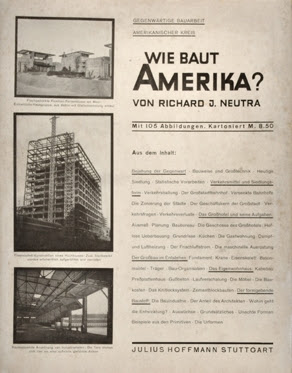


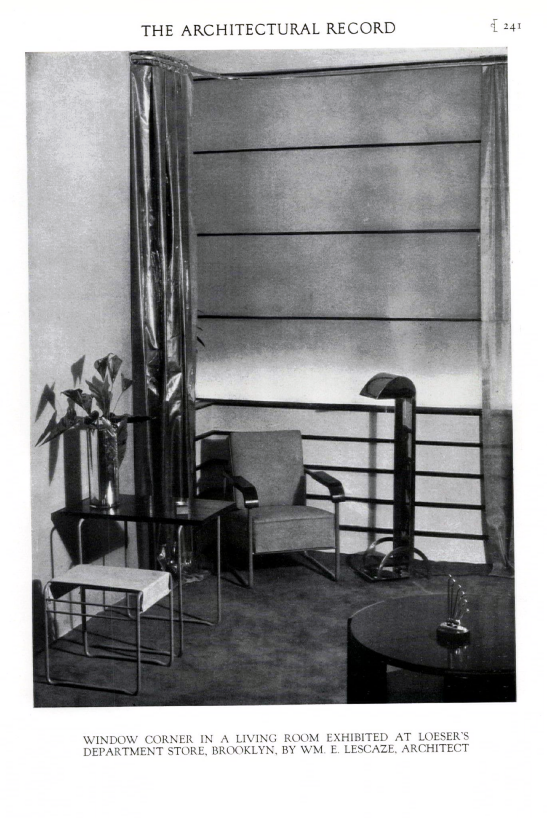


 Left:A Shop Building for L. C. Merrill, Carmel, Blaine & Olsen, Arhitects, Architectural Record, June 1929, p. 608. Top Right: Hotel La Ribera, Carmel, 1929, for Dr. Rudolph A. Kocher, Blaine and Olsen, Architects. Bottom Right: Kocher Building, Carmel, 1928 for Dr. Rudolph A. Kocher.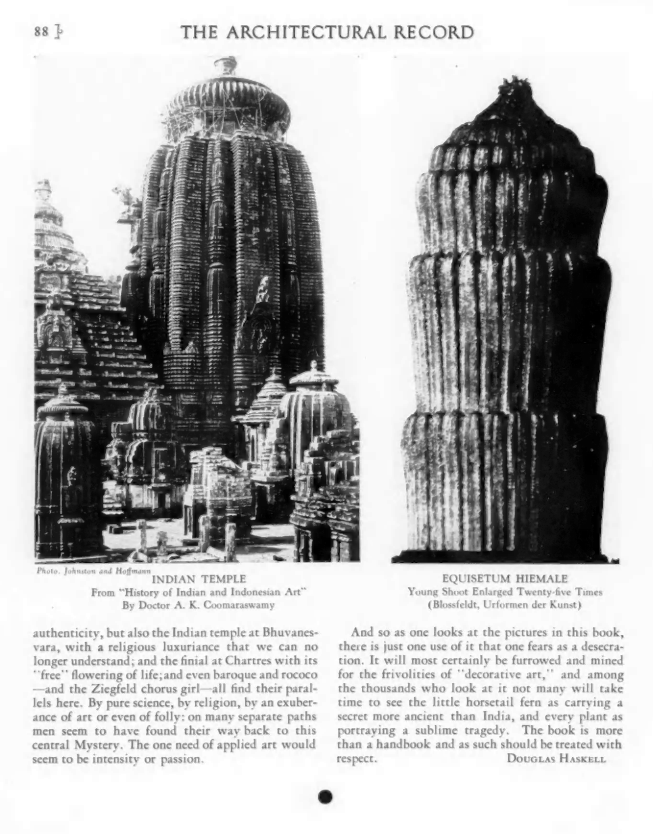


 Projects by Richard Neutra, Walter Gropius, Mies van der Rohe and Le Corbusier. Ibid., pp. 45, 58.


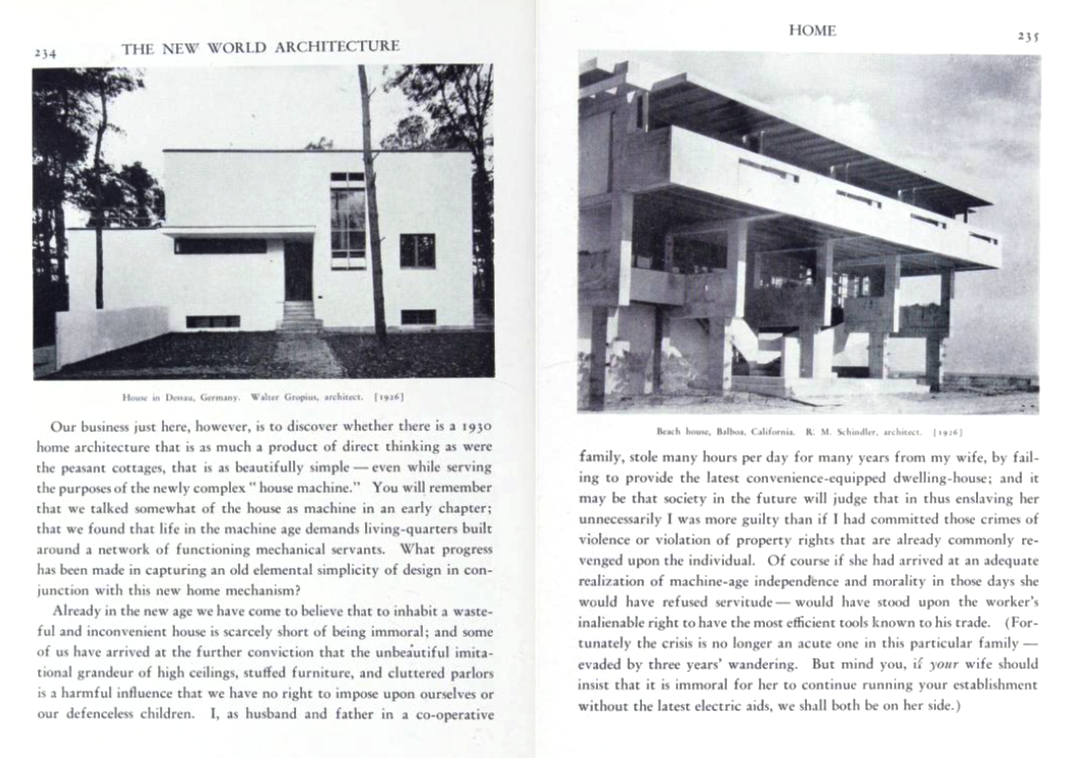


%20-%20Copy.jpg)




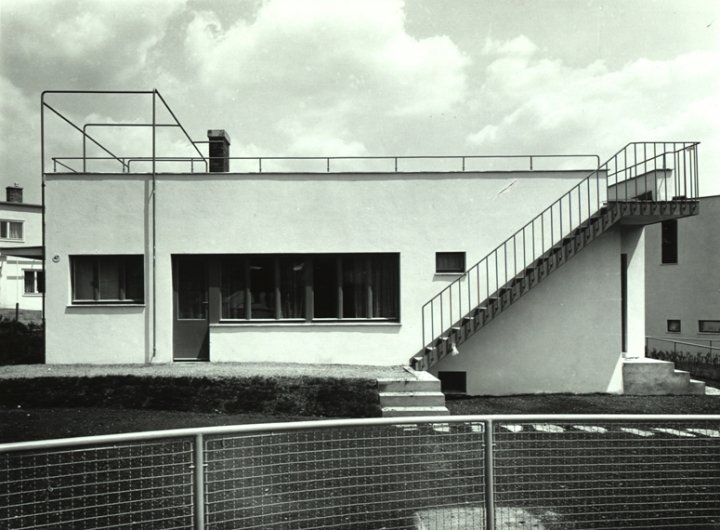


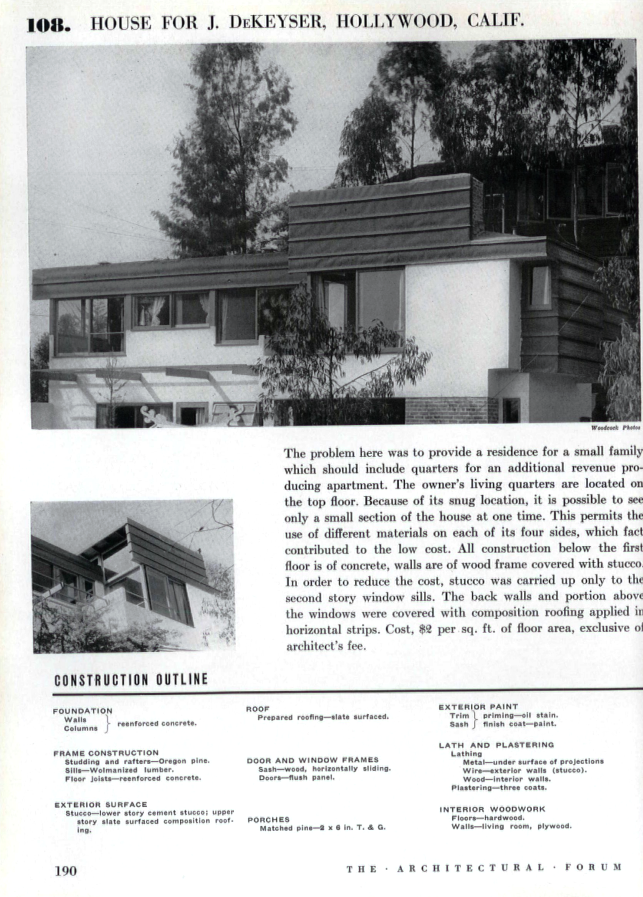


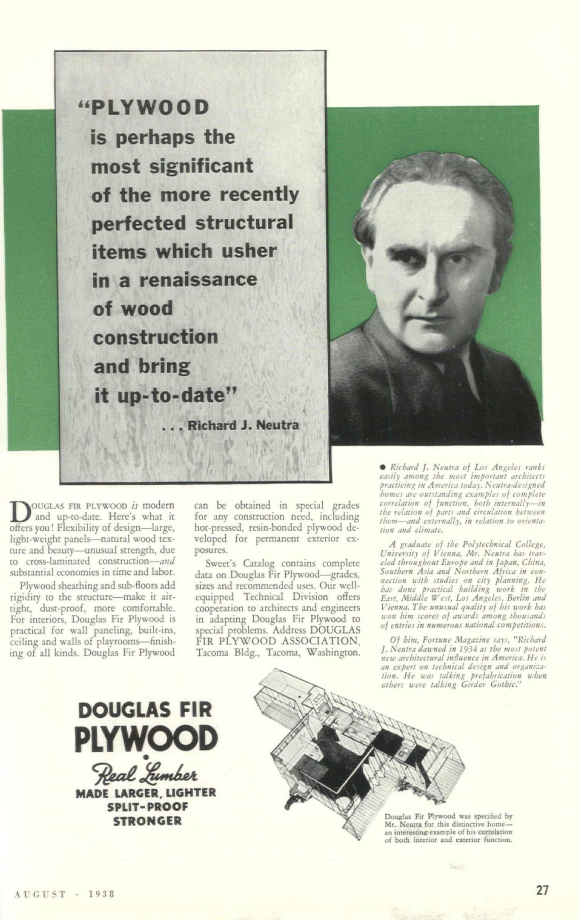


.jpeg)